Crate washer capacity should begin with the number of dirty crates arriving during the busiest return window. A machine rating alone does not show whether the washing area can clear that queue before the next production shift needs clean containers.
For an automatic crate washer, prepare a return profile alongside the crate specification. The profile connects production logistics to a measurable equipment trial and avoids sizing the installation around an average that hides short peaks.
Count arrivals in useful time windows
Use dispatch, production and return records to identify when containers reach the washing area. Separate routine returns from end-of-shift clearances and deliveries from other buildings. Count nested stacks as individual crates, then record the extra work needed to separate and orient them.
| Input | What to record | Why it changes capacity |
|---|---|---|
| Return window | Start, end and crate count | Shows the peak arrival rate |
| Crate family | Dimensions, shape and soil | Defines the tested loading pattern |
| Available time | Authorized washing and cleaning windows | Limits usable operating time |
| Clean stock need | Quantity and required handoff time | Sets the queue-clearance objective |
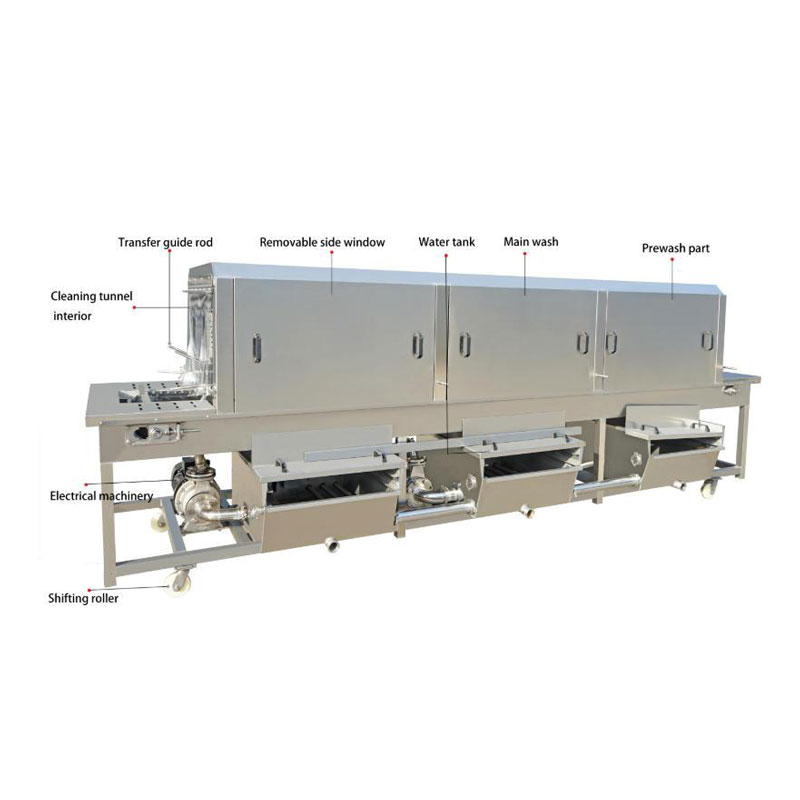
Calculate demand before comparing machine speeds
Required accepted output per hour equals the crates that must be cleared divided by the usable washing hours. Keep this demand figure separate from the supplier's nominal transport rate. Sorting, interruptions, rejected crates and changes between container families can reduce accepted output.
Do not hide all losses inside a guessed efficiency percentage. Ask the supplier which activities are included in the stated rate and list the remaining assumptions individually. An observed trial can then replace assumptions with evidence.
Work through a peak-return example
As an arithmetic example only, suppose 2,400 crates must be cleared within four usable washing hours. The planning demand is 600 accepted crates per hour. This is not an HSYL machine rating or a measured factory result.
If one of those hours is actually required for sorting and planned cleaning, usable washing time becomes three hours and the requirement becomes 800 accepted crates per hour. The example shows why defining the time boundary matters before comparing equipment. It does not establish that a particular washer can meet either demand.
Test the loading and receiving work
The trial should include representative dirty crates, the intended orientation and the actual loading method. Count crates accepted at the clean handoff point, recording those that require another pass. Observe whether the receiving operator can clear the discharge without stacking wet containers in an unsuitable way.
Review the surrounding route using the manual and automatic crate washing comparison. Capacity can be constrained by sorting or clean-stock movement even when the washer itself runs continuously.
Put the capacity basis in the offer
Request a written capacity statement identifying the crate family, soil condition, loading arrangement, assessment method and operating window. Include the space needed for dirty accumulation and clean receiving. Where seasonal peaks remain uncertain, state the uncertainty and evaluate a staged trial before fixing the final configuration.
Frequently Asked Questions
Can a daily crate total be used for sizing?
Should rejected crates count toward capacity?
What if several crate sizes share one washer?
Related Articles


Get professional consultation
Do you have any questions or need technical support regarding the content of this article? Fill out the form below, and our expert team will provide you with professional solutions.