Crate washer water consumption is meaningful only when the measurement boundary and output basis are clear. Litres per accepted crate can support comparison, while an isolated flow reading may exclude filling the tanks, sanitation, filter servicing or rejected containers.
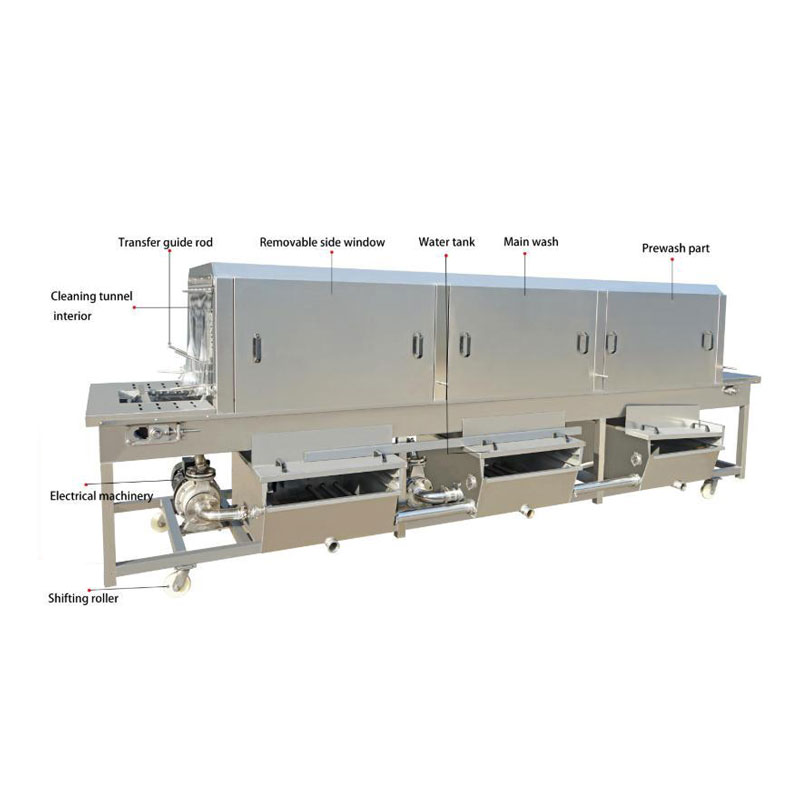
Start with the proposed crate washing equipment and identify every incoming water connection. Keep recirculating flow inside the machine separate from fresh water entering the installation; they answer different engineering questions.
Draw a simple water boundary
Mark the supply meter, tank fills, rinse connections, drains and any external hose use included in the washing task. If a shared meter serves another process, obtain a separate measurement or describe the allocation method explicitly.
| Water event | Measurement basis | Associated record |
|---|---|---|
| Initial filling | Volume entering before production | Starting tank condition |
| Running makeup | Fresh water during the observed run | Product and crate counts |
| Cleaning and emptying | Water used around the run | Cleaning scope and duration |
| Reuse | Internal circulation or recovered supply | Source, destination and approval |
Use the same denominator
For a defined period, divide the included fresh-water volume by the number of crates accepted at the specified clean handoff. Report the operating period as well as the result. A short trial after all tanks are full will not represent a complete shift with startup and cleaning.
Record rewash passes separately. Otherwise an installation can appear more efficient simply because its output counter counts repeated passes as additional clean crates.
A worked measurement boundary
Consider a hypothetical observation with 4,500 litres of included fresh-water input and 900 accepted crates. The result is 5 litres per accepted crate. These invented numbers illustrate the calculation only; they are not equipment consumption data.
If the same run includes 100 additional rewash passes, dividing by 1,000 passes would produce 4.5 litres per pass. That is a different metric and must not be labeled water per accepted crate. Keep the readings and the output classification beside the formula so that a reviewer can reproduce it.
Compare like operating conditions
Crate geometry, retained soil, loading pattern and the required clean condition affect the comparison. Test the same crate family and explain changes in the soil challenge. Supplier estimates may be useful during procurement, but identify them as estimates until the proposed arrangement is measured.
Water cost also depends on supply treatment and discharge responsibilities. The food processing wastewater assessment addresses the discharge side; it should not be replaced by an assumed saving based on freshwater volume alone.
Retain a checkable balance
Keep the meter identity, reading times, starting and ending conditions, accepted output and relevant operating events. An unexplained difference between supply and discharge may involve retained tank water, carryover or an incomplete boundary. Investigate it before using the result in a purchase decision.
Ask suppliers to state which connections and operating states their quoted consumption includes. That clarification is often more useful than a headline percentage reduction with no common baseline.
Frequently Asked Questions
Is recirculation flow the same as water consumption?
Can two washers be compared from brochure figures?
Related Articles



Get professional consultation
Do you have any questions or need technical support regarding the content of this article? Fill out the form below, and our expert team will provide you with professional solutions.