Direct Answer
Building a canned beans production line for export markets is a project that combines a standard low-acid canned food process — soaking, blanching, filling, seaming, and retort sterilization — with a regulatory and documentation layer that is heavier than for any domestic-only operation. The technical line is similar to a canned vegetable line, but the export dimension adds four requirements that drive every design decision: the product must meet the microbiological, contaminant, and labeling standards of every destination market; the plant must hold the food safety certifications those markets require (typically BRCGS or IFS, plus Halal or Kosher where relevant); the thermal process must be filed with the US FDA as a Scheduled Process under an FCE registration if the US is a target market; and the documentation system must support lot-level traceability across an export supply chain that may include shipping, customs, destination inspection, and shelf-life management in a different climate zone. The line is the easier part — the export compliance framework is where most projects lose time and money.For complete autoclave batch scheduling and facility sanitation planning, refer to our engineering overview on tuna canning line.
This article is written for project owners, plant engineers, and procurement managers who are planning a new canned beans line or upgrading an existing line for export to North America, the EU, the Middle East, or Asia. It covers the bean product range, the standard process flow, the capacity and scale decisions, the regulatory frameworks, the documentation system, the equipment specification, and the project implementation stages. For bean-specific machinery references, see the canned bean production line and the broader canned beans production line references.
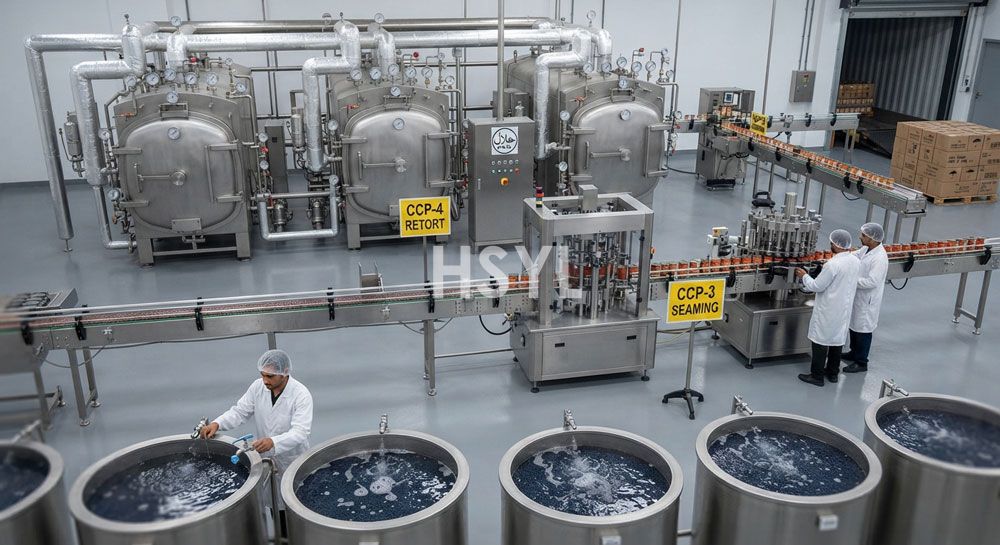
What Makes an Export-Grade Canned Beans Line Different
A canned beans line built for a domestic market can succeed with a single food safety standard, a single labeling regime, and a single set of container sizes. A line built for export cannot. The differences that drive design decisions are:
- Multiple regulatory frameworks: the same product may need to comply with FDA 21 CFR 108/113/114 for the US, EU Regulation 2073/2005 on microbiological criteria and EU Regulation 1881/2006 on contaminants for the EU, the Saudi SFDA standards for the Middle East, the EAC standards for Russia and CIS, and the GB standards for China — simultaneously, if the plant serves multiple markets.
- Third-party certification expectations: export buyers typically require BRCGS Food Safety or IFS Food certification, and additional certifications such as FSSC 22000, Halal (JAKIM, MUI, GAC), or Kosher (OU, OK) may be required depending on the buyer and destination.
- Process filing requirements: if the product is a low-acid canned food (most canned beans are), the thermal process must be filed with the FDA as a Scheduled Process under a Food Canning Establishment (FCE) registration before the product can be exported to the United States. The equivalent in some other markets is a process authority letter or local registration.
- Documentation and traceability: export shipments are subject to destination inspection and recall; the documentation system must support one-up/one-down traceability, lot-level batch records, and the ability to reconstruct a production lot's full history within hours, not days.
- Labeling in multiple languages and formats: export markets require labels in the local language, with specific mandatory information (allergens, nutritional panel, country of origin, date marking) that differs by market. A multi-market plant typically needs a flexible labeling system that can switch label formats per shipment.
- Container sizes and packaging formats: export markets use different can sizes (US #300, #303, #10; European A1, A2, 1/4 club; Middle East 400 g and 800 g round). The line must accommodate the can sizes relevant to each target market, or be designed with rapid size changeover.
Bean Varieties and Product Specifications for Export
Canned beans cover several distinct product categories, each with a different process profile. The line design must specify which products will be produced, because the equipment and thermal process differ:
- Navy beans (white beans, haricot): the base product for canned baked beans and canned white beans in tomato sauce. Soaking and blanching required; tomato sauce is the fill medium; the product is low-acid (pH typically 4.6–5.2 in the finished can, requiring full retort sterilization).
- Kidney beans (red beans): canned in brine or in tomato sauce; common in Latin American and Caribbean export markets. Lower hydration requirement than navy beans.
- Pinto beans: canned in brine or in chili sauce; common in Mexican and Tex-Mex cuisine export.
- Black beans (turtle beans): canned in brine; common in Latin American markets.
- Chickpeas (garbanzo beans): canned in brine; one of the largest export categories, particularly for Middle East and Mediterranean markets.
- Lentils and split peas: canned in brine or as ready-meal components; common in EU and South Asian export.
- Baked beans in tomato sauce: a navy bean product with a tomato sauce that includes sugar, salt, and spices; the largest single canned beans export category by volume, dominated by UK and Commonwealth markets.
The fill medium — brine, tomato sauce, or molasses — affects the thermal process schedule because of differences in product viscosity, thermal diffusivity, and pH. A single line can usually run multiple bean varieties with format changeover, but running different fill media on the same day requires careful scheduling to avoid cross-contamination of allergens (tomato, gluten in some sauces) and to manage cleaning between runs.
The Canned Beans Process Flow
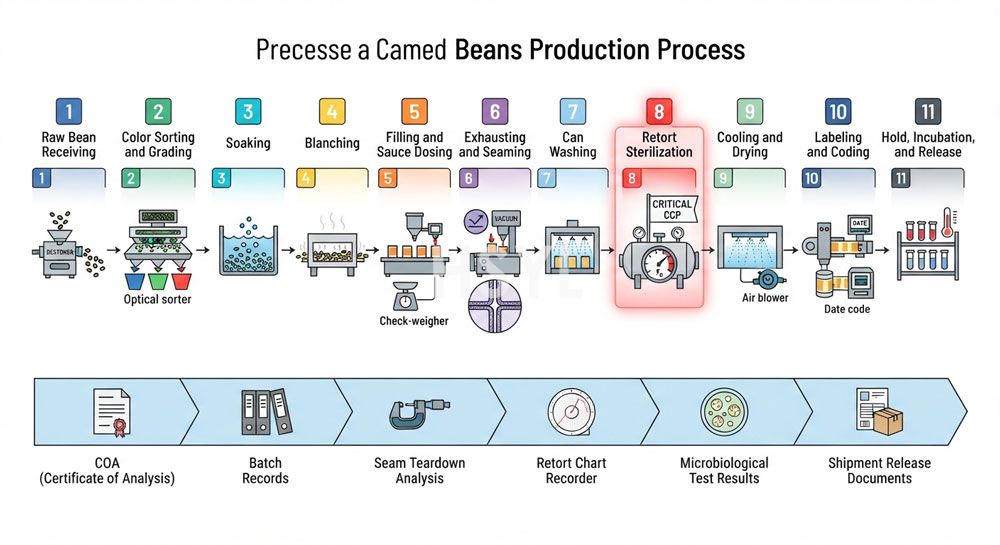
The process flow for canned beans follows the standard low-acid canned vegetable pattern, with the addition of a soaking stage that is unique to dry bean processing. The steps are:
- Raw bean receiving and cleaning: dry beans arrive in bags or bulk. Receiving inspection covers moisture content, foreign material (stones, dirt, stalks), insect damage, and split-bean ratio. Cleaning uses a combination of vibrating sieve, destoner, and air aspiration to remove foreign matter and broken beans.
- Color sorting and grading: optical color sorters remove discolored, moldy, or insect-damaged beans that passed the cleaning stage. This step is critical for export because buyers reject lots with visible defects. Grading by size uses a rotating sieve or cylindrical grader.
- Soaking and hydration: dry beans are soaked in water at controlled temperature (typically 15–25°C for 8–16 hours, or 40–50°C for 2–4 hours for a fast soak) until they reach a target moisture content of approximately 55–60%. Soaking is the longest single stage in the process and determines the bean texture after retort. Under-soaked beans are hard and gritty; over-soaked beans split and disintegrate.
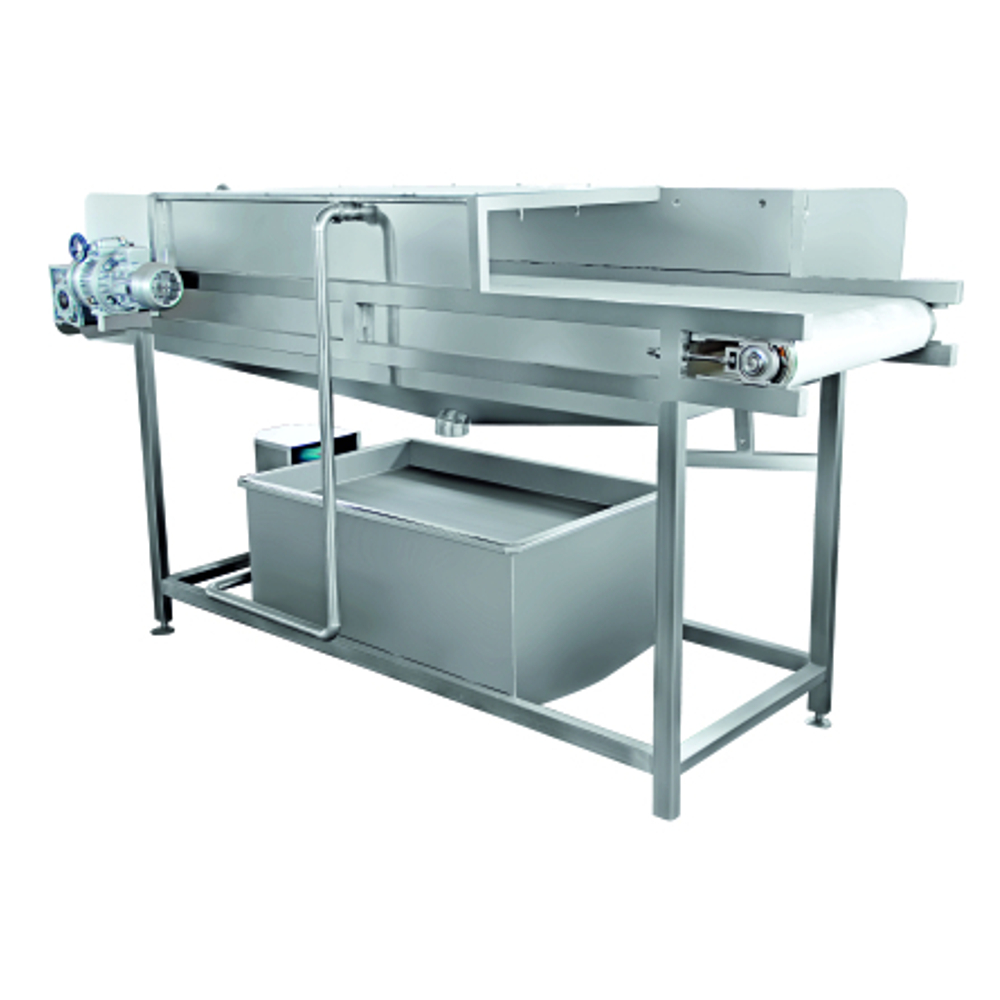
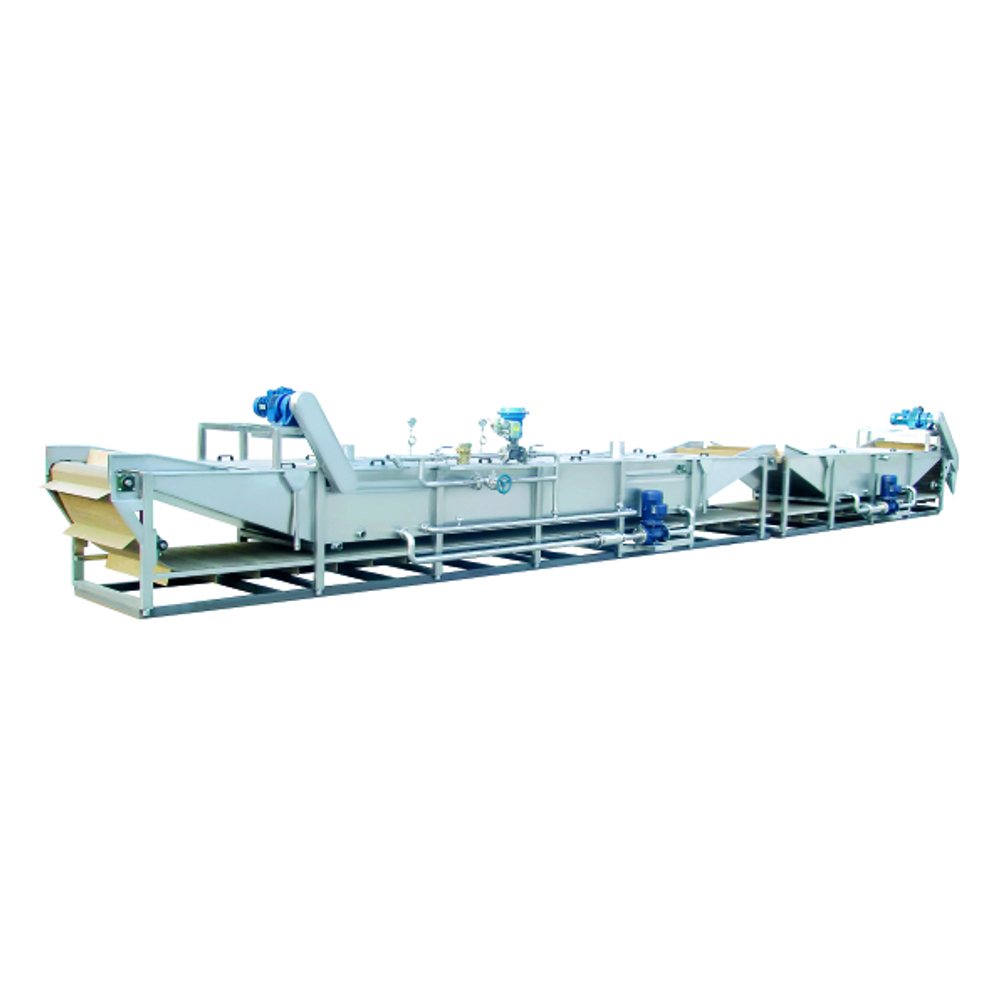
- Blanching: soaked beans are blanched in hot water at 85–95°C for 5–15 minutes. Blanching inactivates enzymes that cause off-color and off-flavor, softens the bean skin for filling, and removes trapped gases that would otherwise expand during retort and cause excessive internal pressure.
- Filling and sauce dosing: blanched beans are filled into cans by weight or volume. The fill medium (brine or tomato sauce) is dosed separately, typically at 50–60% solid and 40–50% liquid by net weight. Headspace is controlled to 6–10 mm to allow for thermal expansion during retort.
- Exhausting and seaming: filled cans are exhausted (heat-treated to remove headspace air) before seaming. Exhausting can be by steam flow, hot-fill, or vacuum sealing. The double seam is formed by the seamer, with seam parameters monitored by teardown inspection every 2–4 hours.
- Can washing and retort loading: seamed cans are washed to remove sauce or brine residue from the can exterior, then loaded into retort baskets in a defined pattern that allows steam or water circulation.
- Retort sterilization: cans are processed in a retort using saturated steam or superheated water at 116–121°C. The thermal process schedule (come-up time, holding time, cooling time) is validated by a process authority to achieve an F₀ of 6–8 at the cold spot. The schedule depends on can size, fill temperature, product viscosity, and initial temperature.
- Cooling and drying: sterilized cans are cooled under pressure to a surface temperature below 40°C, dried, and labeled. Cooling water is chlorinated to prevent post-process contamination through any seam micro-defects.
- Labeling, coding, and case packing: cans are labeled with market-specific labels, coded with production date, batch code, and expiry date, and case-packed for export. Pallets are stretch-wrapped and labeled with shipping marks.
- Hold, incubation testing, and release: canned product is held for incubation testing (typically 10–15 days at 30°C and 55°C) before release to export shipment. Incubation testing confirms commercial sterility before the product leaves the plant.
The process flow is similar to that of other low-acid canned vegetable lines; for the broader engineering context, see the green bean canned food production line and the bean product production line references.
Capacity and Scale Decisions for Export
Capacity planning for an export line is different from a domestic line because export shipments are typically container-load (one 20-ft or 40-ft container per shipment) and the line output must align with the container load pattern. A typical export container holds approximately 1,800–2,200 cases of #300 cans or 1,200–1,600 cases of #10 cans, depending on pallet pattern and stacking height.
- Small-scale export line: 2,000–5,000 cans per hour. Suitable for a single buyer relationship, niche markets, or specialty products (organic, single-origin). Semi-automatic operation is acceptable; manual retort loading is feasible.
- Mid-scale export line: 8,000–15,000 cans per hour. Suitable for multiple buyer relationships and regular container-load shipments. Requires automatic filling and seaming, semi-automatic or automatic retort loading, and continuous cooling.
- Large-scale export line: 20,000–40,000 cans per hour. Suitable for high-volume commodity products (baked beans for UK market, chickpeas for Middle East market). Fully automatic operation, continuous retort (hydrostatic or rotary) for the highest end.
The decision between batch and continuous retort is the single largest cost driver on a canned beans line. A batch retort (still or rotary) is sufficient up to approximately 12,000 cans per hour with 3–4 retorts in parallel; above that, a continuous retort (hydrostatic sterilizer) becomes economically and operationally preferable. For the engineering factors that determine the choice, see the small-scale canning line guide and the broader canning line procurement guide.
Export Regulatory Frameworks
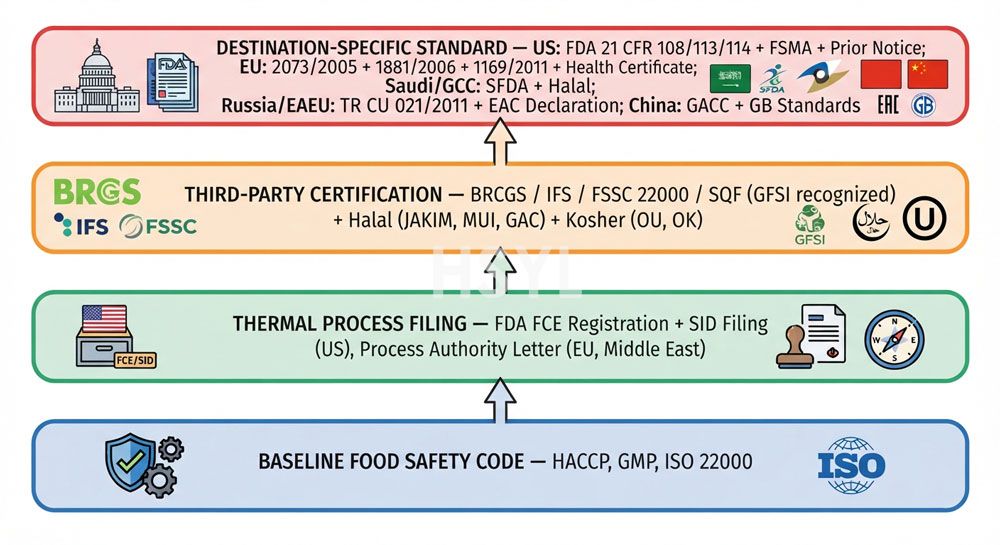
The regulatory frameworks that an export canned beans line must meet are layered: a baseline food safety code, a thermal process filing, a third-party certification, and a destination-specific standard. Each layer must be addressed before the first export shipment.
FDA Requirements for the US Market
- Facility registration: the plant must be registered with FDA under the Food Facility Registration rule (FDA 21 CFR 1.232). Registration must be renewed biennially.
- FCE registration: for low-acid canned food, the plant must register as a Food Canning Establishment under FDA 21 CFR 108.25. The FCE number is required on export documentation.
- Scheduled Process (SID): the thermal process for each product/container combination must be filed with FDA as a Scheduled Process Identifier (SID). The process schedule must be developed and signed by a qualified process authority. Filing is mandatory before any US-bound shipment.
- Acidified food rule (if applicable): if the product is acidified (pH reduced to ≤ 4.6 by added acid), it falls under FDA 21 CFR 114 instead of 113. Canned beans in tomato sauce are typically classified as low-acid because the pH of the finished product remains above 4.6.
- FSMA preventive controls: the plant must operate under a Hazard Analysis and Risk-Based Preventive Controls (HARPC) plan as required by the Food Safety Modernization Act.
- Prior Notice: each US-bound shipment requires Prior Notice submission to FDA before the shipment arrives at the US port.
For the practical compliance angle from a similar export case, see the guide on FDA standards compliance in food processing.
EU Requirements for the European Market
- Establishment approval: the plant must be approved as an establishment by the competent authority of the exporting country, and the approval must be listed on the EU-approved establishment list maintained by the European Commission.
- Microbiological criteria: compliance with EU Regulation 2073/2005, including the absence of C. botulinum toxin and the absence of Salmonella in 25 g.
- Contaminants: compliance with EU Regulation 1881/2006 for heavy metals (lead, cadmium, mercury), mycotoxins (aflatoxins in beans), and pesticide residues (EU MRL Regulation 396/2005).
- Labeling: compliance with EU Food Information for Consumers Regulation 1169/2011, including mandatory allergen declaration, nutritional declaration, country of origin, and date marking in the language of the destination member state.
- Health certificate: each EU-bound shipment requires a health certificate issued by the competent authority of the exporting country.
Middle East, Russia, and Asia Market Requirements
- Saudi Arabia / GCC: SFDA registration, product registration, and Halal certification are required for most food imports. Health certificate and Certificate of Origin are mandatory shipment documents.
- Russia / EAEU: EAC Declaration of Conformity under the Customs Union technical regulations, including TR CU 021/2011 on food safety. Mandatory registration of certain product categories with Rospotrebnadzor.
- China: GACC (formerly AQSIQ) registration of the foreign food facility, GB standards compliance for contaminants and additives, and Chinese-language labeling are mandatory. The facility registration process can take 6–12 months and must be planned early in the project.
- Halal certification: required for all Muslim-majority markets. The certification must be issued by a body recognized in the destination country (JAKIM for Malaysia, MUI for Indonesia, GAC for Gulf countries). The certification covers raw materials, processing aids, sanitation chemicals, and the production line itself.
- Kosher certification: required for the US Jewish market and selected EU markets; issued by a recognized Kosher certification body (OU, OK, KOF-K). Annual inspection and ongoing supervision are required.
For a worked example of an export-grade canning line built for multiple certification frameworks, see the UK turnkey beef canning line case (FSA and BRCGS compliant) and the turnkey Halal fish canning line case.
Third-Party Food Safety Certification
Export buyers typically require one of the Global Food Safety Initiative (GFSI) recognized certifications. The most common are:
- BRCGS Food Safety: the dominant standard for UK and Commonwealth markets and a frequent requirement for European retailers.
- IFS Food: the dominant standard for continental European retailers, particularly German, French, and Italian.
- FSSC 22000: recognized globally, preferred by multinational food manufacturers and increasingly required for Asian markets.
- SQF: the dominant standard for North American retailers.
A new export plant typically targets one of these certifications for the initial audit cycle and adds additional certifications in subsequent years based on buyer requirements. Achieving the first certification usually takes 9–18 months from project start.
Documentation and Traceability Requirements
The documentation system for an export canned beans line must support four operational needs that a domestic-only line does not face:
- Lot-level traceability: the ability to identify, from a single can on a retail shelf in the destination country, the production batch, raw material lot, retort cycle, and shipping container. This requires a batch numbering system that links production records to raw material receiving records and to shipping records.
- One-up/one-down traceability: the ability to identify the immediate supplier of any raw material and the immediate customer (or first recipient) of any finished product. Required by FSMA in the US and by EU food law.
- Shipment documentation: each export shipment requires a coordinated set of documents — commercial invoice, packing list, bill of lading, certificate of origin, health certificate, Halal certificate (where applicable), phytosanitary certificate (for plant-based products), and the destination-specific documentation (FDA Prior Notice for the US, CN code declaration for the EU, SFDA product registration for Saudi Arabia).
- Recall management: the ability to trace and recall a specific lot across the distribution chain within hours, not days. Required by FSMA and by GFSI certification standards. The recall procedure must be tested by mock recall at minimum annually.
The documentation system is usually implemented in an ERP or specialized food manufacturing software. The system should be specified at the line design stage, not added after commissioning — retrofitting traceability to a system designed without it is expensive and never fully effective.
Equipment Selection for an Export-Grade Line
The equipment on an export-grade canned beans line differs from a domestic-grade line in three respects: material specifications, instrumentation, and cleanability. The minimum specifications for export-grade equipment are:
- Food-contact material: SUS304 stainless steel for general contact surfaces; SUS316 for acidic sauce contact (tomato sauce) and for high-salt brine contact.
- Welding and surface finish: continuously welded seams, ground smooth, surface roughness Ra ≤ 0.8 μm for food-contact surfaces to allow effective cleaning.
- Instrumentation: calibrated temperature sensors on every retort, pressure gauges with calibration certificates, check-weighers with data logging, and a continuous chart recorder or digital data acquisition system for every critical control point.
- CIP/SIP capability: cleaning-in-place for filling and sauce systems, with spray balls, return pumps, and a CIP skid. For the retort, steam-in-place or chemical sanitizing capability.
- Allergen management: dedicated equipment or documented changeover cleaning for allergen-containing sauces (e.g., wheat-based thickeners in some baked bean recipes).
- Seam monitoring: a seam micrometer or vision system for teardown inspection, with documented records every 2–4 hours.
- Metal detection and X-ray: in-line metal detector at minimum; X-ray inspection for export lines to detect non-metallic foreign matter (stone fragments, hard bean fragments).
For the broader equipment selection framework, including capacity calculation and procurement strategy, see the canning line bottlenecks guide and the cost analysis in the canning line cost guide.
Factory Layout and Material Flow
The factory layout for an export canned beans line follows the same principles as any low-acid canned food plant: unidirectional material flow, physical separation of raw and post-retort zones, dedicated drainage, and personnel flow control. The export dimension adds two layout considerations:
- Quarantine and hold area: a defined, segregated area for product on incubation hold. The area must be physically separated from the released-product warehouse to prevent inadvertent shipment of untested product. Export buyers and auditors inspect the quarantine area specifically.
- Document control and laboratory: a dedicated laboratory for microbiological, chemical, and seam inspection. Export buyers typically request laboratory capacity on site, and audit reports require the laboratory records.
- Container loading area: a designated loading dock with truck access for container loading. Export pallets are typically loaded directly into shipping containers, which requires a dock designed for container loading rather than pallet-to-truck loading.
- Certification area: a designated area for pre-shipment inspection by the destination market authority or the certification body (Halal, Kosher). The area must accommodate the inspector's workflow and access to records.
For the broader factory planning principles, see the how to build a food factory guide and the how to start a food product line guide.
Thermal Process Validation for Beans
Canned beans are low-acid canned food, and the thermal process must be validated by a process authority before the first commercial production. The validation covers three tests:
- Heat distribution test: confirms that every basket position in the retort reaches the required sterilizing temperature within tolerance. Performed by placing multiple calibrated temperature sensors in a loaded retort and recording the temperature profile.
- Heat penetration test: confirms that the cold spot of the product (typically the geometric center of the can, but for beans it may be shifted by the sauce viscosity) reaches the required F₀. Performed by placing calibrated sensors in the product at the suspected cold spot.
- Inoculated pack test (where applicable): a test using a known concentration of a non-pathogenic surrogate organism to confirm the lethality of the process in real product. Required for novel products or where the cold spot is uncertain.
The validated thermal process schedule is filed with FDA as the SID for the product. Any change to the product formulation, container size, fill weight, or retort operating parameters requires revalidation and re-filing. For the technical principles, see the canned food thermal process control principles and the retort sterilizer design factors.
Quality Control and Inspection
The quality control program on an export canned beans line combines CCP monitoring (covered by the HACCP plan) with quality verification activities. The key quality parameters for canned beans are:
- Drained weight: the weight of solid beans after draining the liquid, expressed as a percentage of net weight. The minimum is typically 60% by weight; export buyers may require higher.
- Bean integrity: the proportion of whole beans versus split beans. Export buyers specify a maximum split ratio (typically 10–15%).
- Color: bean color measured against a reference (e.g., Hunter color values). Off-color beans indicate poor raw material quality or thermal process deviation.
- Texture: bean firmness measured by texture analyzer. Under-processed beans are too firm; over-processed beans are mushy.
- Brine or sauce clarity: visual inspection of the liquid for cloudiness or sediment, which indicates bean disintegration during retort.
- Container integrity: seam teardown inspection every 2–4 hours, plus post-cooling visual inspection for can deformation, seam defects, and rust.
- Microbiological testing: commercial sterility testing by incubation at 30°C and 55°C for 10–15 days before product release. Any positive result triggers a lot hold and investigation.
Project Implementation Stages
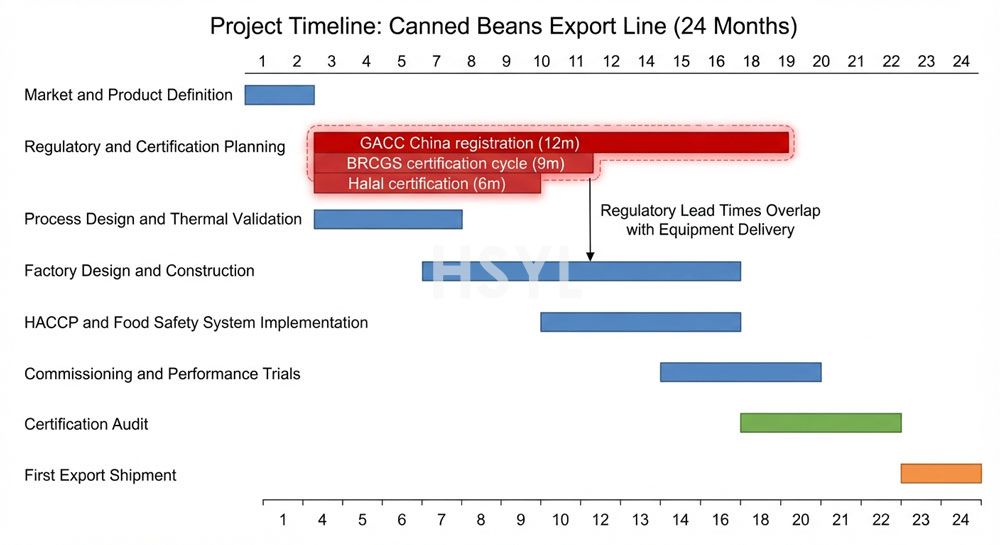
An export canned beans project is typically delivered through the following stages. The total timeline from project start to first export shipment is typically 18–30 months, depending on the certification timeline and the destination market registration requirements.
- Market and product definition: identify the target markets, buyers, product specifications, can sizes, and required certifications.
- Regulatory and certification planning: map the regulatory requirements of each target market, identify the required certifications, and start the certification and registration processes that have the longest lead times (GACC for China can take 12 months; BRCGS certification requires a documented system and an audit cycle).
- Process design and thermal process validation: develop the process flow diagram, mass balance, equipment list, and engage a process authority for thermal process validation.
- Factory design and construction: building design, utility design, equipment specification, procurement, installation, and commissioning.
- HACCP and food safety system implementation: HACCP plan development, prerequisite programs (GMP, sanitation, pest control, recall), and documentation system implementation.
- Commissioning and performance trials: water trials, product trials, heat distribution and heat penetration tests, and validation runs.
- Certification audit: first BRCGS or IFS audit, plus Halal or Kosher audit if applicable.
- First export shipment: first commercial production for export, incubation hold, documentation preparation, and first shipment.
Common Mistakes in Export Canned Beans Projects
- Underestimating regulatory lead times: the GACC registration for China, the SFDA registration for Saudi Arabia, and the FCE/SID filing for the US all have lead times that exceed the equipment procurement timeline. Projects that begin regulatory work after equipment installation lose 6–12 months.
- Building the line before designing the documentation system: retrofitting traceability, recall, and shipment documentation to a line that was designed without them is expensive and produces audit findings.
- Choosing retort capacity based on peak output: retort capacity should be sized for the line's sustainable output, not the peak rated output. A line rated at 15,000 cans per hour rarely sustains 15,000 in production; sizing the retort for 12,000 sustainable produces a bottleneck at the rated peak.
- Neglecting incubation hold capacity: the hold area must accommodate 10–15 days of production at full output. Under-sizing the hold area forces either early shipment (which fails audit) or production slow-down (which destroys throughput).
- Single-label labeling system for a multi-market plant: if the plant serves multiple markets with different label requirements, a single-label system forces changeover between shipments. A multi-label system with format flexibility is more expensive upfront but eliminates the changeover problem.
- Insufficient laboratory capacity: an export line generates more testing demand than a domestic line — commercial sterility testing on every batch, plus buyer-specified quality testing. An under-sized laboratory becomes the operational bottleneck.
- Treating Halal as an afterthought: Halal certification is not a stamp added at the end; it is a system that must be designed into the line from raw material selection onward. Retrofitting Halal to a non-Halal-designed line is rarely successful.
- Underestimating container loading logistics: export pallets loaded into shipping containers require specific pallet sizes, stacking patterns, and stretch-wrap specifications. A factory designed without container-loading dock capacity forces pallet breakdown and re-loading, increasing cost and damage risk.
Conclusion
Building a canned beans production line for export markets is a project where the regulatory, certification, and documentation requirements drive the design as much as the technical line. The technical line — soaking, blanching, filling, seaming, retort, cooling, labeling — is well-established and similar to other low-acid canned vegetable lines. What makes an export line succeed or fail is whether the regulatory frameworks (FDA FCE/SID, EU 2073/2005, GACC, SFDA), the third-party certifications (BRCGS, IFS, Halal, Kosher), and the documentation system (lot traceability, shipment documentation, recall management) are designed into the project from the start rather than added at the end.
If you are planning a canned beans export project, prepare the following information and contact the engineering team: the target markets and required certifications, the bean varieties and product specifications (sauce or brine), the target capacity per hour and per shift, the can sizes for each target market, the available utilities and factory building, the project schedule, and the budget envelope. To discuss a project, contact the engineering team.
Frequently Asked Questions
What makes a canned beans line built for export different from a domestic line?
What bean varieties can a single export line produce?
What is the standard process flow for canned beans?
How do I size the capacity for an export canned beans line?
What is FDA FCE registration and SID filing for canned beans?
Which third-party certifications do export buyers require for canned beans?
How is the thermal process validated for canned beans?
How long does it take to build a canned beans line for export?
What is the most common mistake when building an export canned beans line?
What information is needed to quote a canned beans export line?
Related Articles


Get professional consultation
Do you have any questions or need technical support regarding the content of this article? Fill out the form below, and our expert team will provide you with professional solutions.