Executive Summary
In response to surging regional demand for affordable, shelf-stable protein, our team successfully designed, built, and commissioned a fully automated fish canning production line for a leading food manufacturer in the Gulf Cooperation Council (GCC) region. Operating in an extreme desert climate with ambient temperatures exceeding 45°C (113°F) and high humidity near coastal zones, the facility now reliably produces over 20,000 cans of premium-quality tuna and sardine products per day—all while meeting strict Halal certification standards, international food safety protocols (BRCGS, FDA), and local regulatory requirements.For complete autoclave batch scheduling and facility sanitation planning, refer to our engineering overview on from standalone machines to smart factories.
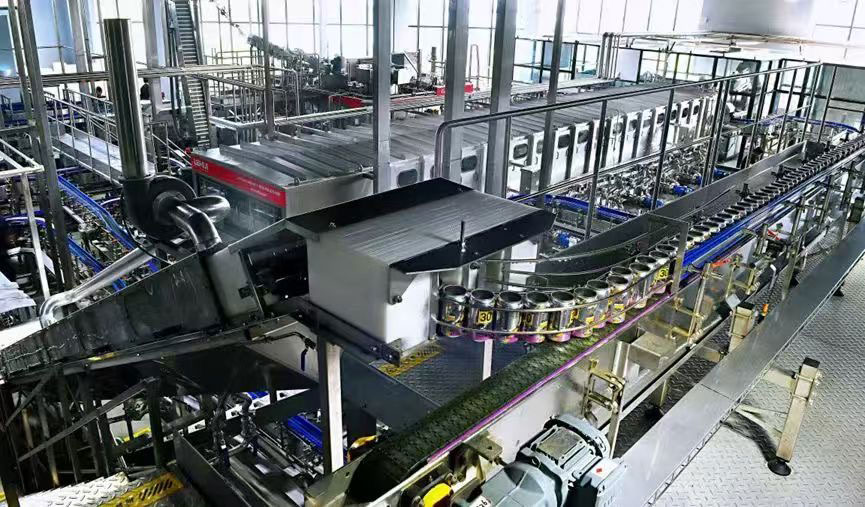
Delivered as a true turnkey EPC (Engineering, Procurement, Construction) solution within 9 months, this project eliminated manual bottlenecks, reduced labor dependency by 50%, cut energy consumption by 28%, and enabled the client to expand into export markets across North Africa, South Asia, and the Levant.
This case study details how we engineered a climate-adapted, digitally connected, and culturally compliant fish canning line that sets a new benchmark for canned seafood production in the Middle East.
1. Client Profile & Market Opportunity
1.1 The Client: A National Food Security Champion
Our client is a state-backed agri-food enterprise based in a major GCC country, tasked with enhancing national food security through localized protein production. Historically reliant on imported canned fish, the government prioritized domestic manufacturing to reduce import dependency and create skilled jobs.
The company’s mandate included:
- Producing affordable, nutritious canned fish for mass-market distribution
- Ensuring 100% Halal compliance at every process stage
- Achieving shelf life of 36+ months without preservatives
- Operating reliably in harsh environmental conditions (high heat, dust, saline air)
Initial attempts with semi-automated lines failed due to frequent breakdowns, inconsistent sealing, and inability to scale beyond 8,000 cans/day.
1.2 The Middle Eastern Canned Fish Market
The GCC canned seafood market is projected to reach USD $1.2 billion by 2027 (CAGR 6.3%), driven by:
- Growing urban populations with limited cold-chain access
- Cultural preference for canned tuna/sardines in Ramadan and everyday meals
- Government incentives for local food manufacturing
- Rising demand for Halal-certified, ready-to-eat proteins
Yet, most regional producers rely on outdated equipment or third-party imports—creating a strategic window for modern, high-capacity domestic production.
2. Project Goals & Key Performance Indicators (KPIs)
The client engaged us with a clear set of objectives:
| Objective | Target KPI |
|---|---|
| Daily production capacity | ≥20,000 cans (200g standard size) |
| Product types | Tuna in oil/water, sardines in tomato sauce |
| Labor reduction | ≥50% vs. previous semi-auto line |
| Energy efficiency | ≤0.85 kWh per 100 cans |
| Seal integrity failure rate | <0.1% |
| Certification readiness | Halal, BRCGS Grade AA, GCC Conformity Marking (G Mark) |
| Uptime reliability | ≥95% in first year of operation |
Critically, the solution had to be desert-proof: resistant to thermal stress, dust ingress, and corrosion from coastal salinity.
3. Our Turnkey Solution: Engineered for the Middle East
3.1 Climate-Adapted Plant Design
We re-engineered every component for extreme-environment resilience:
- IP66-rated electrical cabinets with active cooling and desiccant filters
- Stainless steel 316L construction for all wet-contact surfaces (resistant to salt corrosion)
- Dust-sealed conveyor systems with food-grade polymer belts
- Double-glazed, insulated processing rooms maintaining 22°C internal temp despite 48°C outside
HVAC systems were oversized by 25% to handle latent heat load—a key differentiator from generic European designs.
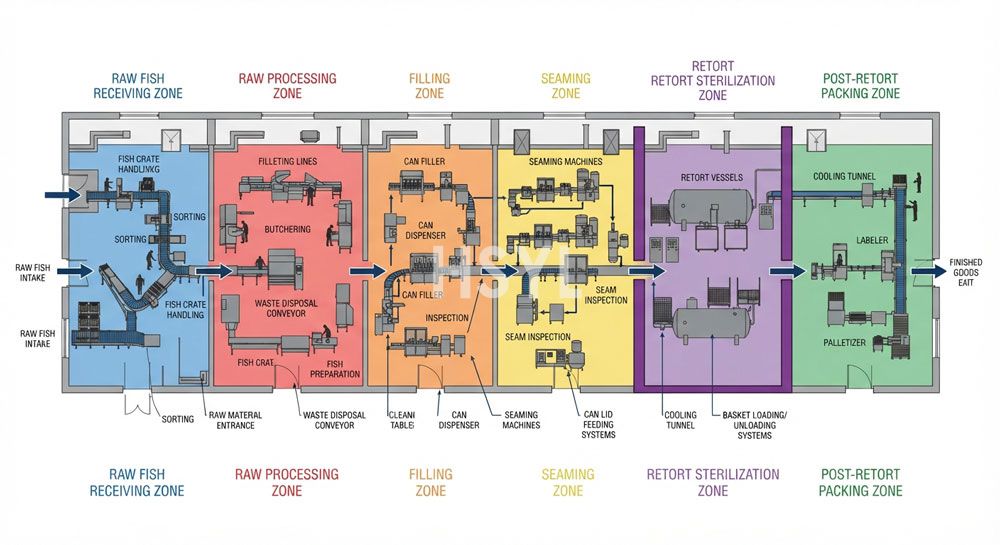
3.2 Fully Automated Production Line (50+ Units)
The integrated line includes:
Raw Material Receiving & Thawing
- Automated cold storage docking with temperature logging
- Controlled thawing tunnels (prevents protein denaturation)
Preparation & Cooking
- Robotic filleting stations (vision-guided for tuna/sardine differentiation)
- Continuous steam cookers with precise time/temperature control
Filling & Seaming
- Dual-head automatic filling machines (±0.5g accuracy)
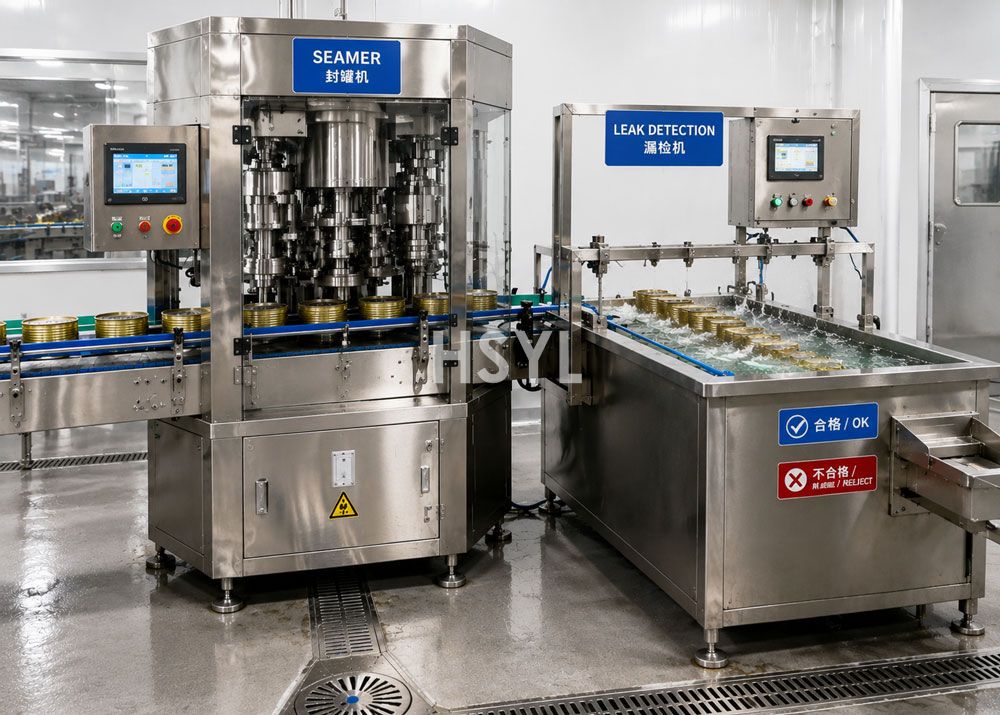
- Vacuum seaming units with real-time seam thickness monitoring
- Leak detection via pressure decay testing (100% inline inspection)
Retorting (Sterilization)
- Rotary batch retorts with programmable F₀ control for optimal sterilization
- Water-saving condensate recovery system (cuts water use by 40%)
Cooling, Labeling & Packing
- Counter-pressure cooling to prevent can deformation
- High-speed labeling (Arabic/English bilingual)
- Robotic palletizing with stretch-wrapping (compatible with GCC logistics standards)
All equipment complies with EHEDG and 3-A Sanitary Standards, ensuring cleanability and hygiene.
3.3 Halal Integrity by Design
To guarantee Halal compliance beyond paperwork, we embedded controls into the process:
- Dedicated utility lines (no shared steam/water with non-Halal zones)
- Digital batch logs tracking origin of raw fish (MSC-certified suppliers only)
- Automated cleaning validation with ATP swab integration
- On-site Halal auditor dashboard showing real-time compliance status
The facility received certification from a GCC-recognized Halal authority within 45 days of commissioning.
3.4 Digital Intelligence: Smart Canning for Predictive Control
We deployed a cloud-connected production ecosystem:
- MES platform managing recipes, batch records, and expiry tracking
- OEE dashboard showing performance by shift, line, and product type
- Predictive maintenance alerts for retort seals, filler nozzles, and motors
- Mobile app for supervisors to approve deviations or halt lines remotely
Data is stored locally (per GCC data sovereignty laws) with optional cloud backup.
4. Implementation Timeline & Risk Mitigation
| Phase | Duration | Key Activities |
|---|---|---|
| Feasibility & Design | Month 1–2 | Site survey, climate modeling, layout simulation |
| Equipment Manufacturing | Month 3–6 | Factory build in EU (with desert-spec components) |
| On-Site Installation | Month 7–8 | Phased erection during cooler night shifts |
| Commissioning & Training | Month 9 | FAT/SAT, operator training (Arabic manuals), trial runs |
Critical Success Factors:
- Pre-shipment desert-condition testing of all motors and sensors
- Local hiring of 30% of installation crew (accelerated customs clearance)
- Use of modular skid-mounted units for rapid assembly
Zero safety incidents reported during the entire project.
5. Measurable Results & Business Impact
Within 3 months of full operation, the client achieved:
✅ Daily output: 22,500 cans (exceeding target)
✅ Labor cost reduction: 52% (from 48 to 23 operators per shift)
✅ Energy use: 0.78 kWh/100 cans (28% below target)
✅ Seam failure rate: 0.04% (vs. industry avg. of 0.3%)
✅ Water recycling: 65% of process water reused via filtration
✅ Export readiness: Secured contracts with retailers in Egypt, Pakistan, and Jordan
Most importantly, the plant became the first domestically produced canned fish brand to appear in national supermarket chains—reducing import reliance by an estimated 1,200 metric tons annually.
6. Why This Project Stands Out in the Middle East
Unlike generic “off-the-shelf” lines, our solution was co-engineered with regional realities in mind:
- No compromise on Halal integrity—not just certification, but process-level assurance
- Built for desert durability, not European mild climates
- Arabic-first digital interface for seamless operator adoption
- Compliance with GCC Standardization Organization (GSO) technical regulations
This project has since become a reference site for government food security initiatives across the region.
7. Testimonial (Client Quote)
“Before this upgrade, we struggled to produce 10,000 cans a day with constant quality issues. Today, we run 22,000+ cans daily with zero recalls—and our products are flying off shelves from Riyadh to Amman. The turnkey approach meant one partner, one timeline, and one point of accountability. That made all the difference.”
— Operations Director, GCC Food Manufacturer
8. Call to Action: Ready to Launch Your Own High-Capacity Canning Line?
Whether you’re a government entity, private investor, or food conglomerate in the Middle East, North Africa, or South Asia, our team delivers proven, scalable, and climate-smart canning solutions tailored to your market.
We offer:
- Free feasibility assessment (including ROI modeling)
- Halal-compliant line design with GSO/BRCGS alignment
- Desert-hardened equipment with 24/7 remote support
- Training programs in Arabic, English, or Urdu
Don’t import canned fish—produce it locally, profitably, and proudly.
👉 Contact us today for a confidential consultation—and let’s build your next-generation fish canning facility together.
Related Articles
Get professional consultation
Do you have any questions or need technical support regarding the content of this article? Fill out the form below, and our expert team will provide you with professional solutions.