Introduction: Industrial Sardine Canning in a Competitive Global Market
The global demand for canned sardines continues to grow steadily, driven by consumer preference for nutritious, shelf-stable, and convenient seafood products. Sardines are widely recognized for their high protein content, omega-3 fatty acids, and affordability, making them a staple product in Europe, North America, the Middle East, Africa, and Latin America.For complete autoclave batch scheduling and facility sanitation planning, refer to our engineering overview on apple canning production line.
As market competition intensifies, sardine processors face increasing pressure to improve production efficiency, product consistency, food safety compliance, and cost control. Traditional manual or semi-automated processing methods are no longer sufficient to meet modern market requirements.
At HSYL, we specialize in delivering turnkey sardine canning food processing line solutions, designed for industrial-scale manufacturers seeking long-term competitiveness, stable quality, and rapid return on investment.
This guide provides a comprehensive overview of sardine canning production line design, equipment configuration, cost considerations, and best practices, helping processors make informed investment decisions.

1. Global Market Demand for Canned Sardines
Canned sardines are a mature but continuously evolving product category. Key demand drivers include:
Growing awareness of healthy diets and marine protein
Long shelf life suitable for export and emergency supply chains
Strong consumption habits in Europe (Spain, Portugal, France), North America, and Africa
Increasing demand from private-label brands and foodservice buyers
From an industrial perspective, this demand translates into:
Higher expectations for consistent product quality
Compliance with international food safety regulations
Pressure to reduce labor dependency
Demand for high-capacity, automated production lines
Manufacturers that invest in modern sardine canning processing lines gain a clear advantage in productivity, scalability, and brand reputation.
2. What Is a Sardine Canning Food Processing Line?
A sardine canning food processing line is a fully integrated industrial system that transforms fresh or frozen sardines into sealed, sterilized, shelf-stable canned products ready for global distribution.
Unlike individual machines, a complete processing line functions as a coordinated production system, covering every stage from raw material handling to final packaging.
At HSYL, a standard sardine canning line typically includes:
Raw fish receiving and handling systems
Cleaning, descaling, and trimming equipment
Pre-cooking or frying systems
Automatic can filling and dosing machines
Vacuum seaming machines
Retort sterilization systems
Cooling, drying, inspection, and packing units
Each subsystem is engineered to operate seamlessly, ensuring stable output, hygiene, and consistent product quality.
3. Sardine Canning Production Process: Step-by-Step
A well-designed sardine canning line follows a precise and repeatable production flow. Below is the standard industrial process adopted by HSYL turnkey solutions.
3.1 Raw Fish Receiving and Sorting
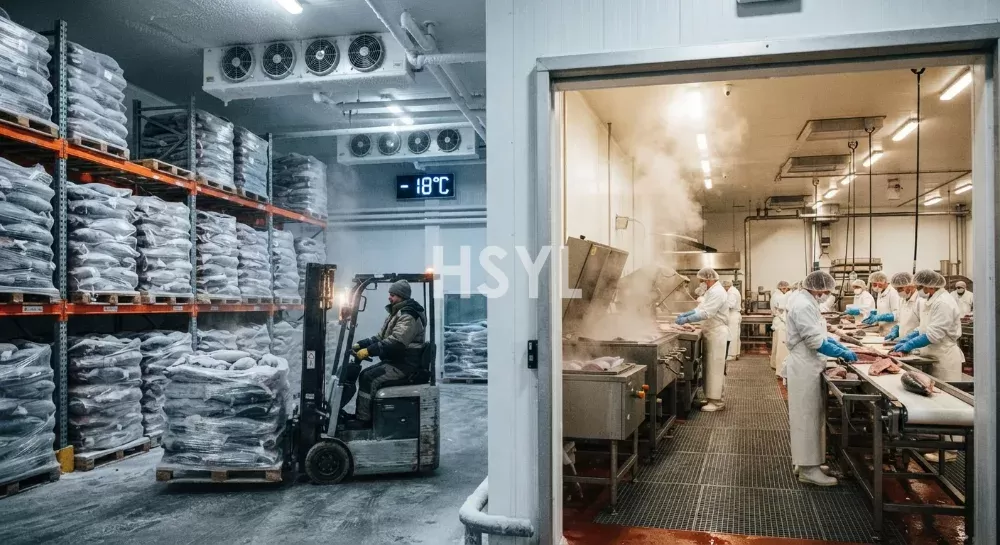
Sardines are delivered fresh or frozen under controlled temperature conditions. Upon arrival, raw materials are:
Weighed and recorded for traceability
Inspected for size, freshness, and quality
Automatically sorted by size if required
Proper raw material handling is essential for maintaining final product consistency and reducing waste.
3.2 Cleaning and Descaling
The sardines are transferred to automatic fish washing machines, where:
Surface impurities, blood, and scales are removed
High-pressure spray systems ensure thorough cleaning
Food-grade stainless steel (SUS304 or SUS316) prevents contamination
This stage directly affects hygiene levels and downstream equipment performance.
3.3 Heading, Gutting, and Cutting
HSYL offers automatic fish heading and gutting machines designed specifically for sardine processing.
Key features include:
Adjustable cutting precision
Minimal meat loss
Stable performance at high speeds
Reduced reliance on manual labor
For markets requiring specific sardine lengths or fillet styles, cutting parameters can be customized.
3.4 Pre-Cooking or Frying Process
Pre-cooking is a critical step that improves texture, flavor stability, and oil absorption control.
Depending on product positioning, HSYL lines support:
Steam pre-cooking tunnels for low-fat products
Oil frying systems for traditional flavor profiles
Temperature and time are controlled via PLC systems to ensure consistent results across large batches.
3.5 Can Filling: Fish and Sauce / Oil Dosing
After pre-cooking, sardines are automatically transferred to the filling section.
This stage includes:
Automatic fish portioning into cans
Liquid filling (oil, tomato sauce, brine, or custom sauces)
Precise weight control to meet labeling regulations
HSYL filling machines are designed for:
Tin cans, aluminum cans, and special shapes
Multiple can sizes with quick changeover
High filling accuracy and minimal spillage
3.6 Vacuum Seaming
Vacuum sealing is essential for shelf stability and product safety.
HSYL vacuum seaming machines provide:
Stable vacuum levels
Double-seam integrity
Low defect rates
Continuous monitoring and alarm systems
Proper seaming prevents oxidation, leakage, and microbial growth.
3.7 Retort Sterilization
Sterilization is the most critical food safety step in sardine canning.
HSYL offers:
Steam retort systems
Water spray retort systems
Automated F₀ value control
All sterilization systems are designed to meet:
HACCP requirements
FDA and EU food safety standards
Long shelf-life targets (2–5 years)
3.8 Cooling, Drying, and Inspection
After sterilization:
Cans are automatically cooled to safe handling temperatures
Surface moisture is removed
Leak detection and visual inspection are conducted
Defective cans are automatically rejected to ensure only qualified products reach packaging.
4. Fully Automatic vs Semi-Automatic Sardine Canning Lines
Choosing the right automation level depends on production volume, labor costs, and long-term strategy.
Semi-Automatic Lines
Lower initial investment
Suitable for small-scale or emerging markets
Higher labor dependency
Limited scalability
Fully Automatic Lines
High production capacity (8,000–30,000+ cans/hour)
Reduced labor costs
Consistent product quality
Faster ROI for medium and large manufacturers
HSYL primarily focuses on fully automatic sardine canning solutions, optimized for export-oriented factories.
5. Key Equipment in an HSYL Sardine Canning Line
Each HSYL production line is engineered with industrial-grade components, including:
Automatic fish washers
Heading and gutting machines
Pre-cooking tunnels or fryers
Multi-head can filling machines
High-speed vacuum seamers
Retort sterilizers
Conveyor systems
CIP cleaning systems
All equipment is manufactured using food-grade stainless steel and compliant with international standards.
6. Production Capacity and Customization
HSYL sardine canning lines are available in multiple capacities:
3,000–5,000 cans/hour (medium-scale)
8,000–12,000 cans/hour (industrial standard)
20,000–30,000 cans/hour (large-scale factories)
Customization options include:
Multiple can sizes and shapes
Different sauce formulations
Local voltage and power standards
Factory layout optimization
7. Food Safety and International Compliance
HSYL systems are designed to meet or exceed global standards, including:
HACCP
ISO 22000
CE certification
FDA compliance for US exports
GMP manufacturing principles
Our engineering team integrates food safety considerations into every design stage.
8. How Much Does a Sardine Canning Production Line Cost?
Investment cost depends on automation level, capacity, and configuration.
Typical Price Ranges
Semi-automatic line: USD 120,000 – 250,000
Fully automatic line: USD 400,000 – 1,200,000+
Key cost factors include:
Production capacity
Sterilization system type
Packaging automation level
Customization requirements
HSYL provides transparent quotations and ROI-based recommendations.
9. ROI Analysis: Why Automation Pays Off
A fully automatic sardine canning line can:
Reduce labor costs by 50–70%
Improve yield consistency
Minimize rework and product loss
Enable higher-value export markets
Typical payback periods range from 12 to 24 months, depending on production volume and market pricing.
10. How to Choose the Right Sardine Canning Line Manufacturer
When selecting a supplier, buyers should evaluate:
Turnkey project experience
Overseas installation references
Engineering and customization capabilities
After-sales support and spare parts availability
HSYL positions itself as a long-term technology partner, not just an equipment supplier.
11. HSYL Turnkey Sardine Canning Line Solutions
Our turnkey services include:
Process design and factory layout
Equipment manufacturing
Installation and commissioning
Operator training
Technical support and upgrades
From concept to production, HSYL ensures smooth project execution.
12. Future Trends in Sardine Canning Technology
Industry trends include:
Higher automation and digital monitoring
Energy-efficient retort systems
Smart production data tracking
Reduced water and oil consumption
HSYL continuously invests in R&D to keep clients ahead of the market.
Conclusion: Partner with HSYL for Reliable Sardine Canning Solutions
In today’s competitive seafood market, success depends on efficiency, compliance, and scalability. HSYL’s sardine canning food processing line solutions are designed to help manufacturers achieve long-term profitability with confidence.
By combining advanced engineering, international standards, and practical industry experience, HSYL delivers production lines that perform reliably today—and adapt to future growth.
Contact HSYL to discuss your sardine canning project and receive a customized solution proposal.
Related Articles



Get professional consultation
Do you have any questions or need technical support regarding the content of this article? Fill out the form below, and our expert team will provide you with professional solutions.