Direct Answer
Canned food production lines require a HACCP plan built around two non-negotiable critical control points: the thermal processing step that eliminates Clostridium botulinum spores, and the double seam that prevents recontamination after sterilization. Every other control on the line — raw material receiving, filling, headspace, can washing, cooling, labeling — exists to protect the integrity of those two CCPs. A HACCP plan that lists ten or twelve CCPs is almost always a sign that the team has confused control points with critical control points, and the result is a plan that is too complex to monitor and too noisy to act on when a real deviation occurs.Ensure hermetic integrity at high line speeds by implementing our technical protocol on can seamer setup and double seam inspection guide.
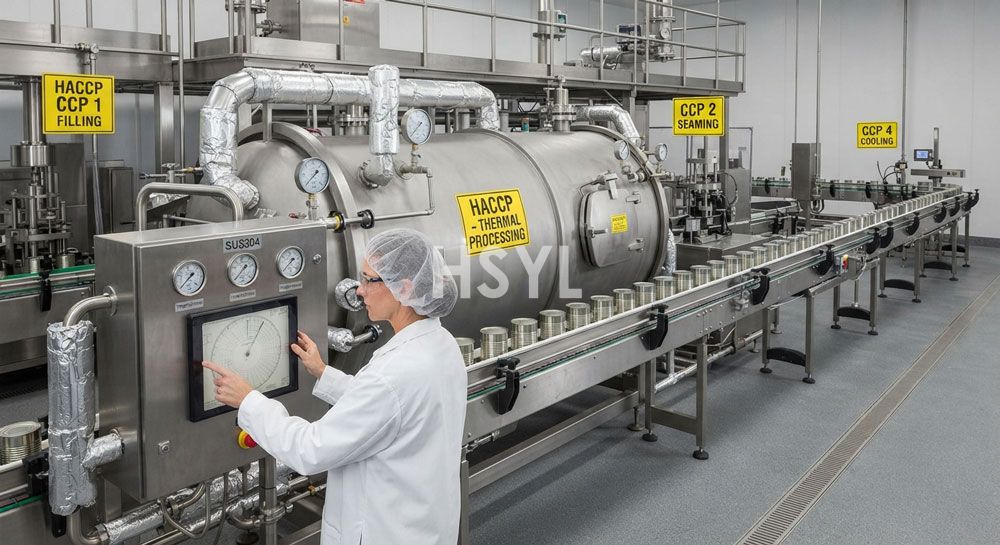
This article walks through the seven HACCP principles as they apply to canned food production, identifies the critical control points that genuinely determine safety, and explains the critical limits, monitoring procedures, and verification steps that a canned food plant must operate under to remain compliant with Codex Alimentarius, FDA 21 CFR 108/113/114, and EU Regulation 2073/2005. It applies to canned fish, canned meat, canned fruit, canned vegetables, canned ready meals, and canned pet food — the products that share the same fundamental thermal-processing and hermetic-sealing hazards. For product-specific layouts, see the HACCP fish canning line design guide and the companion guides for retort sterilization in canned meat.
Why Canned Food Has Unique HACCP Requirements
Canned food is a shelf-stable product that achieves commercial sterility through thermal processing and is then protected by a hermetic seal. The single most important hazard in canned food is Clostridium botulinum, an anaerobic spore-forming bacterium that produces a lethal neurotoxin in low-acid, anaerobic conditions — exactly the conditions inside a sealed can. The hazard is unique to canned food because no other food category combines low acidity, anaerobic packaging, and ambient storage.
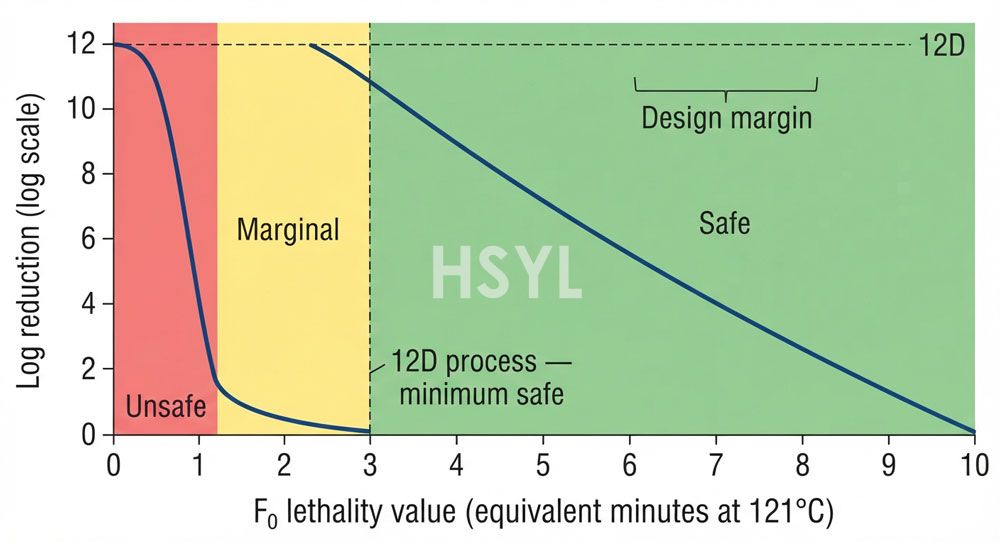
The thermal process designed to eliminate C. botulinum spores is measured in F₀ values — the equivalent lethality in minutes at 121°C. A minimum F₀ of 3.0 is required to achieve a 12-log reduction of C. botulinum spores (the so-called 12D process). Most low-acid canned food processes are designed with an F₀ of 6 to 8 to provide a safety margin. The can seam must then maintain hermetic integrity through cooling, handling, labeling, distribution, and shelf life — typically 24 to 36 months at ambient temperature — to prevent recontamination by environmental spores or post-process pathogens such as Salmonella or Listeria monocytogenes.
This combination — a single lethal thermal step followed by a long-term hermetic barrier — is why canned food HACCP plans are structured differently from HACCP plans for chilled, frozen, or fresh products. The control strategy is binary: either the thermal process and the seam both hold, or the product is potentially lethal. There is no intermediate state.
The Seven HACCP Principles Applied to Canning
The Codex Alimentarius General Principles of Food Hygiene (CAC/RCP 1-1969) define seven HACCP principles. Applied to canned food production, they translate as follows:
- Conduct a hazard analysis — identify biological, chemical, and physical hazards at every stage from raw receiving to finished-goods dispatch, with particular attention to spore-forming pathogens and physical contaminants that could compromise the seam.
- Determine the critical control points (CCPs) — identify the points where control is essential to prevent or eliminate a hazard. In canning, the universal CCPs are the thermal process and the double seam; additional CCPs may be added per product.
- Establish critical limits at each CCP — set measurable limits: F₀ value, retort temperature and time, seam thickness, seam tightness (tightness ratio), headspace, initial temperature of product at retort loading.
- Establish monitoring procedures — define who measures what, how often, with what instrument, and how the result is recorded. Monitoring must be continuous where feasible and at minimum every batch.
- Establish corrective actions — define what happens when a critical limit is breached: product hold, reprocess, segregation, investigation, root-cause analysis.
- Establish verification procedures — confirm that the plan is being followed and is effective: review of monitoring records, calibration of instruments, microbiological testing, seam teardown inspections, heat distribution tests.
- Establish record-keeping and documentation — maintain process records, deviation logs, calibration records, HACCP plan revisions, and validation studies for the regulated retention period (typically 3 years for low-acid canned food under FDA rules).
Hazard Analysis: What Can Go Wrong in a Canned Food Line
The hazard analysis for a canned food line considers three categories of hazards and where each can enter the process:
- Biological hazards: C. botulinum spores (survival if thermal process fails), Salmonella, Listeria monocytogenes, Clostridium perfringens, Staphylococcus aureus toxin (formed pre-process during slow cooling or holding), and post-process contamination through seam defects. For low-acid canned food, C. botulinum is the controlling hazard; for acidified or high-acid canned food, the controlling hazards are acid-tolerant pathogens and spoilage organisms.
- Chemical hazards: heavy metals in raw fish (mercury, lead), histamine in scombroid fish (tuna, mackerel), pesticide residues in fruit and vegetables, allergens introduced through shared equipment, cleaning chemical residues, and migration of can-lining compounds (BPA and alternatives) into the product.
- Physical hazards: metal fragments from cutting and grinding equipment, bone fragments in fish and meat, shell fragments in canned shellfish, stones and pits in fruit, glass fragments (rare in metal-can lines but possible in glass-jar canning), and foreign matter introduced through packaging material.
The hazard analysis must consider the likelihood and severity of each hazard, the conditions under which it can become significant, and whether existing control measures are sufficient. A hazard that is reasonably likely to occur and is severe enough to cause illness or injury must be controlled at a CCP. For a deeper treatment of the thermal process as the controlling CCP for biological hazards, see the guide on canned food thermal process control principles.
Critical Control Points in Canned Food Production
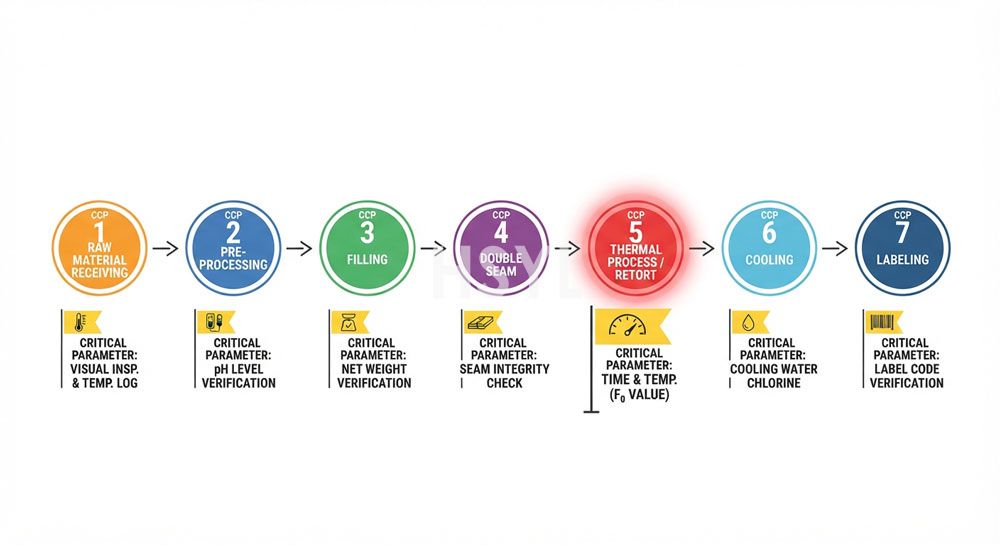
The number of CCPs on a canned food line varies by product, but a correctly designed HACCP plan typically identifies between four and seven CCPs. The list below covers the CCPs that apply across most canned food products; product-specific plans may add or remove CCPs based on the hazard analysis.
CCP 1: Raw Material Receiving
Raw material receiving is a CCP when the raw material itself can introduce a hazard that cannot be eliminated downstream. Examples include histamine in scombroid fish (once formed, histamine is heat-stable and survives the retort), heavy metals in fish, and pesticide residues in fruit. Critical limits are typically supplier specifications, certificate of analysis (COA) limits, and sensory acceptance criteria. Monitoring includes visual inspection, temperature checks (for fresh fish), and COA review for chemical parameters. Corrective action on a failure is rejection of the lot.
CCP 2: Pre-Processing and Preparation
In some products, a pre-processing step such as blanching, pre-cooking, or acidification is a CCP. For acidified low-acid canned food (such as canned vegetables in brine), acidification to a pH below 4.6 is a CCP because it prevents C. botulinum growth even if the thermal process is less severe. For canned tuna, pre-cooking to firm the flesh is not itself a CCP unless it is the only heat treatment before seaming — which it almost never is.
CCP 3: Filling and Net Weight Control
Filling is a CCP because the net weight and fill volume directly determine the thermal process. An overfilled can takes longer to reach sterilizing temperature at the cold spot, and if the thermal process is not adjusted for the overfill, the cold spot may not receive the required F₀. Critical limits are typically net weight tolerance, drained weight, and headspace (the gas space between the product surface and the can lid). Headspace affects heat transfer and is critical for products processed with steam. Monitoring is by in-line check-weigher and periodic headspace measurement. For the related equipment-side consideration, see the guide on headspace control during retorting.
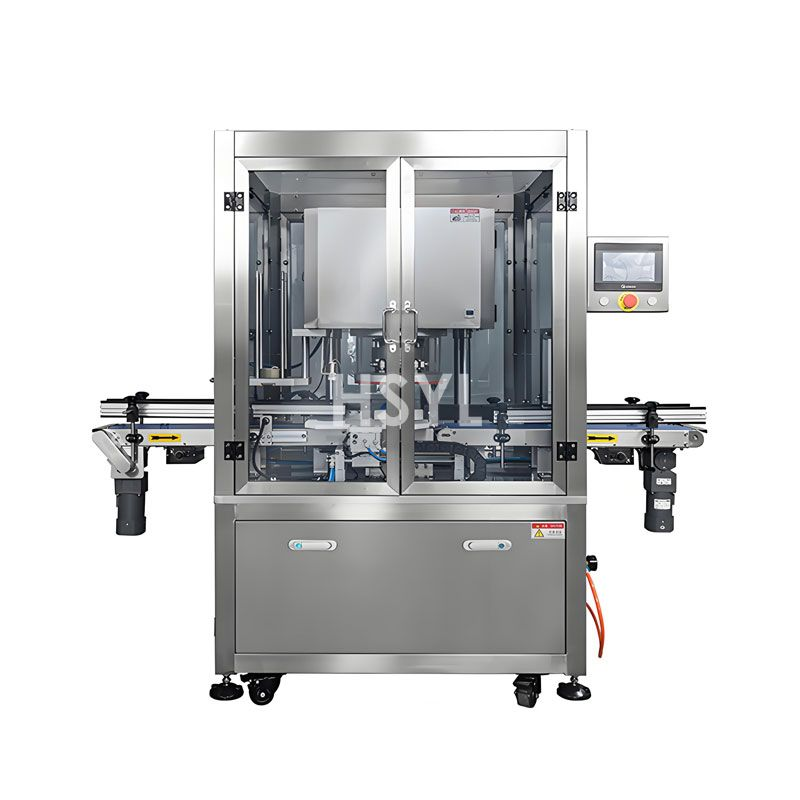
CCP 4: Double Seam Formation
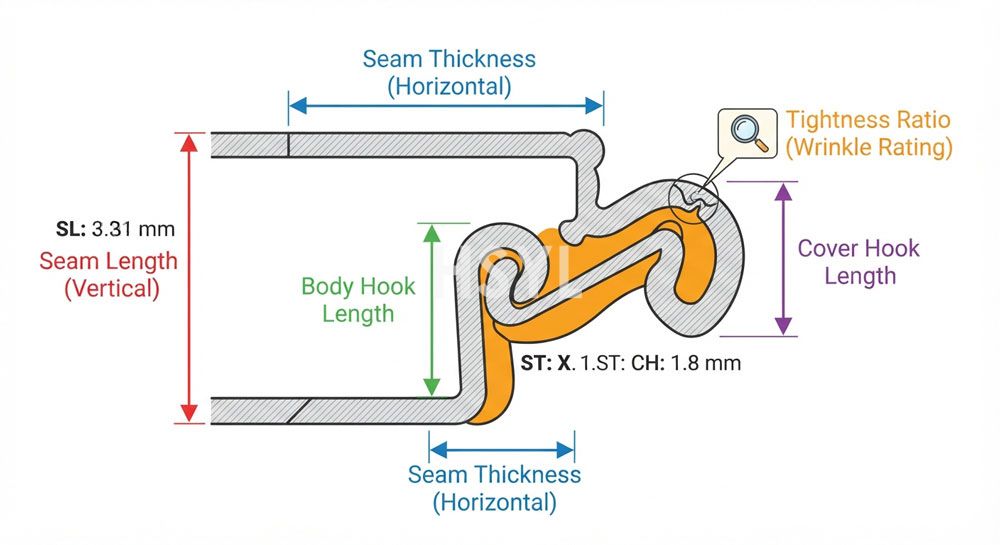
The double seam is the second universal CCP in canned food. It is the physical barrier that prevents recontamination after the retort and that maintains vacuum during shelf life. The seam is formed in two operations — a first-roll operation that interlocks the can body and cover hooks, and a second-roll operation that compresses the interlock to seal — and is measured against five parameters: seam length, seam thickness, body hook length, cover hook length, and tightness (measured by the tightness ratio or wrinkle rating).
Critical limits are defined by the can and end manufacturer's specifications, typically expressed as target values with tolerances. Monitoring is by seam teardown inspection at defined intervals — typically every two to four hours of production, plus at every seamer start-up and after every seamer adjustment. A seam micrometer measures the five parameters on a torn-down seam; the result is recorded and the trend monitored. A seam failure is treated as a critical deviation requiring immediate hold of all product seamed since the last passing inspection. For the practical failure patterns, see the guide on five common double seam defects.
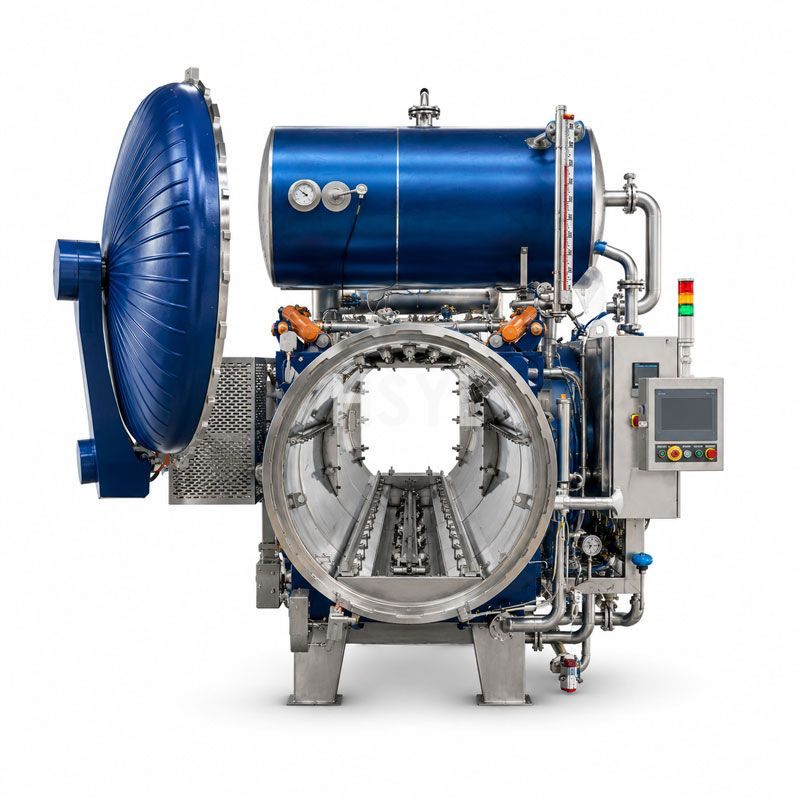
CCP 5: Thermal Processing — Retort Sterilization
The retort step is the single most critical CCP on the line. It is the step that eliminates C. botulinum spores and achieves commercial sterility. The critical limits are the retort temperature, the holding time at temperature, the initial temperature of the product at the start of the process, and the calculated F₀ value. The process must be validated by a thermal process authority and revalidated whenever the product, container, or process changes.
Monitoring is continuous: the retort is fitted with calibrated temperature and pressure sensors, a chart recorder, and an F₀ integrator. Every retort cycle produces a chart and a digital record that includes the come-up time, the holding time, the cooling time, and the calculated lethality. A deviation in any of these — a temperature drop, a come-up time extension, an incomplete cycle — is a critical deviation requiring product hold and a deviation investigation.
The retort itself must be qualified by heat distribution testing to confirm that every basket position reaches the required temperature within tolerance. Heat penetration testing confirms that the product cold spot reaches the required F₀. For the engineering factors that determine retort performance, see the retort sterilizer design factors guide and the broader treatment of canned fish sterilization process engineering.
CCP 6: Cooling and Post-Retort Handling
Cooling is a CCP because of a phenomenon known as post-process contamination or leaker spoilage. Immediately after the retort, the can seam is still hot and the sealing compound is still soft; if the can is exposed to contaminated cooling water or to wet handling surfaces, micro-organisms can be drawn through microscopic seam defects by the vacuum that forms as the can cools. The risk is highest in the first hours after retort, when the can is contracting and drawing in air (or water) from the surrounding environment.
Critical limits include cooling water quality (typically chlorinated to a measurable residual, with microbiological monitoring), can drying before handling, and avoidance of manual handling until cans are below a defined surface temperature. Monitoring includes cooling-water chlorine residual checks at the start of every batch and weekly or biweekly microbiological testing of the cooling water for coliforms and Pseudomonas.
CCP 7: Labeling, Coding, and Date Marking
Labeling and coding are sometimes classified as a CCP and sometimes as a pre-requisite program, depending on the regulatory framework. Where they are a CCP, the critical limits are the presence and legibility of the production date, the retort batch code, and the expiry date — the information that allows a product to be traced and recalled. Monitoring is by visual inspection of the code on every can at the labeling station and by automated vision systems where installed.
Critical Limits Table
The table below summarises typical critical limits for the universal CCPs. Actual limits must be validated per product, container, and process — the values shown are illustrative of the order of magnitude and the parameter types.
| CCP | Critical Parameter | Typical Limit | Monitoring Frequency | Corrective Action |
|---|---|---|---|---|
| 1 — Raw material receiving | Temperature (fresh fish) | ≤ 4°C at receipt | Every delivery | Reject lot |
| 1 — Raw material receiving | Histamine (scombroid fish) | ≤ 50 ppm per FDA; ≤ 100 ppm per EU action limit | COA per lot + periodic verification | Reject lot; review supplier |
| 2 — Acidification (acidified foods) | pH equilibrated | ≤ 4.6 within 24 h of sealing | Every batch | Hold batch; rework if feasible |
| 3 — Filling | Net weight | Per declared weight, tolerance per local weights regulations | Continuous check-weigher | Reject underweight; investigate overfill |
| 3 — Filling | Headspace | Per container spec, typically 6–10 mm | Hourly | Adjust filler; hold cans since last check |
| 4 — Double seam | Seam thickness | Per end manufacturer spec, tolerance ±0.05 mm | Every 2–4 h + start-up | Stop line; adjust seamer; hold product since last passing seam |
| 4 — Double seam | Cover hook / body hook overlap | ≥ 45% (typical); per spec | Every 2–4 h teardown | As above |
| 5 — Thermal process | Retort temperature | Per validated schedule, typically 116–121°C | Continuous chart + digital | Hold batch; deviation investigation |
| 5 — Thermal process | Holding time at temperature | Per validated schedule | Continuous | Hold batch; extend process if feasible |
| 5 — Thermal process | F₀ (calculated lethality) | ≥ 3.0 minimum; typically 6–8 design | Every cycle | Hold batch; process authority review |
| 5 — Thermal process | Initial product temperature | Per validated schedule (cold-spot temperature at start) | Every batch | Hold batch; do not start retort cycle |
| 6 — Cooling | Cooling water chlorine residual | ≥ 0.5 ppm free chlorine at discharge | Every batch | Hold batch; re-treat water; investigate |
| 6 — Cooling | Can handling dryness | Cans dry before conveyance | Continuous visual | Adjust dryer; hold wet cans |
| 7 — Labeling and coding | Code legibility and completeness | Date, batch code, expiry visible | Continuous (vision system) or hourly | Hold lot; re-label |
Monitoring and Verification
Monitoring and verification are not the same activity and are commonly confused in HACCP plans. Monitoring is the routine check that confirms a CCP is under control during operation — it is frequent, real-time, and actionable. Verification is the periodic confirmation that the HACCP plan itself is valid and is being followed — it is less frequent, retrospective, and analytical.
Typical monitoring activities on a canned food line include: continuous retort chart recording, hourly seam teardown inspection, continuous check-weigher output, and visual code-legibility checks. Typical verification activities include: weekly review of monitoring records by the HACCP team leader, monthly instrument calibration, annual heat distribution and heat penetration testing, annual process authority review of the validated thermal schedule, periodic microbiological testing of finished product (incubation testing at 30°C and 55°C for thermophilic spoilage organisms), and an internal HACCP audit at minimum annually.
The distinction matters because monitoring catches operational deviations in real time, while verification catches systematic failures that monitoring cannot see — a drift in the retort temperature sensor that is within tolerance but trending, a seamer that produces passing seams at a marginal tightness ratio, a supplier whose COA values have been creeping upward for six months. A HACCP plan without strong verification is a plan that will pass every audit until the day a product recall begins.
Record-Keeping Requirements
Record-keeping is the seventh HACCP principle and is the one most often under-resourced in practice. The records that a canned food plant must maintain include:
- Process records: retort charts and digital logs, seam teardown records, check-weigher logs, pH and Brix records, cooling-water chlorine logs.
- Deviation records: every critical deviation, the corrective action taken, the product disposition (hold, reprocess, release after review, destroy), and the root-cause investigation.
- Calibration records: every monitoring instrument (retort temperature sensors, pressure gauges, scales, pH meters, seam micrometers, chlorine analyzers) calibrated against a traceable standard at defined intervals.
- Validation studies: the original thermal process validation by a process authority, heat distribution and heat penetration studies, and revalidation records after any product, container, or process change.
- HACCP plan revisions: the version history of the HACCP plan, with the rationale for each change and the approval signatures.
- Training records: every operator trained on the CCPs they monitor, with the date, content, and signature.
The regulated retention period for low-acid canned food records under FDA 21 CFR 113 is three years from the date of manufacture. EU rules under Regulation 2073/2005 do not specify a fixed period but require retention for a period appropriate to the product shelf life and traceability requirements — typically interpreted as the shelf life plus one year.
CCP Comparison Across Canned Food Types
While the universal CCPs (thermal process and double seam) apply to every canned food, the additional CCPs differ by product. The table below compares the CCP configurations for the major canned food categories.
| Canned Food Type | Universal CCPs | Additional Product-Specific CCPs | Controlling Hazard |
|---|---|---|---|
| Canned fish (low-acid) | Thermal process; double seam | Histamine at receiving; cooling water; post-retort handling | C. botulinum; histamine (scombroid fish) |
| Canned meat (low-acid) | Thermal process; double seam | Pre-cooking (where applicable); emulsion temperature (luncheon meat); cooling water | C. botulinum; Staphylococcus aureus toxin (if cooling too slow) |
| Canned fruit (high-acid) | Thermal process (pasteurization); double seam | Syrup Brix; pH; pesticide residues at receiving | Acid-tolerant spoilage organisms; mycotoxins |
| Canned vegetables (acidified) | Thermal process; double seam | Acidification to pH ≤ 4.6; salt brine concentration | C. botulinum (controlled by acidification) |
| Canned ready meals (low-acid) | Thermal process; double seam | Cooking step; cooling water; allergen segregation | C. botulinum; allergen cross-contact |
| Canned pet food (low-acid) | Thermal process; double seam | Raw material receiving; emulsion temperature; cooling water | C. botulinum; Salmonella |
For product-specific layout and process detail, see the existing guides on tuna canning process and the related canned-fish, canned-meat, and canned-fruit process guides.
Common HACCP Failures in Canned Food Plants
HACCP plans fail in practice through a small number of recurring patterns. Each is preventable with disciplined plan design and review.
- Too many CCPs: a plan that lists ten or twelve CCPs is almost certainly confusing control points with critical control points. The result is a plan that is too complex to monitor with discipline and too noisy for the operator to identify a true critical deviation when it occurs. The fix is to re-examine every CCP against the Codex decision tree and remove any that is not on the critical path to product safety.
- Critical limits without measurable parameters: a critical limit stated as "must be sterilized properly" is not a critical limit. A critical limit must be a number, a range, or a measurable condition that an operator can verify with an instrument.
- Monitoring without recording: a check performed but not recorded is a check that did not happen for audit and recall purposes. Every monitoring activity must produce a contemporaneous record.
- Deviation handling that defaults to release: when a critical limit is breached, the default action must be hold, not release-after-judgment. Release after a deviation requires documented process authority review and a written disposition rationale — not an informal operator decision.
- Validation not updated after changes: when a product formulation, container size, or process parameter changes, the original thermal process validation no longer applies. Revalidation is required before resuming production. This is one of the most common findings in canned food audits.
- Cooling-water hygiene neglected: the post-retort cooling step is frequently treated as a utility rather than a CCP. The result is undisciplined chlorination, untreated water tanks, and a higher rate of leaker spoilage that may not be detected until incubation testing or customer complaints.
- Seam monitoring at wrong frequency: a seamer running for an entire shift without an intermediate teardown inspection is operating without verification that the seam is still in specification. The standard interval is every two to four hours; longer intervals are acceptable only with documented justification.
- Records retained but never reviewed: records stored in a filing cabinet or a database but never analysed provide no verification value. The HACCP team must review trends — not just pass-fail results — to catch drift before it becomes a deviation.
For an integrated treatment of CIP and sanitation pre-requisite programs that support the HACCP plan, see the guide on CIP systems for canning lines.
Conclusion
HACCP in canned food production is built around two universal critical control points — the thermal process that eliminates C. botulinum spores and the double seam that prevents recontamination — supported by product-specific CCPs at receiving, pre-processing, filling, cooling, and labeling. A correctly designed plan identifies between four and seven CCPs, sets measurable critical limits at each, monitors them in real time, and verifies the plan itself through periodic review, calibration, and revalidation. The single most common failure of canned food HACCP is not the absence of a plan but the dilution of the plan with too many non-critical control points, which makes the true critical deviations invisible until they produce a recall.
If you are designing or auditing a HACCP plan for a canned food line and need engineering support on retort validation, seam inspection, or process authority review, prepare the following information and contact the engineering team: the product and container specification, the target market and applicable regulatory framework (FDA / EU / other), the validated thermal process schedule, the seamer type and seam specification, the production rate, and the existing HACCP plan if one exists. To discuss a project, contact the engineering team.
Frequently Asked Questions
What are the critical control points in a canned food production line?
What is the minimum F₀ value required for a low-acid canned food?
Why is the double seam a critical control point in canned food?
What is post-process contamination or leaker spoilage in canned food?
How many CCPs should a canned food HACCP plan have?
What records must a canned food plant retain under HACCP?
How do HACCP CCPs differ across canned food types?
What is the single most common HACCP failure in canned food plants?
Related Articles
Get professional consultation
Do you have any questions or need technical support regarding the content of this article? Fill out the form below, and our expert team will provide you with professional solutions.