In industrial food processing, retort sterilization directly controls ensuring the safety, quality, and shelf life of canned meat products. Retort systems are designed for industrial buyers, including meat processors, canning facility managers, and plant engineers, who require consistent, high-volume production while maintaining regulatory compliance. For companies producing beef, poultry, pork, or mixed meat products, retort sterilization ensures microbial stability, prevents spoilage, and preserves nutritional and sensory qualities over extended storage periods. Understanding the operational principles, technical advantages, and practical applications of retort sterilization is critical for optimizing canned meat production and maximizing ROI.For complete autoclave batch scheduling and facility sanitation planning, refer to our engineering overview on meat canning line.

What Retort Sterilization Is & How It Works
Retort sterilization is a thermal processing method that uses pressurized steam or hot water to eliminate pathogenic and spoilage microorganisms in canned foods. The process involves placing sealed cans into a retort chamber where they are subjected to controlled high temperatures and pressure for a predetermined time. The key principle is to achieve commercial sterility without compromising meat texture, flavor, or nutritional value.
Retort sterilizers may be batch-based or continuous, depending on production requirements:
Batch Retorts: Ideal for smaller or mixed-product lines, allowing flexible processing with strict temperature monitoring. Cans are loaded on racks or baskets and treated in cycles.
Continuous Retorts: Designed for high-volume production, these systems convey cans through steam or water tunnels with precise temperature and pressure control. Continuous retorts maximize throughput while maintaining product consistency.
Advanced retort systems integrate PLC or SCADA control, monitoring temperature, pressure, and time in real-time to ensure each batch or continuous run achieves the target F-value—a measure of microbial lethality—without overprocessing the meat.
Industry Problems This Equipment Solves
Microbial Contamination and Food Safety Risks
Canned meat is susceptible to pathogens such as Clostridium botulinum and Listeria monocytogenes. Retort sterilization ensures commercial sterility, preventing contamination and reducing recall risks.
Yield Loss and Product Inconsistency
Manual or inadequate thermal processing can result in undercooked cans, leakage, or overcooked texture. Automated retorts reduce yield loss by maintaining consistent heat penetration across all cans.
Labor Intensity and Operational Inefficiency
Traditional cooking methods require constant supervision and manual handling. Modern retorts automate heating cycles, reduce labor, and free staff for higher-value tasks.
Scalability Challenges
Scaling production without compromising safety or quality is a major concern. Continuous retorts allow facilities to increase output from thousands to tens of thousands of cans per hour without adding significant labor or complexity.
Regulatory Compliance Pressure
Meeting FDA, HACCP, ISO, and CE standards is critical for domestic and international markets. Retort sterilization ensures temperature-time profiles comply with these regulations, maintaining audit readiness and market access.
Key Features & Technical Advantages
Precision Thermal Control: Ensures consistent heat penetration for commercial sterility without overcooking.
Flexible Cycle Programming: Customizable temperature and pressure profiles for different meat products, can sizes, and formulations.
Batch and Continuous Options: Provides scalability from pilot production to high-volume industrial operations.
PLC/SCADA Integration: Real-time monitoring and automatic adjustments enhance reliability and safety.
Sanitary Design: Food-grade stainless steel construction with CIP compatibility minimizes contamination risks.
Energy Efficiency: Advanced insulation and heat recovery reduce operating costs.
Safety Systems: Pressure relief valves, door interlocks, and automated alarms protect operators and equipment.
Typical Applications & Production Scenarios
Beef Stews and Roast Beef: Batch retorts allow precise cooking for premium texture and flavor.
Poultry and Chicken Products: Continuous retorts maintain high throughput for regional or national distribution.
Mixed Meat Products: Flexible cycle programming accommodates various ingredients and viscosities.
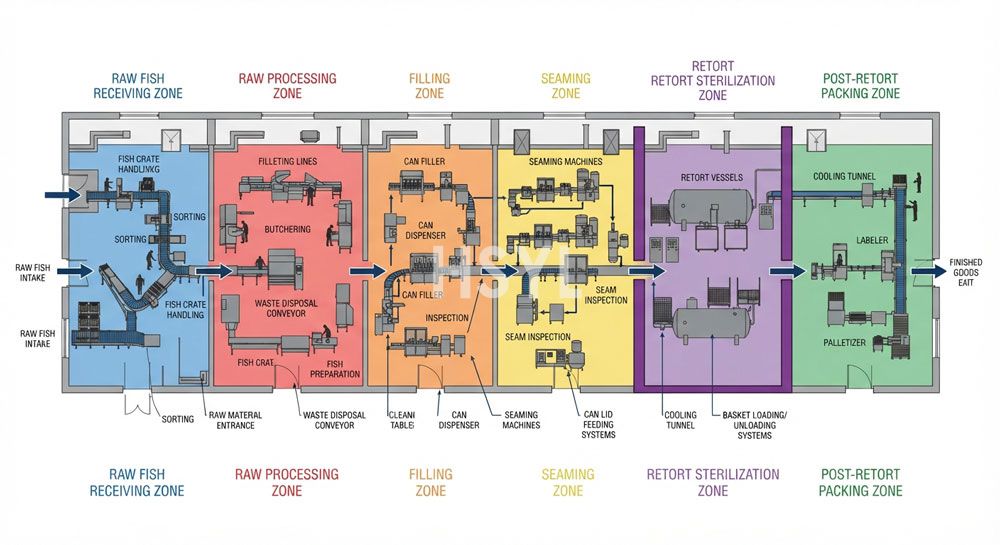
Ready-to-Eat Meals: Integration with upstream filling and sealing systems ensures seamless production flow.
Retort sterilizers are widely applied in industrial canning facilities, co-packers, and private label meat processors where shelf life, safety, and product consistency are non-negotiable.
Capacity Options & Selection Guidance
Small-Scale / Pilot Retorts: 100–500 liters, suitable for R&D or niche production.
Medium-Scale Retorts: 500–2,000 liters, balancing throughput and flexibility.
High-Capacity Retorts: 2,000–10,000+ liters, designed for large-scale industrial production.
Selection should consider:
Target production volume and can dimensions
Meat type, density, and formulation
Batch vs. continuous operation preference
Integration with upstream fillers and downstream packaging
Regulatory and certification requirements
Buyer Benefits
Extended Shelf Life: Achieves commercial sterility, allowing months to years of storage.
Consistent Product Quality: Uniform heating prevents texture degradation and flavor loss.
Labor Optimization: Automated cycles reduce manual oversight and workforce requirements.
Scalable Production: Modular design supports facility expansion without compromising quality.
Regulatory Compliance: Aligns with FDA, HACCP, ISO, and CE standards.
Resource Efficiency: Energy-saving designs reduce utility costs and environmental footprint.
Customization & Engineering Support
Equipment manufacturers offer:
Retort cycle optimization for specific meat products
Custom can racks and loading systems for diverse can sizes
Integration with automatic filling, sealing, and cooling units
Engineering support for installation, commissioning, and preventive maintenance
Optional automation upgrades such as robotic loading/unloading, advanced CIP systems, and real-time remote monitoring
These services ensure each retort system aligns with operational goals and factory layout constraints.
Standards, Certifications, and Compliance
HACCP Compliance: Ensures food safety risk management from raw materials to finished cans.
ISO 22000 / ISO 9001: Quality management systems for consistent production and traceability.
FDA-Approved Design Principles: Retort chambers, valves, and control systems designed for regulatory adherence.
CE Certification: Confirms European safety, pressure vessel, and electrical standards are met.
Sanitary Construction: 304/316 stainless steel, CIP compatibility, and minimal crevices prevent microbial contamination.
Adherence to these standards ensures both domestic and export-ready product lines.
Conclusion & Professional CTA
For industrial meat processors, retort sterilization is indispensable in maintaining safety, quality, and shelf life of canned products. Selecting the right retort system—whether batch or continuous—ensures operational efficiency, compliance with regulatory standards, and consistent product excellence. Our engineering team provides tailored retort solutions, cycle optimization, and integration support to meet diverse production needs. Contact our specialists today to discuss your facility requirements and receive a detailed proposal for a turnkey retort sterilization solution that maximizes your canned meat shelf life and operational efficiency.
Frequently Asked Questions
What is retort sterilization and why is it important for canned meat?
Can a batch retort handle multiple can sizes and meat types simultaneously?
How does retort sterilization improve production efficiency?
What is the difference between batch and continuous retorts?
Which certifications should a reliable retort sterilizer have?
Can retort sterilization impact the texture or flavor of meat?
How do I select the right retort capacity for my facility?
Is engineering support available for installation and maintenance?
Related Articles




Get professional consultation
Do you have any questions or need technical support regarding the content of this article? Fill out the form below, and our expert team will provide you with professional solutions.