The Role of Sterilization in Canned Fish Production
In canned fish processing, sterilization is not a separate event. It is the control point that determines whether the packed can can safely leave the line and sit on a shelf for months.
For seafood plant engineers, the sterilization process is where product quality, can integrity and regulatory compliance intersect.For complete autoclave batch scheduling and facility sanitation planning, refer to our engineering overview on canned fish production process plant.

What “canned fish sterilization” actually means
Sterilization for canned fish means applying sufficient thermal energy to inactivate spores and pathogens while preserving texture. This is different from pasteurization, which is suitable for ready-to-eat products with shorter shelf life.
The process begins after filling and seaming, but the whole line must be designed to support it.
Core steps in the sterilization process
The standard flow is: can filling and exhausting, sealing, retort loading, thermal cycle, and cooling. Any weak point in this chain can force an immediate reject or later leak.
| Stage | Engineering focus | Common plant issue |
|---|---|---|
| Filling & exhausting | Headspace, fill weight, oil separation | Liquid film under lid, inconsistent vacuum |
| Seaming | Double seam fit, torque, seam profile | Leakers after retort/cooling |
| Retort cycle | Heat penetration, pressure control, come-up time | Overcooked meat, underprocessed can center |
| Cooling | Rapid equilibration, washdown layout | Can distortion, delayed line release |
Selecting the right retort for canned fish
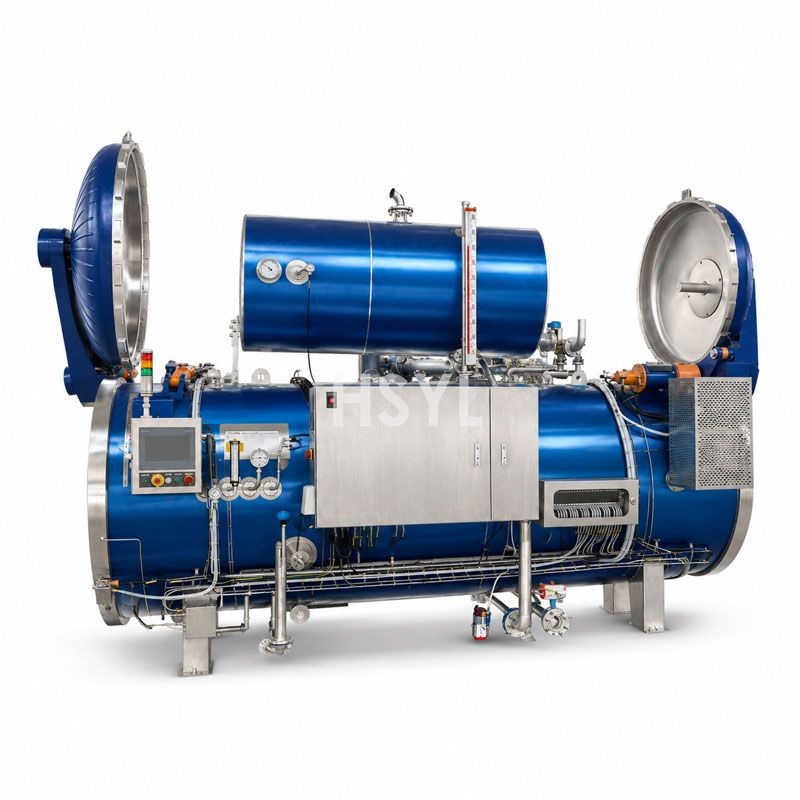
There are two typical options: batch retorts and continuous or rotary retorts. The choice depends on line capacity, product mix and available floor space.
Batch retorts are easier to validate, but continuous systems usually have a smaller footprint and better throughput for a steady production schedule.
For detailed equipment options, review the HSYL retort sterilizer for canned fish page.
Why headspace and exhausting matter for canned fish
Every canned fish product needs a controlled headspace volume. Too much gas leaves a cavity at the top, while too little can create pressure problems during sterilization.
Exhausting the can before seaming removes trapped air and reduces the chance of seam failures. This is especially important with oily products that can trap more air than water-based fillings.
Sanitation design and maintenance access
A sterilization area must be easy to clean and inspect. Retorts, conveyors and sealers see fish oils and protein residue every day, so they need quick drain points and accessible spray nozzles.
If the line design forces operators to dismantle the filler or retort door for routine cleaning, the expected uptime will drop faster than any claimed rated capacity.
Common engineering mistakes in canned fish sterilization lines
- specifying a sterilizer based only on can count rather than the product’s thermal load
- placing the retort too close to raw material zones, creating cross-contamination risk
- ignoring the need for a separate cooling conveyor after sterilization
- buying a seamer without confirming the can size range and lid thickness used by the plant
These are the project risks that experienced plant managers look for during supplier evaluation.
Practical trade-offs for plant planners
Three key trade-offs typically determine the best sterilization arrangement:
- capacity vs. flexibility: a single retort with narrow can size capability may be cheaper, but it limits future product changes
- automation vs. maintenance: more conveyors and transfers reduce manual handling, but they require stronger seals and spare parts support
- cycle time vs. quality: faster come-up times save energy, yet they can stress the product texture if not matched to the fish type
It is usually wiser to choose a retort system that allows process adjustment rather than one locked to a single recipe.
How sterilization affects downstream line balance
The sterilization module must be viewed as part of the whole fish canning line. If the retort cannot discharge at the same rate as the seamer, the upstream filler and cooker will quickly be forced to stop.
For overall line flow guidance, see the HSYL fish canning process flow practical plant guide.
Regulatory and validation considerations
For canned fish sold in regulated markets, engineers should ensure the sterilization process meets the required thermal process validation standard. That means documented retort charts, temperature probes and cooling records.
HACCP teams will also want to confirm that the sealing, retort loading and post-cool handling are defined as critical control points. This is not a paperwork exercise; it is the basis for daily line release.
Maintenance reality: what operators will notice first
Most plants start to lose throughput because of retort door seal wear, failed steam traps, or clogged filters in the heating circuit.
Routine checks should include the retort gasket condition, the accuracy of temperature sensors, and the condition of the exhaust manifold on the seamer. These issues are far more likely to cause line stoppage than a missing automation feature.
Operator handover and start-up verification
Before the first commercial run, the production team should run a dry test of the sterilization loop with empty cans or water-filled cans. This verifies the heat-up curve, seal integrity and transfer timing without risking product waste.
A practical start-up checklist includes:
- confirming retort pressure and temperature control loops
- validating exhaust settings on the filler/seamer
- checking can orientation and transfer geometry into the retort load carts
- verifying the cooling conveyor speed and washdown coverage
How to spot a sterilization proposal that is too optimistic
If a supplier proposal only quotes “high throughput” and does not include a retort process chart or can transfer diagram, it is a red flag.
A competent seafood line offer should spell out the sterilization cycle, the expected come-up time, and the retort capacity in terms of thermal processing rather than can/hour alone.
Related Topics
- Retort Sterilizer for Canned Fish
- Fish Canning Process Flow Practical Plant Guide
- Tuna Canned Production Line
Call to Action
For a canned fish line, the sterilization module is the heart of food safety and line stability. HSYL can review your process flow, retort choice and sanitation layout from an engineering-first perspective.
Frequently Asked Questions
What is the main difference between sterilization and pasteurization in canned fish processing?
Why is headspace control important for canned fish?
Can I use a batch retort for a small canned fish line?
What are the most common causes of sterilization line downtime?
How should I verify a supplier’s sterilization proposal?
Related Articles



Get professional consultation
Do you have any questions or need technical support regarding the content of this article? Fill out the form below, and our expert team will provide you with professional solutions.