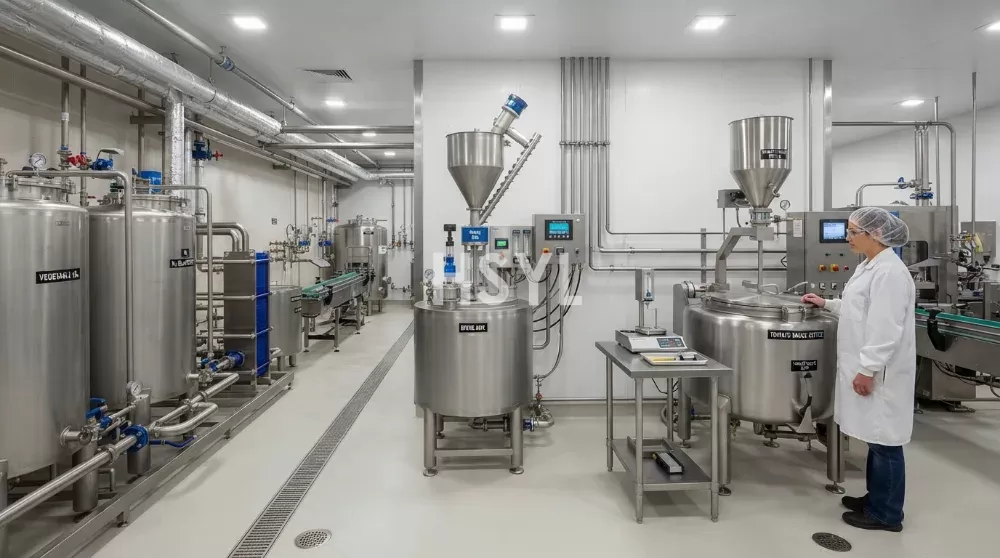
Canned Fish Filling Media: Oil, Brine, Tomato Sauce and Flavored Sauce Systems
The filling medium — the liquid that fills the void spaces between the fish piec...


HSYL Cooking Range 900 Series covers 16 upright models across stockpot (HS), griddle (HG) and solid top (HTP) lines in 400/800/1200mm widths, with gas and 380V electric options, cabinet base or integrated oven, for hotel, hospital and central kitchen hot prep.
The Cooking Range 900 Series is HSYL's upright commercial cooking range line, built around three independent hot-prep workstations — stockpot (HS), griddle (HG) and solid top (HTP) — unified under one cabinet platform. Every model in the series shares a 900 mm net depth and 920 mm net height, so a kitchen designer can place a stockpot range, a griddle and a solid-top range side by side on the same counter run without step-downs or filler panels. Width is the only variable that changes with capacity: 400 mm for twin-burner stockpot or compact griddle, 800 mm for four-burner stockpot or full-size griddle or single solid top, and 1200 mm for six-burner stockpot.
Each workstation comes in gas (-G) and electric (-E) heating variants, and each variant offers a cabinet base or an integrated oven underneath — gas oven (VG) or electric oven (VE). That gives buyers 16 distinct models within one series, all running on the same footprint family, all serviceable with the same component family. For sites already running the smaller Cooking Range 700 Series, the 900 Series is the step-up path when menu volume or cooktop area outgrows the 700 platform.
The series is engineered for buyers who need a coordinated hot-prep line rather than a single cooking appliance. It belongs to HSYL's broader cooking and frying equipment range, so a 900 Series line can be specified alongside tilting steam kettles, continuous fryers and spiral ovens in a central kitchen or hotel main kitchen layout.
The 900 Series is organized along three decision axes: workstation type, heating source, and base configuration. Understanding these axes makes the 16-model matrix navigable.
| Code | Workstation | Primary Use |
|---|---|---|
| HS | Stockpot range | Stockpot simmering, soup boiling, congee, stewing — round-burner flame for wok or stockpot |
| HG | Griddle | Flat-top searing, teppanyaki, breakfast griddle items, burger and steak searing |
| HTP | Solid top | Even-heat solid plate for sauce work, slow simmer, multi-zone pan placement |
| Code | Heating | Power Supply | Typical Use |
|---|---|---|---|
| -G | Gas | Gas connection (no electrical supply required for burner operation) | Sites with established gas infrastructure, high instantaneous heat demand, wok-style cooking |
| -E | Electric | 380V / 50Hz, three-phase | Sites without gas, indoor air-quality sensitive kitchens, precise temperature control |
| -VE / -VG | Hybrid (gas top + electric or gas oven below) | 380V / 50Hz for VE oven; gas only for VG oven | Sites that need both top cooktop and bottom oven, with the oven energy source chosen independently |
| Code suffix | Base | Function |
|---|---|---|
| (none) — e.g. HS9080-G | Cabinet base | Storage cabinet under the cooktop — pots, pans, dry goods |
| VG — e.g. HS9080VG-G | Gas oven below | Gas-heated baking/roasting oven under the cooktop |
| VE — e.g. HS9080VE-G | Electric oven below | Electric baking/roasting oven under the cooktop — useful when top is gas but oven needs electric thermostatic control |
Width follows the model number: 9040 = 400 mm, 9080 = 800 mm, 9120 = 1200 mm. So an HS9120VE-G is a gas six-burner stockpot range with electric oven below, at 1200 mm wide. Once a buyer decodes the model number, the spec sheet is redundant.
| Model | Configuration | Heating | Gas Power | Electric Power | Net Size (W×D×H) | N.W. |
|---|---|---|---|---|---|---|
| HS9040-G | Twin-burner, cabinet base | Gas | 12 kW | — | 400×900×920 mm | 53 kg |
| HS9080-G | Four-burner, cabinet base | Gas | 24 kW | — | 800×900×920 mm | 95 kg |
| HS9080VG-G | Four-burner, gas oven below | Gas | 29 kW | — | 800×900×920 mm | 127 kg |
| HS9080VE-G | Four-burner gas top, electric oven below | Gas top + Electric oven | 24 kW | 6 kW (380V/50Hz) | 800×900×920 mm | 90 kg |
| HS9120VG-G | Six-burner, gas oven below | Gas | 41 kW | — | 1200×900×920 mm | 177.4 kg |
| HS9120VE-G | Six-burner gas top, electric oven below | Gas top + Electric oven | 36 kW | 6 kW (380V/50Hz) | 1200×900×920 mm | 133 kg |
HS stockpot ranges use open round burners sized for stockpot and wok cooking. The HS9080 and HS9120 platforms cover the four- and six-burner configurations typical of hotel Chinese-restaurant main kitchens and central-kitchen soup stations.
| Model | Configuration | Heating | Gas Power | Electric Power | Net Size (W×D×H) | N.W. |
|---|---|---|---|---|---|---|
| HG9040-G | Flat griddle, cabinet base | Gas | 6 kW | — | 400×900×920 mm | 65.8 kg |
| HG9080-G | Flat griddle, cabinet base | Gas | 12 kW | — | 800×900×920 mm | 131 kg |
| HG9080VG | Flat griddle, gas oven below | Gas | 17 kW | — | 800×900×920 mm | 179 kg |
| HG9040-E | Flat griddle, cabinet base | Electric | — | 3.5 kW (380V/50Hz) | 400×900×920 mm | 65.8 kg |
| HG9080-E | Flat griddle, cabinet base | Electric | — | 10.5 kW (380V/50Hz) | 800×900×920 mm | 131 kg |
| HG9080VE | Flat griddle, electric oven below | Electric | — | 16.5 kW (380V/50Hz) | 800×900×920 mm | 179 kg |
HG griddles use a full flat plate. The "full pit / half flat" (R / M) option noted in the source spec applies to plate profile — R for recessed pit, M for half-flat — selectable per menu requirement.
| Model | Configuration | Heating | Gas Power | Electric Power | Net Size (W×D×H) | N.W. |
|---|---|---|---|---|---|---|
| HTP9080-G | Solid top, cabinet base | Gas | 14 kW | — | 800×900×920 mm | 106.2 kg |
| HTP9080VG | Solid top, gas oven below | Gas | 19 kW | — | 800×900×920 mm | 135 kg |
| HTP9080-E | Solid top, cabinet base | Electric | — | 10.4 kW (380V/50Hz) | 800×900×920 mm | 108.2 kg |
| HTP9080VE | Solid top, electric oven below | Electric | — | 12 kW + 8 kW (380V/50Hz) | 800×900×920 mm | 120 kg |
HTP solid-top ranges use a heavy cast plate that radiates even heat across the cooking surface, suited to sauce work, multi-zone pan placement and slow simmering where localized hot spots are undesirable. The HTP9080VE carries separate power ratings (12 kW top + 8 kW oven) because the top plate and the electric oven operate on independent thermostatic circuits.
The highest-value deployment is the central-kitchen and hotel-restaurant scenario: the unified 900 mm depth and 920 mm height across HS, HG and HTP let a buyer build a coordinated three-workstation hot-prep line without mixing incompatible platforms, while the gas/electric and cabinet/oven matrix gives the kitchen designer 16 configurations to match menu and utility constraints.
The 900 Series is one node in a coordinated hot-prep and cooking line. These HSYL resources are typically evaluated alongside it:
Send your menu type (Chinese restaurant, central kitchen, hospital canteen, school cafeteria), your utility availability (gas connected? 380V three-phase available?) and your peak-hour dish count — HSYL will return a 900 Series configuration recommendation covering workstation mix, width tier and base configuration.
Running a multi-site hotel or catering chain? Ask our engineers for a fleet standardization brief covering HS, HG and HTP on one cabinet platform, with unified service scheduling.
Upgrading from the 700 Series? Tell us your current 700 layout and we will map it onto a 900 Series line, reusing your existing utility connections where possible.


The filling medium — the liquid that fills the void spaces between the fish piec...
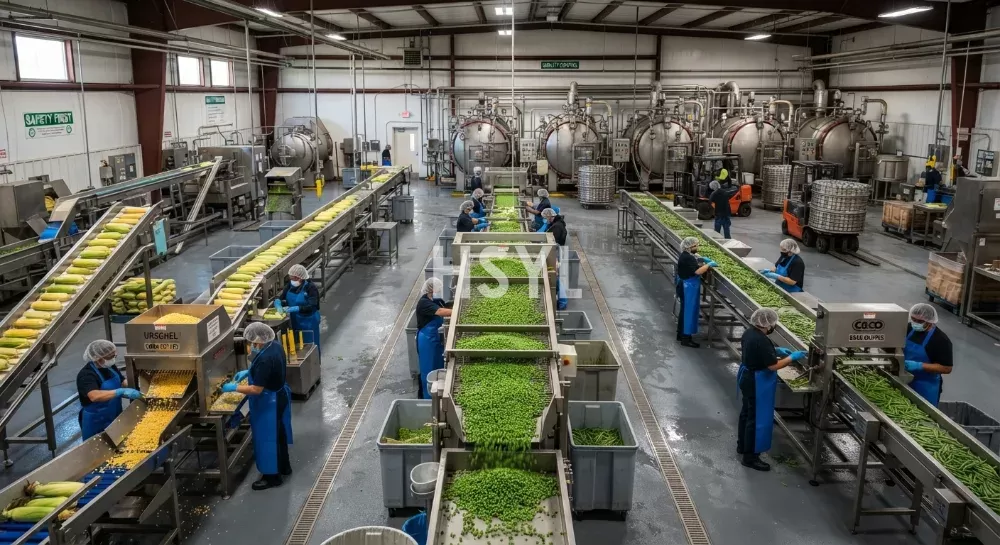
Direct AnswerA low-acid canned vegetable processing line — corn, peas, and green...
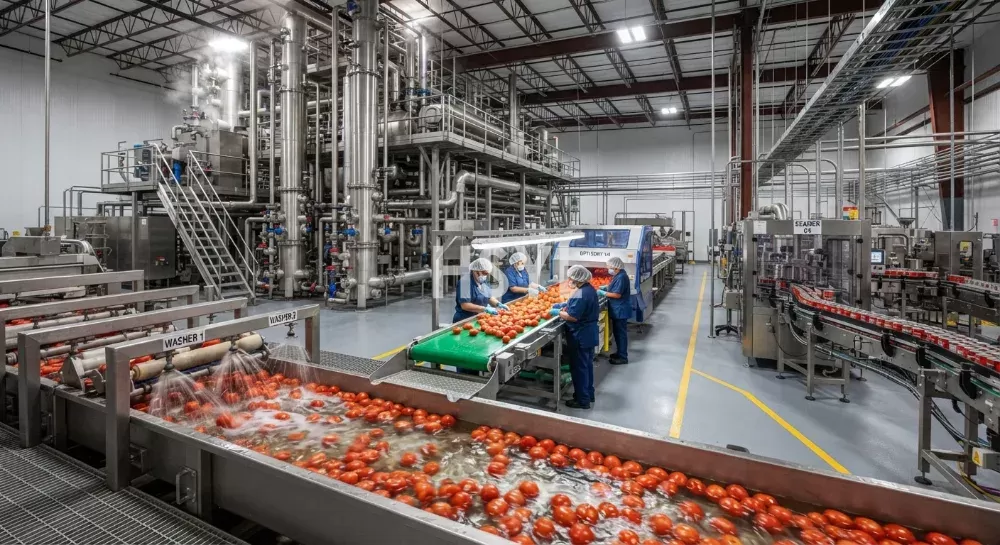
Direct AnswerA tomato products canning line converts fresh tomatoes into four di...
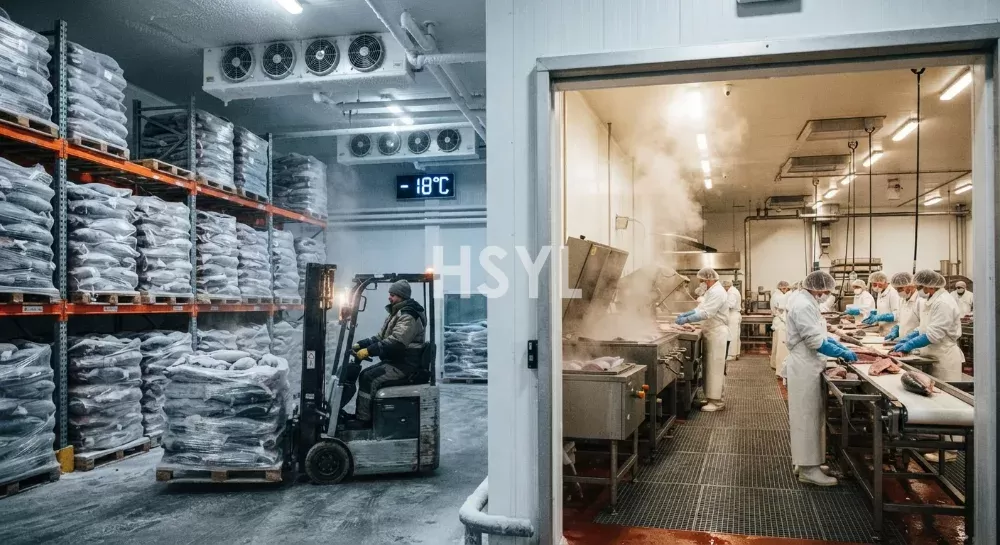
Direct AnswerThe most expensive asset in a fish cannery is not the retort or the...