Most sandwich griddle buying decisions go wrong in the same three ways. The buyer picks a plate size based on the sandwich they imagine making rather than the volume they actually need to push during the morning rush. The buyer assumes any electric griddle will work on any kitchen outlet and discovers too late that their building cannot deliver the amperage the unit requires. Or the buyer focuses on the griddle itself and ignores how ingredients, assembly, and service flow around it — ending up with a beautifully specced machine jammed into a workflow that turns every sandwich into a four-step obstacle course.
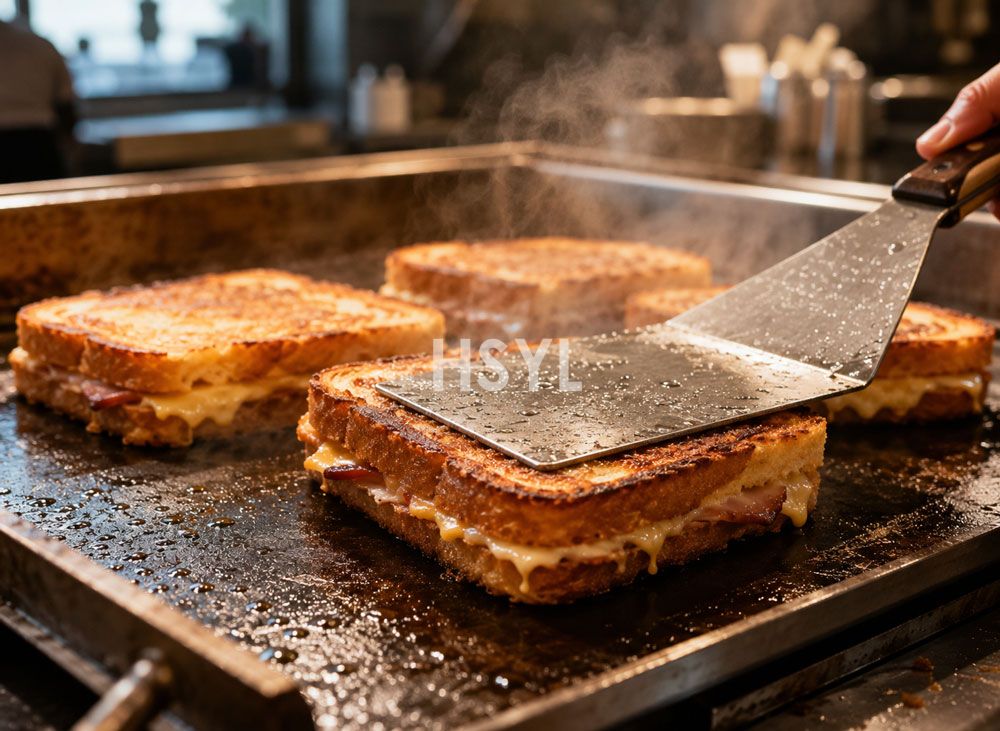
This guide walks through the three decision dimensions that actually determine whether a sandwich griddle performs well in your venue: plate size matched to peak sandwich volume, temperature control matched to your menu mix, and workflow integration matched to your counter layout and power supply. The focus throughout is on HSYL's compact countertop griddle line — the HSG37E, HSG41E, and HSG57E — because these three models cover the typical decision range for sandwich shops, cafes, food trucks, and small-format food service venues. The same framework applies if you eventually need to step up to a larger Cooking Range 900 Series griddle for higher-volume operations.
If your sandwich griddle decision is part of a broader small-food-business launch rather than a single equipment replacement, you may also want to review the how to start a food product line planning guide, which covers menu engineering, equipment budgeting, and venue selection together.
Plate Size: Match Width to Peak Sandwich Volume, Not to Your Imagination
The HSYL sandwich griddle line offers three plate widths: 370 mm, 410 mm, and 570 mm. The common buying mistake is to think "bigger is better" and pick the 570 mm model when the 370 mm would have handled actual demand comfortably — leaving the operator with a larger footprint, higher power draw, and a griddle surface that is mostly empty during normal service. The opposite mistake is just as common: choosing the smallest model to save money, then discovering at peak hour that you can only cook two sandwiches at a time while six orders pile up on the ticket rail.
The right way to choose plate width is to calculate your realistic peak-hour sandwich volume, then match the griddle capacity to that volume with a small buffer:
| Model | Plate Size (W×D) | Power | Typical Sandwiches per Batch | Peak-Hour Volume Fit | Best Venue Match |
|---|---|---|---|---|---|
| HSG37E | 370 × 305 mm | 1.8 kW | 2 sandwiches | 10-20 sandwiches/hour | Food kiosk, office pantry, single-staff snack bar, mobile cart |
| HSG41E | 410 × 305 mm | 2.2 kW | 3 sandwiches | 20-35 sandwiches/hour | Small cafe, convenience store kitchen, breakfast counter |
| HSG57E | 570 × 305 mm | 3.6 kW | 4-5 sandwiches | 35-60 sandwiches/hour | Sandwich shop, food truck with high turnover, bistro lunch service |
Practical Note: The "sandwiches per batch" estimates above assume standard rectangular sandwiches approximately 100-120 mm wide. If your menu includes larger pressed sandwiches (panini, Cuban mix, full-size club sandwiches), reduce the per-batch count by one sandwich per tier. If you primarily cook smaller items like breakfast sliders or mini-sandwiches, you can increase per-batch count by one. The 305 mm plate depth is consistent across all three models — depth accommodates the sandwich length, width determines how many fit side by side.
The depth dimension (305 mm) is the same across the entire line, which means all three models fit the same standard commercial sandwich length. What changes is the width — and width translates directly to batch capacity. If your peak hour demands 30 sandwiches and you choose the HSG37E at 2 sandwiches per batch with roughly 5 minutes per batch including load and unload, your theoretical maximum is 24 sandwiches per hour — you are already underwater before the rush even peaks. The HSG41E at 3 per batch reaches 36 per hour, giving you headroom. The HSG57E at 5 per batch reaches 60 per hour, comfortable for sustained peak demand.
Temperature Control: What Actually Matters in a Sandwich Griddle
Sandwich griddle temperature control is less about the maximum temperature the plate can reach and more about three operational characteristics that determine cooking consistency across a service shift. Buyers who focus only on the advertised maximum temperature often miss these factors, then wonder why their sandwiches cook unevenly or why the griddle seems to lose heat halfway through a rush.
Factor 1: Heat Distribution Across the Plate Surface
A sandwich griddle's plate is heated from below by electric elements, but the heat must distribute evenly across the cooking surface to ensure consistent results. Uneven distribution creates hot spots and cold spots — sandwiches placed in one area brown faster than sandwiches placed elsewhere, forcing the operator to remember plate geography and rotate items manually. Plate material and thickness (specific values for the HSG37E/41E/57E not confirmed in source specification — confirm with supplier per project) are the primary determinants of even heat distribution. Thicker plates generally distribute heat more evenly but take longer to preheat; thinner plates preheat faster but are more prone to hot spots.
Factor 2: Heat Recovery Time After Loading
When cold sandwiches are placed on a hot griddle, the plate surface temperature drops. How quickly the griddle recovers to its set temperature determines whether the second batch cooks at the same rate as the first. Power rating directly affects recovery time — the HSG37E at 1.8 kW has slower recovery than the HSG57E at 3.6 kW. For low-volume venues cooking one batch at a time with recovery gaps between batches, this is not a problem. For high-volume venues loading batch after batch with no recovery gap, a higher power rating becomes critical to maintaining consistent cook times through the rush.
Factor 3: Thermostat Range and Stability
The thermostat controls the target temperature and cycles the heating element to maintain it. Different sandwich types require different temperatures: a breakfast sandwich with egg needs a moderate temperature to cook the egg without burning the bread; a pressed panini needs higher temperature for shorter time to create the characteristic crust; a grilled cheese needs lower temperature for longer time to melt the cheese before the bread overbrowns. A griddle with a wider thermostat range and tighter stability (specific thermostat type and range for HSG37E/41E/57E not confirmed in source specification — confirm with supplier) supports a more diverse menu without operator workarounds like cycling the griddle on and off manually.
Engineering Note: Many buyers assume that higher power automatically means better temperature control. This is only partially true. A high-power griddle with a poor thermostat will overshoot the target temperature, burn the sandwich surface before the interior cooks, and recover from overshoot slowly. A moderate-power griddle with a precise thermostat can outperform a high-power griddle with a cheap control. When evaluating griddles, ask the supplier specifically about thermostat type (bi-metallic, capillary, electronic), temperature range, and stability tolerance — not just maximum wattage.
Workflow Integration: Power Supply, Counter Layout, and Station Flow
A sandwich griddle does not operate in isolation. Its performance depends on how it integrates with the surrounding kitchen workflow — power supply, counter placement, prep-to-assembly flow, and staff movement patterns. This is the dimension most often overlooked in buying decisions, and it is also the dimension where the HSYL sandwich griddle line has its strongest differentiator: all three models run on 230V/50Hz single-phase household-grade power.
Power Supply: 230V Single-Phase Changes What Is Possible
Most commercial cooking equipment requires 380V three-phase power, which means a dedicated industrial electrical circuit, a three-phase breaker panel, and often a building electrical upgrade. This is feasible for established restaurants with commercial-grade electrical infrastructure but creates a hard barrier for small venues operating out of spaces originally built for retail or office use — food trucks, kiosks in shopping malls, pop-up kitchens in leased storefronts, office pantries, and residential-scale commercial kitchens.
All three HSYL sandwich griddle models — HSG37E (1.8 kW), HSG41E (2.2 kW), and HSG57E (3.6 kW) — run on standard 230V/50Hz single-phase power. This means they plug into a standard commercial or household-grade outlet without requiring an electrician to install a three-phase circuit. For small-venue operators, this can be the difference between being able to install the equipment at all versus facing a $3,000-$8,000 electrical upgrade before any cooking can begin.
| Venue Type | Typical Power Available | Recommended Griddle Model | Why This Fit |
|---|---|---|---|
| Food truck or mobile cart | 230V single-phase via generator or shore power | HSG37E or HSG41E | Lower power draw fits generator capacity; compact footprint fits mobile counter |
| Office pantry or break room | 230V standard outlet | HSG37E | Smallest model handles low-volume occasional use; no electrical upgrade needed |
| Cafe kiosk in mall or storefront | 230V standard commercial outlet | HSG41E | Mid-tier capacity for steady lunch rush; plug-and-play installation |
| Sandwich shop with dedicated counter | 230V with possible 380V upgrade | HSG57E | Highest capacity within 230V constraint; can step up to 900 Series griddle if volume grows |
| Bistro or small restaurant | 230V plus 380V three-phase | HSG57E or step up to Cooking Range 900 Series | HSG57E handles sandwich demand; 900 Series if griddle becomes primary cooking station |
Counter Layout: Plan the Workflow Before Buying the Griddle
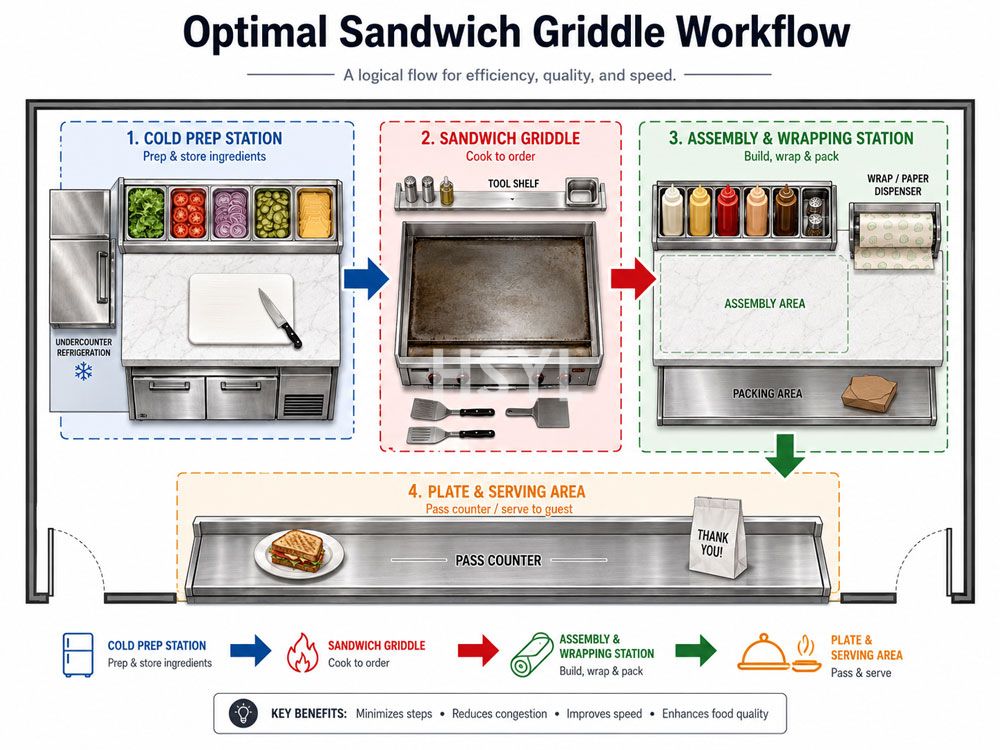
The griddle's physical placement on the counter determines how efficiently staff can move through the prep-cook-assembly sequence. A griddle placed too close to the cold prep station leaves no room for ingredient staging; a griddle placed too far from the assembly station means carrying hot sandwiches across the kitchen, increasing drop risk and slowing service. The ideal layout follows a linear flow:
- Cold prep station — bread, cheese, proteins, vegetables staged in cold drawers or under-counter refrigeration within arm's reach of the griddle
- Griddle station (center) — the griddle itself with 100-150 mm clearance on each side for spatula movement and emergency pan placement
- Assembly station — cutting board, wrapper, and serving plates positioned immediately adjacent to the griddle's unload side
- Service pass — finished sandwiches placed directly onto the service counter or into a holding warmer within one step of assembly
All three HSYL griddle models share a 305 mm depth and 210 mm height, making them suitable for standard commercial counter depths (typically 600 mm). The variable dimension is width — 370 mm for the HSG37E up to 570 mm for the HSG57E. When planning your counter, allocate the griddle width plus at least 300 mm on each side for ingredient staging and unloading, plus 600-900 mm for the assembly station adjacent to the unload side.
Complementary Equipment: What Pairs with a Sandwich Griddle
A sandwich griddle rarely operates as the sole cooking equipment in a venue. Typical pairings include a small refrigerator for ingredient storage, a beverage station (often paired with a yogurt maker machine if the venue serves breakfast parfaits or yogurt-based snacks alongside sandwiches), and a panini press or contact grill for items that need top-and-bottom simultaneous heat. If the venue serves ice with beverages, a small commercial ice maker may also be needed — but for pure sandwich-focused operations, the griddle plus refrigeration plus assembly station is the minimum viable equipment set.
Decision Framework: Which Model Fits Your Venue
Once you have worked through plate size, temperature control, and workflow integration, the model selection often becomes obvious. The decision framework below summarizes the typical match between venue profile and recommended model:
| Venue Profile | Daily Sandwich Volume | Power Available | Counter Available | Recommended Model |
|---|---|---|---|---|
| Mobile food cart, weekend market stall | 20-50/day | 230V shore power | Under 600 mm width | HSG37E |
| Office pantry, staff break room | 10-30/day | 230V standard outlet | Standard counter | HSG37E |
| Convenience store with sandwich counter | 40-80/day | 230V commercial outlet | 600-800 mm width | HSG41E |
| Small cafe with breakfast service | 60-120/day | 230V commercial outlet | 800-1000 mm width | HSG41E |
| Dedicated sandwich shop, lunch-only | 100-200/day | 230V with adequate amperage | 1000+ mm width | HSG57E |
| Food truck with high turnover | 80-180/day | 230V via generator | Limited but deep counter | HSG57E |
| Bistro with sandwich plus grill menu | 150-300/day | 230V plus 380V available | Full cooking line | HSG57E or step up to Cooking Range 900 Series |
Value Angle: The cost difference between the HSG37E and the HSG57E is modest compared to the operational cost of choosing the wrong model. An under-sized griddle costs you in lost sales during peak hours — every sandwich you cannot produce at peak is a sandwich sale lost forever, not just deferred. An over-sized griddle costs you in wasted energy, wasted counter space, and wasted capital that could have been deployed on complementary equipment. The right model is the one that handles your peak hour with a 15-20% capacity buffer, not the biggest one you can afford.
Common Buying Mistakes to Avoid
Before finalizing your sandwich griddle purchase, review these common mistakes that buyers make and that this guide's framework is designed to prevent:
- Mistake 1: Buying on peak imagination, not peak reality. Buyers imagine the busy lunch rush they hope to have and buy the largest griddle, when actual peak volume is half what they imagined. Calculate peak volume from realistic menu and seating data, not from aspiration.
- Mistake 2: Ignoring power supply constraints. A 380V griddle cannot run on a 230V outlet without an electrical upgrade that often costs more than the griddle itself. Confirm available power supply before choosing a model — all three HSG models run on 230V, removing this barrier entirely.
- Mistake 3: Treating the griddle as a standalone purchase. The griddle's performance depends on workflow integration — counter layout, prep station proximity, assembly flow. Plan the entire station, not just the cooking equipment.
- Mistake 4: Focusing only on maximum temperature. Maximum temperature matters less than heat distribution, recovery time, and thermostat stability. Ask the supplier about all four characteristics, not just the headline wattage or temperature number.
- Mistake 5: Forgetting to plan for growth. If you expect volume to grow significantly over the next 12-24 months, choose a model with headroom or choose a model from a product line that includes larger step-up options — the HSG line steps up naturally to the Cooking Range 700 and 900 Series griddles for operations that outgrow the countertop format.
Recommended Resources for Sandwich Griddle Buyers
Once you have a shortlist of models that fit your volume, power, and workflow requirements, these resources help you finalize the decision and plan the broader kitchen setup:
- HSYL Sandwich Griddle 37E/41E/57E product specifications — Complete technical specifications for all three models including dimensions, power ratings, and weight data for counter load planning.
- Cooking Range 900 Series griddle options — Step-up path for venues that anticipate outgrowing the HSG57E within 12-24 months and need a higher-capacity griddle with broader workstation coverage.
- Cooking and frying equipment overview — Broader catalog of griddles, fryers, and cooking equipment for venues planning a multi-station kitchen rather than a sandwich-only operation.
- How to start a food product line — Planning guide for buyers launching a new sandwich shop, cafe, or small food business, covering menu engineering, equipment budgeting, and venue selection.
Frequently Asked Questions
What size sandwich griddle do I need for a small cafe?
Can I run a sandwich griddle on a regular household outlet?
How hot does a commercial sandwich griddle get?
What is the difference between a sandwich griddle and a panini press?
How do I clean and maintain a sandwich griddle?
Can I use a sandwich griddle for cooking things other than sandwiches?
How long does it take for a sandwich griddle to preheat?
Should I buy the largest griddle I can afford to leave room for growth?
Related Articles


Get professional consultation
Do you have any questions or need technical support regarding the content of this article? Fill out the form below, and our expert team will provide you with professional solutions.