The Strategic Case for Vibratory Cutting in Industrial Bakeries
In the high-pressure environment of industrial bakery manufacturing, management often focuses on oven efficiency and mixing consistency. However, the finishing stage—specifically cutting and portioning—is where significant margin is lost. Traditional mechanical cutting is a process defined by friction, compression, and drag. For complex bakery products like cheesecakes, cream-filled pastries, or dense energy bars, these mechanical forces are the primary drivers of yield loss and production bottlenecks.
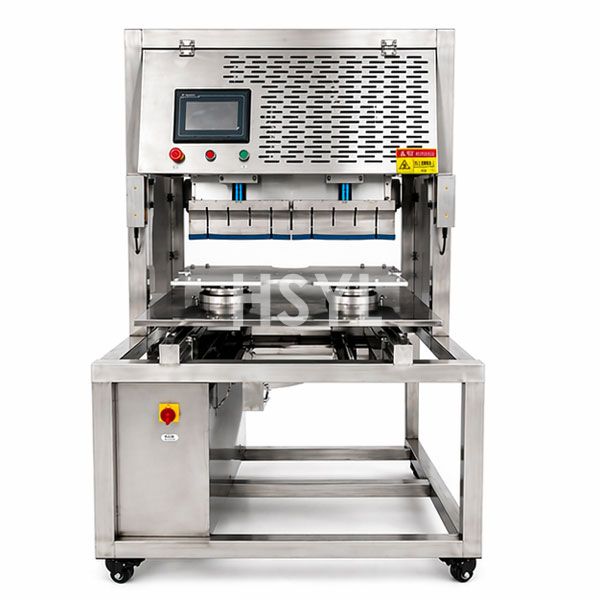
Ultrasonic technology is not merely an alternative to a knife; it is a fundamental shift in how we manage material separation. By oscillating a titanium blade at 20,000 to 40,000 cycles per second, we create a high-frequency cutting interface that behaves as if it is virtually frictionless. For a plant engineer, this means the ability to achieve precision cuts at higher speeds with zero "smear" and minimal waste. At HSYL, we view ultrasonic integration as a strategic ROI play that addresses the triple challenge of yield, hygiene, and versatility.
The Physics of the "Friction-less" Slice
To understand why your line needs this technology, we must look at the Coefficient of Friction. In mechanical cutting, the blade must force its way through the product, causing the crumb or dough to compress and stick to the metal surface. This adhesion leads to "dragging," which ruins the visual appeal and deposits product onto the blade, requiring immediate cleaning.
Ultrasonic vibration creates a "non-stick" effect through acoustic cavitation at the cutting edge. The rapid forward-and-backward motion creates a microscopic layer of air or moisture between the blade and the product. This prevents the molecular bonds of sugars and fats from sticking to the titanium. The result is a clean, surgical separation. For a plant running thousands of units per hour, this reduction in drag translates directly into lower motor torque requirements and a significant decrease in product rework.
Quantifying the ROI: Yield Recovery and Smear Elimination
The most compelling argument for ultrasonic technology is the impact on the bottom line through yield recovery. In facilities processing high-value items like premium cheesecakes or multi-layer cream cakes, "smear" is a major profit killer. When a mechanical blade drags the dark chocolate layer into the white cream layer, the product is often downgraded or discarded.
By using ultrasonic vibration, the layers remain distinct. The internal structure is not compressed, preserving the aerate crumb and the intended volume of the product. Data from HSYL installations suggests that bakeries can recover between 1% and 3% of their total output by transitioning to advanced cutting technology. On a line producing $10 million worth of product annually, a 2% yield recovery is $200,000 in found revenue—often enough to pay for the ultrasonic equipment in less than one fiscal year.
Sanitation: The Self-Cleaning Advantage
Hygiene is the "silent" cost of bakery production. Every time a mechanical line stops for a blade washdown because of sugar buildup, the factory loses money. In some high-fat applications, mechanical blades must be cleaned every 15 to 30 minutes to maintain cut quality.
The high-frequency vibration of an ultrasonic blade acts as a continuous self-cleaning mechanism. The acceleration forces on the blade surface are so intense that most food particles are literally rejected before they can bond to the alloy. This extends the interval between manual cleanings by 300% to 500%. For facilities following strict HACCP or FSMA guidelines, this reduction in human intervention also lowers the risk of cross-contamination. Our technical comparison of cutting methods highlights how this "low-drag" surface is essential for maintaining hygiene standards in 24/7 operations.
Versatility on Multi-SKU Production Lines
Modern consumers demand variety, leading bakeries to run multiple SKUs on a single line. A common bottleneck is the "changeover." Switching from a dense brownie to a delicate, air-filled puff pastry typically requires a different blade geometry or a complete line reset.
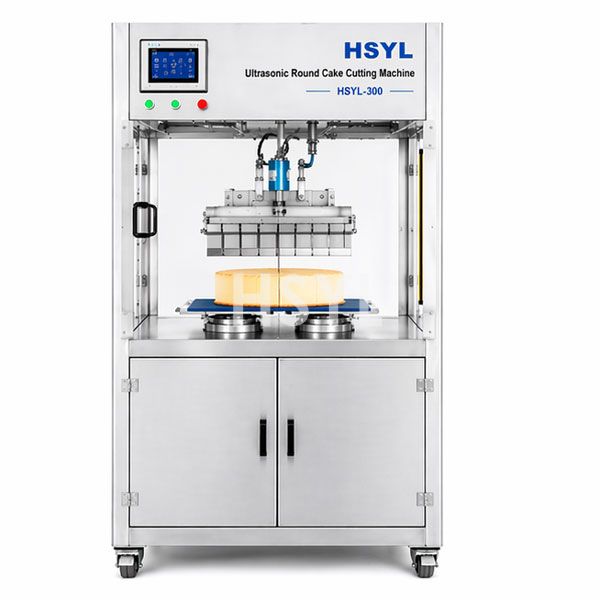
Ultrasonic knives are inherently more versatile because they rely on vibration rather than physical sharpness. By simply adjusting the ultrasonic amplitude and the conveyor speed via a PLC interface, a single knife can cut through a frozen tray of bars and then immediately switch to slicing fresh sponge cakes. This eliminates the need for tool changes and drastically reduces changeover downtime. Facilities using automatic ultrasonic frozen cake cutting machines often see a 20% increase in total equipment effectiveness (OEE) due to this flexibility.
Integration Realities: Managing the Transducer Stack
For an engineer, the success of an ultrasonic system depends on the integration of the "stack"—the transducer, booster, and horn (blade). This assembly must be precisely tuned to a specific resonant frequency. If the conveyor timing is not synchronized with the vertical stroke of the ultrasonic knife, you risk "scuffing" the product or creating mechanical stress on the blade threads.
At HSYL, we focus on the PLC synchronization of the entire line. The cutting speed must match the product feed rate to ensure the blade enters and exits the product at the null point of its horizontal vibration. When done correctly, this creates a seamless, 24/7 operation where the cutting station is no longer the bottleneck of the facility.

Comparison: Mechanical Slicing vs. Ultrasonic Vibration
| Parameter | Mechanical Steel Blade | Ultrasonic Titanium Blade | Engineering Impact |
|---|---|---|---|
| Compression Force | High (5-10kg) | Low (<0.5kg) | Preserves crumb structure |
| Product Smear | Significant in fats/creams | Near Zero | Superior visual appeal |
| Cleaning Interval | 15-30 Minutes | 4-8 Hours | Dramatically higher OEE |
| Waste Contribution | 1.5% - 4.0% | <0.5% | Direct ROI on ingredients |
| SKU Versatility | Requires tool change | Software-adjusted | Faster changeovers |
Practical Engineering Tip: The Temperature Sweet Spot
Even the best ultrasonic technology has a "performance curve" based on product temperature. For cheesecakes and dense mousses, cutting at -5°C to -10°C provides the highest rigidity for the cleanest slice. However, if the product is too cold (below -20°C), the acoustic impedance changes, requiring the generator to work harder, which can lead to thermal de-tuning. Always calibrate your blast freezer to ensure the product core temperature is consistent before it hits the cutting station.
Future-Proofing Your Bakery Facility
As labor costs rise and ingredient margins shrink, automation is no longer optional. But automation without precision is just "faster waste." Ultrasonic technology provides the precision necessary to scale up production while actually reducing the cost per unit. By eliminating the friction in your process, you eliminate the hidden costs of failure on your production floor.
Related Topics
- Ultrasonic vs. Mechanical Cutting: Technical ROI Comparison
- Optimizing Frozen Cake Production with Automated Ultrasonic Slicing
Partner with HSYL for Engineering Excellence
Transitions in production technology require a partner who understands the engineering behind the solution. HSYL provides not just the machinery, but the technical expertise to integrate ultrasonic cutting into your existing workflow. Whether you are scaling a single product or managing a complex multi-line facility, we offer the diagnostic and implementation support to ensure your ROI is met. Contact the HSYL engineering team today to audit your current cutting waste and discover the potential for recovery.
Frequently Asked Questions
How much yield can I expect to recover with ultrasonic technology
Does ultrasonic cutting work on warm bread
Can any blade be used with ultrasonic generators
Is ultrasonic technology safe for operators in a food plant
What is the maintenance schedule for an ultrasonic transducer
Can ultrasonic knives cut through nuts and fruit inclusions
Related Articles




Get professional consultation
Do you have any questions or need technical support regarding the content of this article? Fill out the form below, and our expert team will provide you with professional solutions.