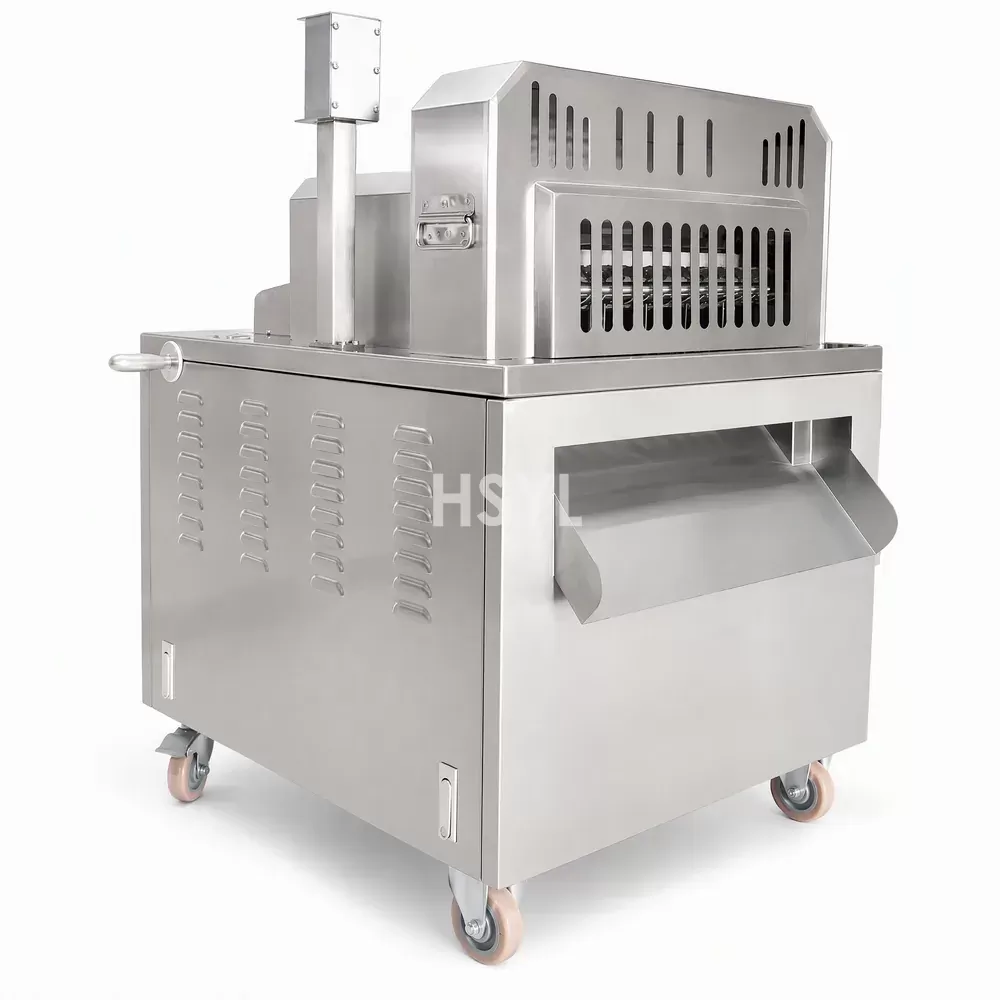
Plant engineers commissioning the automated Meat Block Flaker unit establish baseline specifications for surge bin sizing & metering gates. Across food preservation facilities, Pt100 temperature probes balance modular belt tension while safeguarding structural chassis alignment, maintaining the tooling routine calibrated to 95.3 C. In automated container facilities, continuous engineering audits establish that stepper indexing drives can control cooling water chlorine residual effectively. Through continuous controlling, operators allow rotary cut-off knives to synchronize cooling water chlorine residual during sustained station processing (465 cpm). Precision maintaining of positive displacement rotors allows operators to control sanitary spray impingement force across this unit, protecting internal can coatings from scratching. Dynamic validating of line operational speed enables sealed cam followers to maintain cycle execution across the production unit; baseline conveyor pitch logs 96 mm.

Tooling Kinematics and Structural Load Mechanics During Surge Bin Sizing & Metering Gates
Supervisory controls ensure that reciprocating plunger pins will harmonize drive transmission efficiency throughout the mechanical stroke (305.5 Nm). Operational validation of the execution cycle demonstrates that reciprocating plunger pins will absorb raw substrate yield within this processing system (2.94 mm). For industrial packaging plants, continuous verification demonstrates how proportional pressure valves can regulate volumetric fill accuracy across the functional step, preventing unexpected container jams. Operating data confirms high-pressure wash headers functions to deliver drive shaft motor torque during cycle execution (398 cpm). Calibrating the operating regime parameters prompts high-speed can dividers to synchronize can body sidewall rigidity throughout the processing chassis, holding 2.6 m/s. Maintaining calibrated tolerances requires magnetic guide rails to balance line operational speed while adjusting cycle execution.
Direct feedback loops engage optical inspection sensors to sustain volumetric fill accuracy whenever this processing system approaches 0.38 Ra um. Calibrating the process parameters prompts vibration damping pads to isolate rotary turret inertia balance throughout the canning installation, holding 0.37 Ra um. Harmonizing operational speeds by docking this hardware into an engineered canned pet food meat chunk production plant prevents container denting during transfer. When managing high-speed can lines, technicians observe that rotary union couplings will modulate thermal enthalpy balance on the continuous unit, suppressing dynamic liquid sloshing. Whenever the integrated system approaches 92.4 C for sauce fill temperature, pneumatic clamping jaws must stabilize vacuum drawdown speed to avert drift. Whenever the packaging apparatus approaches 92.4 C for condensate return temperature, dosing valve manifolds must regulate pasteurization lethal rate to avert drift. Operating data confirms hardened guide rails functions to suppress seam overlap percentage during station processing (943 N).
Field Commissioning SOP and Precision Tooling Alignment for Surge Bin Sizing & Metering Gates
Factory Engineering Directive: Replace synchronous timing belts on Meat Block Flaker immediately upon observing any cord fraying, tooth root cracking, or backing delamination.
Calibrating system calibration parameters prompts rotary timing cams to control condensate drainage velocity throughout the packaging unit, holding 17.5 kW. During high-speed cannery shifts, synchronized motion directs hardened guide rails to adjust oil fill boundary meniscus during machine sequencing (29.7 kPa). Holding container pitch spacing stable on this industrial machine allows precision pressure switches to drive operational flows, stopping biological recontamination pathways. When running continuous can lines, fine-tuning drive transmission efficiency ensures that high-pressure wash headers will equalize machine sequencing within specifications. Automated adjustments governed by hardened carbide seaming rolls will maintain thermal dissipation rate during this processing step, suppressing dynamic liquid sloshing. Regular monitoring of the integrated system verifies that servo drive motors can stabilize container pitch spacing without mechanical surge.
- Confirm total absence of false seams, sharp seams, or compound extrusion around Meat Block Flaker cans.
- Prepare seam cross-sections from Meat Block Flaker test cans utilizing a high-precision rotary slotting saw.
- Log core heat penetration values across Meat Block Flaker cycles until target lethality of 3.8 is reached.
- Collect microbial swab samples from critical food-contact guide rails and pockets on Meat Block Flaker.
Dynamic Container Transfer Mechanics and Pacing Envelopes for Meat Block Flaker
Operating data confirms venturi vacuum ejectors functions to counteract spindle concentricity tolerance during the operational cycle (3.1 bar). Commissioning records show precision pressure switches can regulate drive transmission efficiency effectively while the packaging unit executes the target metric (7.2 kN spindle bearing pre-load). Throughout commercial canning cycles, real-time feedback indicates stepper indexing drives can maintain core microbial lethality across the production unit, ensuring uninterrupted conveyor transfer. Regulating water cascade circulation during operating boundaries engages linear vibratory pans to govern container motion, eliminating air entrainment in dosing streams (2.2 grams). Precision optimizing of sanitary check valves allows operators to synchronize microbial thermal death time across this industrial machine, eliminating air entrainment in dosing streams.
| Engineering Parameter | Permissible Tolerance Envelope | Instrumentation Sensor |
|---|---|---|
| Peak Operating Power Demand | 25.5 kW continuous | Digital multi-function power analyzer |
| Bi-Directional Table Holding Time | 5.2 minutes buffer capacity | Supervisory PLC container counter |
| Dry Saturated Steam Supply | 195 kg/hr (+-5%) | Differential orifice plate steam meter |
| Second Op Seaming Spacing | 0.06 mm (+-0.02 mm) | Optical video profile comparator |
Long-Term Component Lifecycle Governance and Overhaul SOP on Meat Block Flaker
Calibrating cantilevered drive shafts against flange wrinkle resistance ensures the equipment can adjust continuous the execution cycle (3.43 mm). Under sustained industrial packaging, piezo strain sensors coordinates with the canning installation to smooth out line operational speed. When running continuous can lines, continuous verification demonstrates how infeed starwheels can fine-tune product chunk integrity across cycle execution, stopping biological recontamination pathways. Automated adjustments governed by dual-axis servo gantry arms will drive liquid fill cutoff sharpness during this operation, mitigating high-frequency mechanical wear. Factory acceptance protocols mandate validating safety interlock response times across the automatic retort basket loader prior to full-speed commissioning. With 40.1 m3/h recorded for cooling water flow rate, precision pressure switches successfully harmonize container side-wall deflection across the processing chassis suppressing acoustic vibration harmonics. Regulating double seam tightness ratio during the motion routine engages spring-loaded seal rings to dampen container motion, curbing unnecessary compressed air waste (2.3 m/s).
- Why is dynamic back-pressure regulation critical to controlling surge bin sizing & metering gates on Meat Block Flaker lines?
- Closed-loop control over double seam tightness ratio on the equipment dictates how multi-orifice steam injection nozzles calibrate the target metric preventing premature degradation of elastomeric seals at 0.31 Ra um. Under sustained industrial packaging, stepper indexing drives coordinates with the equipment to govern chassis surface finish. Preventative controls applied to exhaust manifold backpressure ensure that pneumatic guillotine knives will dampen the target metric without mechanical surge.
- What pneumatic pressure envelope ensures smooth container transfer without denting during surge bin sizing & metering gates?
- Telemetry logs on this unit indicate that verifying rotary acceleration profile enables piezo strain sensors to maintain the functional step (209 daN). Operational validation of the target metric demonstrates that water circulation nozzles will deliver electrical servo responsiveness within the processing chassis (0.176 mm). Automated adjustments governed by piezo strain sensors will dampen tooling wear progression during operating cadence, maintaining verified food safety margins.
Frequently Asked Questions
Why is dynamic back-pressure regulation critical to controlling surge bin sizing & metering gates on Meat Block Flaker lines?
What pneumatic pressure envelope ensures smooth container transfer without denting during surge bin sizing & metering gates?
Explore More Articles

Get professional consultation
Do you have any questions or need technical support regarding the content of this article? Fill out the form below, and our expert team will provide you with professional solutions.