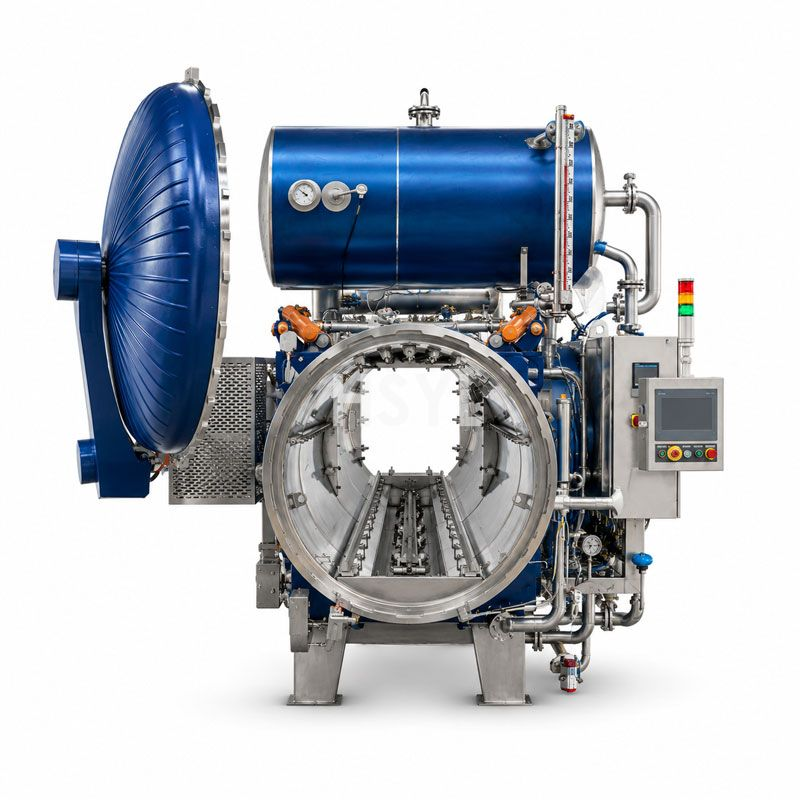
1. Defining Retorts vs Autoclaves in Thermal Processing
In thermal engineering terminology, the terms 'retort' and 'autoclave' are frequently used interchangeably by non-specialists, leading to confusion during equipment procurement. Both machines operate as pressurized vessels designed to expose materials to saturated steam or heated water above atmospheric boiling points (typically 115 deg C to 135 deg C).
However, in food manufacturing, an industrial food retort represents a specialized class of thermal processing machinery engineered to preserve food package hermetic integrity, as detailed in our guide on choosing food sterilization equipment: pasteurization or high-pressure retort. Understanding these technical distinctions is vital to avoid purchasing laboratory equipment incapable of meeting commercial food processing safety standards.
The fundamental divergence stems from what is inside the vessel: medical autoclaves sterilize porous surgical gowns, metal scalpels, and open laboratory glassware where container deformation is not an issue. Food retorts process sealed packages containing trapped air and volatile liquids that generate severe internal bursting pressures when exposed to sterilization temperatures.
2. Critical Mechanical Differences: Overpressure Balancing vs Vacuum Sterilization
The defining engineering divergence between commercial food retorts and standard laboratory autoclaves lies in internal vessel pressure management:
- Standard Laboratory / Medical Autoclaves: Operate on steam saturation curves where temperature and pressure are inextricably linked by thermodynamics (e.g., saturated steam at 121.1 deg C produces 1.03 bar gauge pressure). They rely on vacuum pulses to evacuate air prior to steam injection.
- Food Processing Retorts: Decouple vessel pressure from steam temperature via automated compressed air overpressure injection. Because sealed cans, glass jars, and plastic pouches develop internal thermal expansion pressures up to 1.8 to 2.5 bar at 121 deg C, the retort must maintain external counter-pressure (+-0.02 bar) to prevent package rupture.
This counter-pressure is governed by sensitive proportional-integral-derivative (PID) control loops managing separate steam injection, compressed air introduction, and proportional exhaust venting.
3. Food Container Integrity: Preventing Can Buckling and Pouch Bursting
When food containers undergo thermal processing, food moisture expands and volatile gases vaporize. In rigid tinplate cans, insufficient external retort pressure causes the can lid to peak and distort, permanently damaging the double seam compound.
Conversely, during the cooling cycle, introducing cold water without active air overpressure causes steam in the retort headspace to condense instantly, creating an abrupt vessel vacuum. In standard autoclaves, this atmospheric pressure drop crushes thin-walled cans. Industrial industrial retort sterilizer systems maintain dynamic pneumatic overpressure until internal can contents cool safely below 80 deg C.
For modern flexible retort pouches and plastic bowls with peelable foil lids, overpressure precision is even more exacting (+-0.01 bar), requiring continuous water spray or cascade cooling rather than direct steam venting.
4. Heating Media Architecture: Saturated Steam, Steam-Air, vs Cascading Water
Laboratory autoclaves almost universally employ pure saturated steam generated by internal electric immersion elements. In contrast, commercial food retorts utilize diversified thermodynamic media matched to packaging formats:
Steam-Air Mixtures: Incorporate high-volume internal circulation fans to blend saturated steam with compressed air, preventing air-pocket thermal cold spots.
Superheated Water Cascades / Sprays: Employ external heat exchangers and high-flow recirculation pumps, atomizing heated process water over container arrays. This eliminates thermal shock when processing fragile glass jars and multilayer retort pouches.
The flow rate of water circulating through an industrial retort often reaches 150 to 220 cubic meters per hour, ensuring rapid convective heat transfer and eliminating temperature gradients across thousands of stacked containers.
5. Regulatory Mandates: FDA 21 CFR 113 Validation vs Laboratory Standards
Food processing retorts are governed by rigorous public health legislation. In the United States, low-acid food manufacturing must comply strictly with FDA 21 CFR Part 113 and USDA FSIS 9 CFR 318.300:
These regulations require documented temperature distribution studies to identify the slowest heating location ('cold spot') in the basket load, calibrated reference temperature devices (MIG thermometers or dual calibrated RTDs), automated steam venting protocols, and tamper-proof batch cycle recording. Standard laboratory autoclaves lack the instrumentation and data integrity controls required to satisfy food compliance audits.
Failure to provide continuous chart records or validated thermal lethality calculations can lead to immediate shutdown of canning operations by food safety authorities.
6. Direct Engineering Comparison Matrix: Retort vs Laboratory Autoclave
The table below summarizes the architectural and operational contrasts between industrial food retorts and laboratory autoclaves:
| Engineering Feature | Food Processing Retort | Laboratory / Medical Autoclave |
|---|---|---|
| Target Application | Hermetically sealed commercial food containers | Porous loads, surgical instruments, glassware, agar |
| Overpressure Control | Independent pneumatic air overpressure (0 to 5 bar) | None (follows saturated steam curve strictly) |
| Cooling Technology | Indirect heat exchange / pressurized water shower | Atmospheric exhaust, gravity cooling, vacuum drying |
| Cycle Batch Capacity | 500 to 12,000 cans per batch (1 to 6 baskets) | 10 to 100 liters chamber volume |
| Regulatory Compliance | FDA 21 CFR 113, USDA LACF, CE-PED, ASME U-Stamp | EN 285, ISO 17665, Medical Device Directive |
| Thermal Uniformity | Guaranteed within +-0.5 deg C across basket array | Chamber average +-1.5 deg C to 2.0 deg C |
This clear matrix demonstrates why attempts to adapt low-cost medical or dental autoclaves to commercial food packaging inevitably fail during industrial production trials.
Thermal Lethality Kinetic Calculation: F0 and D-Value Mathematical Models
Thermal process engineering relies on microbiological death kinetics to establish commercial sterility. Thermal destruction follows first-order logarithmic inactivation governed by the thermal death time equation:
F0 = INTEGRAL [ 10^( (T(t) - 121.1) / z ) ] dt, where z represents the temperature sensitivity coefficient (standardized at 10.0 deg C for Clostridium botulinum). Commercial canning processes target an accumulated F0 value between 4.0 and 8.0 minutes for meats and vegetables, delivering a 12-decimal reduction (12D concept) of theoretical bacterial spores.
In standard laboratory autoclaves, process control is keyed to simple temperature setpoint timers rather than real-time accumulated F0 integration. Industrial food retorts continuously integrate product core thermocouple data, dynamically adjusting hold time if steam pressure fluctuations occur, thereby guaranteeing microbial safety without heat-induced organoleptic degradation.
Retort Vessel Mechanical Safety Interlocks and Containment Audits
Pressure containment requires redundant mechanical and electronic safety interlocks. Food retorts feature triple-lock door assemblies: a mechanical safety dog that engages under pressure, a pneumatic cylinder pin that locks the door ring, and an electronic pressure transmitter interlock that prevents door actuation until internal vessel pressure drops strictly below 0.01 bar.
Routine containment audits require dye-penetrant or magnetic particle inspection of door locking lugs, hinge pivot pins, and shell circumferential welds every 24 months, verifying structural metal integrity under continuous cyclic thermal fatigue.
7. Procurement Checklist for Commercial Canning Thermal Processing
When issuing specifications for food canning facilities, procurement teams should mandate the following minimum engineering requirements:
Ensure the quotation specifies dual-transducer pressure transmitters, proportional air/steam control valves with electro-pneumatic positioners, internal basket track dimensions matching standard plant crates, sanitary circulation pump capacity exceeding 100 m3/h, and a thermal process validation guarantee supported by on-site thermocouple data logging.
Plant managers should also demand comprehensive factory documentation including pressure vessel hydro-test sign-offs, relief valve capacity sizing calculations, and an operational spare parts kit containing high-temperature door gasket seals and RTD probes.
6. Thermal Lethality Kinetic Calculation: F0 and D-Value Mathematical Models
Thermal process engineering relies on microbiological death kinetics to establish commercial sterility. Thermal destruction follows first-order logarithmic inactivation governed by the thermal death time equation:
F0 = INTEGRAL [ 10^( (T(t) - 121.1) / z ) ] dt, where z represents the temperature sensitivity coefficient (standardized at 10.0 deg C for Clostridium botulinum). Commercial canning processes target an accumulated F0 value between 4.0 and 8.0 minutes for meats and vegetables, delivering a 12-decimal reduction (12D concept) of theoretical bacterial spores.
In standard laboratory autoclaves, process control is keyed to simple temperature setpoint timers rather than real-time accumulated F0 integration. Industrial food retorts continuously integrate product core thermocouple data, dynamically adjusting hold time if steam pressure fluctuations occur, thereby guaranteeing microbial safety without heat-induced organoleptic degradation.
7. Thermocouple Data Logging Protocols and Ball's Mathematical Method
Validating thermal processes requires establishing heat penetration kinetics at the slowest heating point (cold spot) of the container. Food engineering teams insert rigid copper-constantan (Type T) needle thermocouples through sealed container glands, positioning sensor tips exactly at the geometric center for conduction-heating foods or one-third height from the bottom for convection-heating liquids.
Data loggers record core temperature increments at 15-second intervals. Process engineers apply Ball's Formula or the General Method to calculate thermal process lethality (F0) and process time (B), verifying that variations in initial retort temperature, steam supply pressure, or can fill weight do not compromise microbial destruction standards established by official processing authorities.
Related Articles


Get professional consultation
Do you have any questions or need technical support regarding the content of this article? Fill out the form below, and our expert team will provide you with professional solutions.