La física de la vibración en el corte ultrasónico
Cuando los fabricantes describenultrasonic cutting machines, they typically say the blade vibrates at high frequency and cuts cleanly. That's technically accurate but mechanically incomplete. It doesn't explain why a vibrating blade outperforms a sharp stationary one, or why frequency choice matters more than blade sharpness for specific applications.

El corte ultrasónico funciona mediante tres mecanismos simultáneos en cada ciclo de corte:
- Reducción del coeficiente de fricción — The blade tip oscillates at 20,000 cycles per second, meaning the food product never maintains continuous contact with the blade surface. Each microsecond of contact is interrupted by the vibration displacing the food relative to the blade.
- Desplazamiento localizado del material — The high-frequency oscillation creates microscopic gaps at the blade-food interface. This eliminates the compression wave that conventional blades generate ahead of the cutting edge, which causes cellular structure damage in soft products like cakes and processed meats.
- Cuchilla con superficie autolimpiante — Products with high sugar, fat, or moisture content do not adhere to a vibrating blade the way they stick to stationary steel. The vibration continuously breaks any adhesive bond forming between the food surface and the blade, preventing fouling during continuous operation.
The practical result: a multi-layered cream cake cut with a conventional blade shows compressed, smeared layers at the cross-section. The same cake cut with an industrial ultrasonic cutting system at correct parameters displays clean, vertical layer separation with no visible evidence of the cutting action. This difference directly affects retail packaging appearance and consumer selection decisions.
La importancia de la selección de frecuencia
Most industrial ultrasonic cutting systems operate at either 20kHz or 40kHz. Some dual-frequency systems offer both options. The frequency is not a marketing decision—it directly constrains the blade geometries that are physically possible and the product types the system can handle effectively.
El desafío de la longitud de onda en frecuencias elevadas
Higher frequencies generate shorter acoustic wavelengths. At 40kHz, the wavelength in titanium is approximately 122mm. At 20kHz, the wavelength is approximately 245mm. This matters because the blade (called a sonotrode) must be acoustically resonant—it must be an integer multiple of half-wavelengths long to maintain efficient energy transfer from the transducer to the cutting edge.
A 40kHz, la menor longitud de onda implica una longitud máxima práctica de cuchilla más reducida.40kHz systems work well for shallow cuts under 50mm depth with narrow blade widths. 20kHz systems can accommodate blades 150-200mm long and 40-60mm wide. If you need to cut a 100mm-deep frozen meat block, 20kHz is effectively your only option with standard acoustic geometries.
Matriz de Selección de Frecuencia según el Producto
| Tipo de producto | Frecuencia Recomendada | Justificación Técnica |
|---|---|---|
| Bloques congelados de más de 80 mm de espesor | 20kHz | Requiere una geometría de cuchilla resonante más alargada |
| Pasteles blandos de menos de 50 mm de altura | 40 kHz aceptable | Shallow penetration allows compact blade design |
| Carnes fibrosas de músculo entero | 20kHz | Higher amplitude needed to separate collagen structures cleanly |
| Postres de capas múltiples con relleno de crema | 40kHz | Clean cross-section priority with minimal penetration depth |
| Quesos duros curados | 20kHz | Una matriz densa requiere la máxima transferencia de energía de vibración |
| Chocolates y productos de confitería | 40kHz | Clean edge definition critical with low cutting resistance |
A common misjudgment buyers make: selecting a 40kHz system because higher frequency implies greater precision, then discovering the blade cannot physically penetrate their product to the required depth. Always validate the available blade geometry against your maximum cutting depth requirement before committing to a frequency.
Comprendiendo el Rendimiento del Transductor durante el Funcionamiento Continuo
The ultrasonic transducer converts electrical energy into mechanical vibration through piezoelectric stacks. Most spec sheets quote efficiency figures (typically 92-96% for industrial units) without explaining what that thermal reality means during extended operation.
Ninety-six percent efficiency sounds excellent, but 4% of a 2,000-watt system is 80 watts of heat that must be dissipated from the piezoelectric stack interface. This heat concentrates at the transducer-to-blade junction. Without adequate cooling, temperature rise causes the piezoelectric elements to shift their resonant frequency by approximately 50-200Hz per 10°C change.
A system tuned to 20,000Hz at start of shift might drift to 19,850Hz after four hours of continuous operation. That 150Hz deviation represents approximately 0.75% frequency offset—enough to reduce cutting efficiency noticeably and increase required cutting force. Operators notice the blade "working harder" in the final hours of a production run, often attributing it to blade wear when the actual cause is thermal drift.
Requisitos de Gestión Térmica según la Duración del Turno
| Modo de Funcionamiento | Requisitos de Refrigeración | Desviación de Frecuencia Esperada |
|---|---|---|
| Turno único inferior a 6 horas | Convección pasiva es suficiente | Menos de 100 Hz durante todo el turno |
| Dos turnos (8-12 horas) | Se requiere refrigeración por aire forzado | 100-200 Hz durante todo el turno |
| Tres turnos o producción continua (16+ horas) | Camisa de enfriamiento activo por agua indispensable | Under 100Hz with active cooling |
Paralíneas de producción para panificación running two or three shifts, active transducer cooling is not optional—it is essential for consistent cutting quality throughout the operating period.
Mecanismos de desgaste del sonotrodo y cronograma de sustitución
Equipment spec sheets list sonotrode (blade) lifespan at 3-5 years under standard maintenance protocols. That range is accurate but incomplete. The actual lifespan depends on specific failure mechanisms that determine whether you achieve the short end or the long end of that range.
Desplazamiento en la configuración modal por desgaste gradual
As the titanium blade tip wears through continuous contact with abrasive food materials—particularly frozen vegetables, grain-based products, or anything with crystalline inclusions—the blade's effective mass distribution changes. This shifts the resonant mode shape. The blade remains resonant but no longer at its original designed frequency with maximum amplitude at the tip.
A blade resonant at 20,000Hz with a 15-micron tip amplitude at installation might develop a secondary node point 5-8mm from the tip after 2,000 operating hours. The blade continues to function but operates less efficiently. Cutting force requirements increase, energy consumption per cut rises, and product cross-section quality gradually deteriorates.
Most operators do not recognize this gradual degradation pattern. They attribute increased cutting resistance to general dullness and replace blades still operating at 40-50% of their original efficiency. This calendar-based replacement approach wastes significant maintenance budget.
Criterios de Reemplazo Basados en el Estado de la Cuchilla
- El consumo de corriente del motor servo se incrementa 15%+ por encima de la línea base manteniendo los mismos parámetros de corte
- La deriva de frecuencia excede los 200 Hz con respecto al punto de calibración original de fábrica
- Alteración geométrica visible en la punta de la cuchilla superior a 0,3 mm con respecto a las dimensiones originales
- Variación audible en el sonido de corte (se torna más rugoso o presenta signos de sobreesfuerzo)
- La calidad de la sección transversal del producto se deteriora aunque se confirmen los parámetros de corte correctos.
If your maintenance protocol uses calendar-based blade replacement without monitoring these parameters, you are likely discarding blades with substantial remaining operational life.
El Costo de Cambio de Formato que los Compradores Sistemáticamente Subestiman
Ultrasonic cutting systems are not inherently slow at product changeover, but the way they are typically specified creates hidden time penalties that do not appear in equipment quotes or throughput specifications.
Most dual-frequency systems require physical replacement of the blade and booster assembly to switch between 20kHz and 40kHz operation. This mechanical changeover takes 15-30 minutes plus the re-tuning time required after reassembly. If your production schedule requires switching between product types requiring different frequencies multiple times per shift, you need to account for 30-90 minutes of changeover time daily.
The financial impact: consider two scenarios for a facility running both frozen meat blocks (requiring 20kHz) and soft desserts (suitable for 40kHz) across two shifts. Option A uses one dual-frequency system with daily frequency changes. Option B uses two dedicated single-frequency machines.
| Concepto de Costo | Opción A: Sistema Único de Doble Frecuencia | Opción B: Dos máquinas exclusivas |
|---|---|---|
| Coste de capital del equipamiento | Una unidad de gama alta ($180,000) | Two standard units ($150,000 each = $300,000) |
| Tiempo de reconversión por turno | 45 minutos al día | Cero (máquinas dedicadas a producto) |
| Coste anual de reconversión (a $150/h) | $16.425 al año | $0 |
| Capacidad máxima de producción por máquina | Compartidos 150 cortes/min | 150 cortes/min dedicados por máquina |
| Necesidad de inventario de cuchillas | Dos juegos de cuchillas | Un juego por máquina |
The payback period for Option B over Option A is approximately 6 years based purely on changeover time—not including the throughput advantages of dedicated equipment. The conventional assumption that one flexible machine is more economical than two dedicated machines often does not hold for high-mix production environments.
Integración en la Línea de Producción: Requisitos de la Interfaz Física
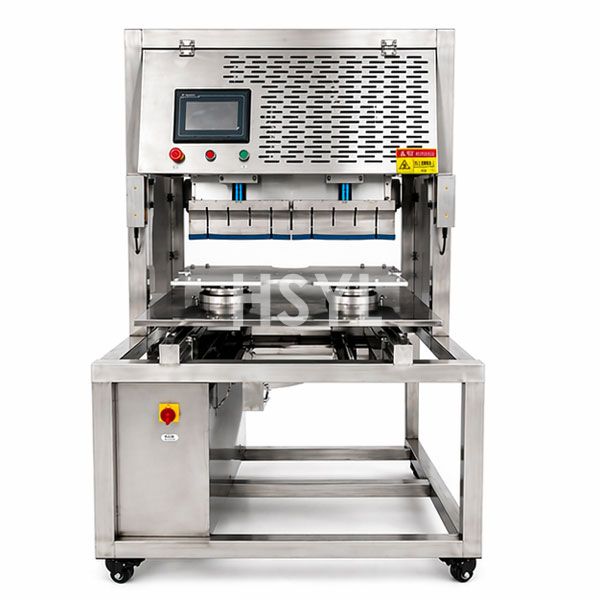
Installing an ultrasonic cutter into an existing production line requires more than finding floor space. The cutting station needs a product feeding mechanism that presents items to the blade at consistent height, angle, and spacing. It needs a reject mechanism for non-conforming pieces. It needs a discharge system for cut products. And it needs to communicate with your existing PLC for recipe parameter storage and production data logging.
Parámetros Críticos de Integración que Deben Definirse desde el Inicio
| Parámetro | Requisito Técnico | Error Común en la Planificación |
|---|---|---|
| Ángulo de corte | Vertical vs. en ángulo (generalmente 0-15° respecto a la vertical) | Assuming vertical cutting is always optimal for downstream product flow |
| Altura del transportador. | Con respecto a la línea central de la cuchilla, con tolerancia a la variación en la altura del producto. | Not accounting for product-to-product height variation within production runs |
| Mecanismo de avance de la cuchilla. | Servo-controlled stroke precision vs continuous motion cutting | Elegir el movimiento continuo cuando las paradas indexadas ofrecen mayor precisión en la posición. |
| Presentación del producto. | Alimentación por pieza individual vs alimentación continua de losa | Feeding loose pieces that shift or rotate during the cutting stroke |
| Gestión de rechazos | Retiro manual vs eyección neumática con transportador dedicado | No defined reject pathway defined before line integration begins |
Limitaciones de compatibilidad con limpieza CIP para cabezas de corte
Equipamiento industrial para el procesamiento de alimentos with SUS304 stainless steel frames and IP65-rated motors supports standard washdown cleaning protocols. However, the ultrasonic transducer and blade assembly have cleaning constraints that differ from the rest of the machine frame.
High-pressure water spray directed at the transducer housing can damage electrical connections and compromise the acoustic coupling at the blade interface. Standard Clean-In-Place protocols designed for conveyors, rollers, and food-contact surfaces require modification when an ultrasonic cutting head is part of the system. Verify the IP rating of the transducer assembly separately from the machine frame rating—the overall enclosure might be IP65 while the transducer is only IP54.
Situaciones en las que el corte ultrasónico no es la opción más adecuada
Facilities sometimes install ultrasonic cutting systems where conventional band saws, rotary knives, or water jet cutters would perform better at significantly lower cost. Ultrasonic cutting has genuine performance advantages, but those advantages only translate to value for specific product characteristics.
Productos en los que los métodos de corte convencionales generalmente resultan suficientes
- Bloques macizos uniformes — Dense, uniform materials like large cheese blocks or unlayered meat slabs without internal structure to preserve often achieve acceptable results with conventional knives at lower cost and maintenance burden
- Líneas de producción de un solo producto con volúmenes extremadamente altos — Continuous production exceeding 200 cuts per minute typically exceeds ultrasonic system maximum throughput; mechanical cutting may be the only viable high-speed option
- Productos con inclusiones rígidas integradas — Ultrasonic blades do not significantly reduce cutting force against hard objects like bone fragments, nut clusters, or candy pieces embedded in soft matrices
- Productos donde el aspecto de la sección transversal no es prioritario — Some processed meats and cheeses are dense enough that conventional cutting produces no visible cellular damage; if customers do not complain about appearance, ultrasonic offers limited value
Evaluación de Propuestas de Proveedores: Preguntas Clave para Identificar su Nivel de Experiencia
Al compararultrasonic cutting equipment proposals, these questions separate vendors who have characterized their own systems thoroughly from those reselling without deep application expertise:
- What is the frequency drift measured at the blade tip over a 6-hour continuous run at maximum amplitude? (Request actual test data, not theoretical estimates)
- ¿Cuál es la amplitud en micrones en la punta de la cuchilla a la frecuencia operativa estándar bajo sus condiciones de carga especificadas?
- What blade replacement procedure do you recommend, what tools are required, and what is the typical time for a trained operator to complete?
- Can you provide references for your stated product applications—not generic food processing references but specific installations processing similar materials?
- What blade lifespan do you project for my specific product matrix, and how does that compare to your general specification range?
- What cleaning procedures will not damage the transducer assembly, and what IP rating is required for my sanitation environment?
- Do you include recipe development support during Factory Acceptance Testing to optimize cutting parameters for my actual products?
A vendor who cannot answer questions 1 and 2 with documented test numbers probably has not performed rigorous characterization of their own equipment. A vendor who provides specification ranges without asking about your specific product is applying generic data to a specialized application.
Framework Práctico de Decisión para la Planificación de Líneas de Producción
Before reviewing equipment specifications for ultrasonic cutting systems, answer three foundational questions:
En primer lugar: Does your product actually demonstrate visible quality improvement when cut with minimal compression damage? Obtain sample cuts on an ultrasonic system and compare against your current method with actual product samples. Most equipment suppliers will run sample cutting tests for prospective buyers using your actual materials.
En segundo lugar: What is your actual changeover frequency between different product types? If your production schedule requires switching between products that require different cutting parameters—including different frequencies—multiple times per shift, factor changeover costs into your ROI calculation. Dedicated equipment for each product family may prove more economical than flexible equipment with high changeover overhead.
En tercer lugar: Does your maintenance team have the technical capability to support ultrasonic equipment? These systems require less physical maintenance than mechanical blades (no sharpening) but demand more electrical parameter monitoring. If your technicians are uncomfortable interpreting frequency displays and evaluating drift data, budget for supplier training during installation and commissioning.
Preguntas frecuentes
¿Qué principios físicos fundamentales diferencian el corte por ultrasonidos del corte con cuchilla tradicional?
¿Cómo identifico la frecuencia óptima (20kHz o 40kHz) para mi proceso de corte específico?
¿Qué señales específicas indican que una hoja ultrasónica debe sustituirse y no simplemente recalibrarse?
¿De qué manera la deriva térmica del transductor impacta en la calidad del corte durante jornadas de producción prolongadas?
¿Cuál es el costo real de la reconfiguración del proceso al alternar el corte ultrasónico entre distintos productos?
¿Qué habilidades de mantenimiento específicas demanda un sistema de corte ultrasónico en comparación con el equipo de corte convencional?
¿Cuál es el plazo de fabricación estándar para una máquina de corte ultrasónico a medida?
¿Los cortadores ultrasónicos industriales necesitan fuentes de alimentación especializadas o servicios auxiliares específicos en la instalación?
Artículos Relacionados



Obtenga asesoramiento profesional
¿Tiene alguna consulta o necesita soporte técnico relacionado con el contenido de este artículo? Rellene el formulario que aparece a continuación y nuestro equipo de expertos le ofrecerá soluciones profesionales.