Ang Pisika ng Vibrasyon sa Likod ng Ultrasonic Cutting
Kapag inilalarawan ng mga supplierultrasonic cutting machines, they typically say the blade vibrates at high frequency and cuts cleanly. That's technically accurate but mechanically incomplete. It doesn't explain why a vibrating blade outperforms a sharp stationary one, or why frequency choice matters more than blade sharpness for specific applications.

Ang ultrasonic na pagputol ay gumagamit ng tatlong sabay-sabay na mekanismo sa bawat siklo ng pagputol:
- Pagbaba ng coefficient ng pagkiskis — The blade tip oscillates at 20,000 cycles per second, meaning the food product never maintains continuous contact with the blade surface. Each microsecond of contact is interrupted by the vibration displacing the food relative to the blade.
- Lokal na paglipat ng materyal — The high-frequency oscillation creates microscopic gaps at the blade-food interface. This eliminates the compression wave that conventional blades generate ahead of the cutting edge, which causes cellular structure damage in soft products like cakes and processed meats.
- Ibabaw ng blade na may self-cleaning na kakayahan — Products with high sugar, fat, or moisture content do not adhere to a vibrating blade the way they stick to stationary steel. The vibration continuously breaks any adhesive bond forming between the food surface and the blade, preventing fouling during continuous operation.
The practical result: a multi-layered cream cake cut with a conventional blade shows compressed, smeared layers at the cross-section. The same cake cut with an industrial ultrasonic cutting system at correct parameters displays clean, vertical layer separation with no visible evidence of the cutting action. This difference directly affects retail packaging appearance and consumer selection decisions.
Bakit ang Pagpili ng Frequency ay Hindi Basta-basta
Most industrial ultrasonic cutting systems operate at either 20kHz or 40kHz. Some dual-frequency systems offer both options. The frequency is not a marketing decision—it directly constrains the blade geometries that are physically possible and the product types the system can handle effectively.
Ang Isyu sa Wavelength sa Mas Mataas na Frequencies
Higher frequencies generate shorter acoustic wavelengths. At 40kHz, the wavelength in titanium is approximately 122mm. At 20kHz, the wavelength is approximately 245mm. This matters because the blade (called a sonotrode) must be acoustically resonant—it must be an integer multiple of half-wavelengths long to maintain efficient energy transfer from the transducer to the cutting edge.
Sa 40kHz, dahil sa mas maikling wavelength, ang pinakamahabang blade na magagamit nang praktikal ay mas maikli rin.40kHz systems work well for shallow cuts under 50mm depth with narrow blade widths. 20kHz systems can accommodate blades 150-200mm long and 40-60mm wide. If you need to cut a 100mm-deep frozen meat block, 20kHz is effectively your only option with standard acoustic geometries.
Gabay sa Pagpili ng Frequency Base sa Uri ng Produkto
| Uri ng Produkto | Inirekomendang Frequency | Teknikal na Dahilan ng Inhinyero |
|---|---|---|
| Mga bloke ng yelo na lampas sa 80mm kapal | 20kHz. | Nangangailangan ng mas mahabang resonant na disenyo ng talim |
| Mga malambot na cake na wala pang 50mm taas | 40kHz ay katanggap-tanggap | Shallow penetration allows compact blade design |
| Mga hiblang buong-kalamnan na karne | 20kHz. | Higher amplitude needed to separate collagen structures cleanly |
| Mga multi-layer dessert na may cream filling. | 40kHz | Clean cross-section priority with minimal penetration depth |
| Mga aged hard cheese. | 20kHz. | Ang makapal na matrix ay nangangailangan ng pinakamataas na paglipat ng vibrational energy. |
| Mga produktong chocolate at confectionery. | 40kHz | Clean edge definition critical with low cutting resistance |
A common misjudgment buyers make: selecting a 40kHz system because higher frequency implies greater precision, then discovering the blade cannot physically penetrate their product to the required depth. Always validate the available blade geometry against your maximum cutting depth requirement before committing to a frequency.
Pag-unawa sa Performance ng Transducer sa Mahabang Operasyon
The ultrasonic transducer converts electrical energy into mechanical vibration through piezoelectric stacks. Most spec sheets quote efficiency figures (typically 92-96% for industrial units) without explaining what that thermal reality means during extended operation.
Ninety-six percent efficiency sounds excellent, but 4% of a 2,000-watt system is 80 watts of heat that must be dissipated from the piezoelectric stack interface. This heat concentrates at the transducer-to-blade junction. Without adequate cooling, temperature rise causes the piezoelectric elements to shift their resonant frequency by approximately 50-200Hz per 10°C change.
A system tuned to 20,000Hz at start of shift might drift to 19,850Hz after four hours of continuous operation. That 150Hz deviation represents approximately 0.75% frequency offset—enough to reduce cutting efficiency noticeably and increase required cutting force. Operators notice the blade "working harder" in the final hours of a production run, often attributing it to blade wear when the actual cause is thermal drift.
Mga Pangangailangan sa Pag-manage ng Init batay sa Tagal ng Shift
| Mode ng Operasyon | Kinakailangang Sistemang Paglamig | Inaasahang Paglihis ng Dalas |
|---|---|---|
| Isang shift na mas mababa sa 6 na oras | Sapat na ang natural na daloy ng hangin | Mas mababa sa 100Hz ang paglihis sa buong shift |
| Dalawang shift (kabuuang 8-12 oras) | Kinakailangan ang forced air cooling | 100-200Hz sa buong shift ng operasyon |
| Tatlong shift o walang tigil na operasyon (tumatagal ng 16+ na oras) | Kinakailangan ang aktibong sistema ng tubig na paglamig | Under 100Hz with active cooling |
Para samga linya ng produksiyon para sa kagamitang pambakery running two or three shifts, active transducer cooling is not optional—it is essential for consistent cutting quality throughout the operating period.
Mga Dahilan ng Pagsusuot ng Sonotrode at Tamang Oras ng Pagpapalit
Equipment spec sheets list sonotrode (blade) lifespan at 3-5 years under standard maintenance protocols. That range is accurate but incomplete. The actual lifespan depends on specific failure mechanisms that determine whether you achieve the short end or the long end of that range.
Pagbabago ng Hugis ng Mode Dahil sa Posteprosesong Pagsuot
As the titanium blade tip wears through continuous contact with abrasive food materials—particularly frozen vegetables, grain-based products, or anything with crystalline inclusions—the blade's effective mass distribution changes. This shifts the resonant mode shape. The blade remains resonant but no longer at its original designed frequency with maximum amplitude at the tip.
A blade resonant at 20,000Hz with a 15-micron tip amplitude at installation might develop a secondary node point 5-8mm from the tip after 2,000 operating hours. The blade continues to function but operates less efficiently. Cutting force requirements increase, energy consumption per cut rises, and product cross-section quality gradually deteriorates.
Most operators do not recognize this gradual degradation pattern. They attribute increased cutting resistance to general dullness and replace blades still operating at 40-50% of their original efficiency. This calendar-based replacement approach wastes significant maintenance budget.
Mga Batayan para sa Pagpapalit ng Talim Batay sa Aktwal na Kalagayan
- Ang pagguhit ng kuryente ng servo motor ay tumataas ng 15%+ kumpara sa basehan kapag pareho ang mga setting ng pagputol.
- Ang pagbabago sa dalas ng vibrasyon ay lumampas na sa 200Hz mula sa orihinal na tuning nito mula sa pabrika.
- May nakikitang pagbabago sa hugis ng dulo ng talim na lampas sa 0.3mm kumpara sa orihinal nitong dimensyon.
- May kapansin-pansing pagbabago sa tunog ng pagputol (nagiging mas magaspang o 'hirap sa paggana')
- Bumababa ang kalidad ng cross-section ng produkto kahit na na-verify na ang tamang mga parameter ng pagputol.
If your maintenance protocol uses calendar-based blade replacement without monitoring these parameters, you are likely discarding blades with substantial remaining operational life.
Ang Gastos sa Pagpapalit ng Produkto na Laging Mababa ang Tantsa ng mga Buyer
Ultrasonic cutting systems are not inherently slow at product changeover, but the way they are typically specified creates hidden time penalties that do not appear in equipment quotes or throughput specifications.
Most dual-frequency systems require physical replacement of the blade and booster assembly to switch between 20kHz and 40kHz operation. This mechanical changeover takes 15-30 minutes plus the re-tuning time required after reassembly. If your production schedule requires switching between product types requiring different frequencies multiple times per shift, you need to account for 30-90 minutes of changeover time daily.
The financial impact: consider two scenarios for a facility running both frozen meat blocks (requiring 20kHz) and soft desserts (suitable for 40kHz) across two shifts. Option A uses one dual-frequency system with daily frequency changes. Option B uses two dedicated single-frequency machines.
| Gastos na Faktor | Pagpipilian A: Makinang May Dual na Frequency | Pagpipilian B: Dalawang Espesyal na Makina |
|---|---|---|
| Gastos sa Kapital ng Kagamitan | Isang high-end na yunit ($180,000) | Two standard units ($150,000 each = $300,000) |
| Oras ng Pagpapalit sa Bawat Shift | 45 minuto bawat araw | Wala (mga nakatuon na makina para sa partikular na produkto) |
| Gastos taun-taon sa pagpapalit (sa $150/oras) | $16,425 bawat taon | $0 |
| Pinakamataas na damang output bawat makina | Ibinahagi 150 pagputol/minuto | Nakatuon 150 pagputol/minuto bawat isa |
| Pangangailangan sa imbentaryo ng talim | Dalawang set ng talim | Isang kumpletong set kada makina |
The payback period for Option B over Option A is approximately 6 years based purely on changeover time—not including the throughput advantages of dedicated equipment. The conventional assumption that one flexible machine is more economical than two dedicated machines often does not hold for high-mix production environments.
Integrasyon sa Production Line: Mga Pisikal na Requirement ng Interface
Installing an ultrasonic cutter into an existing production line requires more than finding floor space. The cutting station needs a product feeding mechanism that presents items to the blade at consistent height, angle, and spacing. It needs a reject mechanism for non-conforming pieces. It needs a discharge system for cut products. And it needs to communicate with your existing PLC for recipe parameter storage and production data logging.
Mga Kritikal na Parameter ng Integrasyon na Kailangan Itakda Agad
| Sukatan | Kinakailangan ng Specification | Common na Error sa Planning |
|---|---|---|
| Anggulo ng pagputol | Patayo vs. nakahilig (karaniwang 0-15° mula sa patayo) | Assuming vertical cutting is always optimal for downstream product flow |
| Taas ng Conveyor | Kaugnay sa centerline ng talim na may allowable na pagkakaiba-iba sa taas ng produkto | Not accounting for product-to-product height variation within production runs |
| Mekanismo ng Pag-unlad ng Talim | Servo-controlled stroke precision vs continuous motion cutting | |- Pagpili ng tuloy-tuloy na galaw sa halip na naka-index na mga hintuan na magbibigay ng mas tumpak na posisyon |
| Pagsusuri at pagpapakilala ng produkto | Pakain ng hiwalay na piraso kumpara sa tuloy-tuloy na pakain ng malaking bloke | Feeding loose pieces that shift or rotate during the cutting stroke |
| Pamamahala sa mga tangging produkto | Mano-manong pag-alis kumpara sa pneumatic na pagtapon gamit ang nakalaang kumbeyor | No defined reject pathway defined before line integration begins |
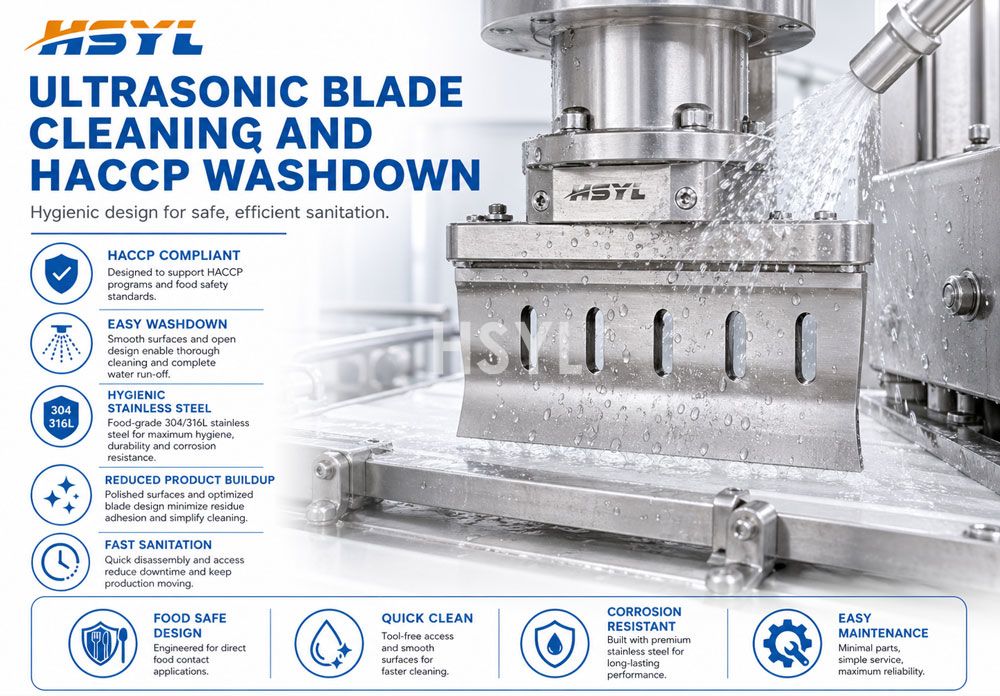
Mga Batayan ng Compatibility sa CIP para sa mga Ulo ng Pandayan
Kagamitan sa pang-industriyang pagpoproseso ng pagkain with SUS304 stainless steel frames and IP65-rated motors supports standard washdown cleaning protocols. However, the ultrasonic transducer and blade assembly have cleaning constraints that differ from the rest of the machine frame.
High-pressure water spray directed at the transducer housing can damage electrical connections and compromise the acoustic coupling at the blade interface. Standard Clean-In-Place protocols designed for conveyors, rollers, and food-contact surfaces require modification when an ultrasonic cutting head is part of the system. Verify the IP rating of the transducer assembly separately from the machine frame rating—the overall enclosure might be IP65 while the transducer is only IP54.
Kapag Hindi Ang Ultrasonic Cutting Ang Pinakamainam Na Opsyon
Facilities sometimes install ultrasonic cutting systems where conventional band saws, rotary knives, or water jet cutters would perform better at significantly lower cost. Ultrasonic cutting has genuine performance advantages, but those advantages only translate to value for specific product characteristics.
Mga Produkto Na Sapat Na Ang Karaniwang Pamamaraan Ng Pagputol
- Malalaking bloke na pantay ang pagkakagawa — Dense, uniform materials like large cheese blocks or unlayered meat slabs without internal structure to preserve often achieve acceptable results with conventional knives at lower cost and maintenance burden
- Mga linya ng iisang produktong may napakataas na dami ng produksyon — Continuous production exceeding 200 cuts per minute typically exceeds ultrasonic system maximum throughput; mechanical cutting may be the only viable high-speed option
- Mga produkto na may matitigas na nakabaong mga inclusions — Ultrasonic blades do not significantly reduce cutting force against hard objects like bone fragments, nut clusters, or candy pieces embedded in soft matrices
- Mga produkto kung saan ang hitsura ng cross-section ay hindi kritikal. — Some processed meats and cheeses are dense enough that conventional cutting produces no visible cellular damage; if customers do not complain about appearance, ultrasonic offers limited value
Pagtatasa ng Mga Proposisyon ng Vendor: Mga Tanong na Naglalantad sa Antas ng Karanasan
Sa paghahambing ngultrasonic cutting equipment proposals, these questions separate vendors who have characterized their own systems thoroughly from those reselling without deep application expertise:
- What is the frequency drift measured at the blade tip over a 6-hour continuous run at maximum amplitude? (Request actual test data, not theoretical estimates)
- Ano ang amplitude (microns) ng dulo ng talim sa karaniwang operating frequency sa ilalim ng iyong mga tinukoy na load condition?
- What blade replacement procedure do you recommend, what tools are required, and what is the typical time for a trained operator to complete?
- Can you provide references for your stated product applications—not generic food processing references but specific installations processing similar materials?
- What blade lifespan do you project for my specific product matrix, and how does that compare to your general specification range?
- What cleaning procedures will not damage the transducer assembly, and what IP rating is required for my sanitation environment?
- Do you include recipe development support during Factory Acceptance Testing to optimize cutting parameters for my actual products?
A vendor who cannot answer questions 1 and 2 with documented test numbers probably has not performed rigorous characterization of their own equipment. A vendor who provides specification ranges without asking about your specific product is applying generic data to a specialized application.
Praktikal na Gabay sa Pagpapasya para sa Pagpaplano ng Linya ng Produksyon
Before reviewing equipment specifications for ultrasonic cutting systems, answer three foundational questions:
Una: Does your product actually demonstrate visible quality improvement when cut with minimal compression damage? Obtain sample cuts on an ultrasonic system and compare against your current method with actual product samples. Most equipment suppliers will run sample cutting tests for prospective buyers using your actual materials.
Pangalawa: What is your actual changeover frequency between different product types? If your production schedule requires switching between products that require different cutting parameters—including different frequencies—multiple times per shift, factor changeover costs into your ROI calculation. Dedicated equipment for each product family may prove more economical than flexible equipment with high changeover overhead.
Pangatlo: Does your maintenance team have the technical capability to support ultrasonic equipment? These systems require less physical maintenance than mechanical blades (no sharpening) but demand more electrical parameter monitoring. If your technicians are uncomfortable interpreting frequency displays and evaluating drift data, budget for supplier training during installation and commissioning.
Mga Madalas Itanong (FAQ)
Anong mga pisikal na mekanismo ang nagpapagiba ng ultrasonic cutting sa karaniwang blade cutting?
Paano ko malalaman kung 20kHz o 40kHz ang angkop na frequency para sa aking application?
Ano ang mga tunay na indikasyon na ang isang ultrasonic blade ay kailangang palitan at hindi lang basta i-retune?
Paano nakaaapekto ang thermal drift ng transducer sa kalidad ng pagputol sa mga mahabang production run?
Ano ang tunay na halaga ng changeover kapag nagpapalit ng uri ng produkto gamit ang ultrasonic cutting?
Anong mga partikular na kasanayan sa maintenance ang kinakailangan ng ultrasonic cutting system na hindi kailangan ng karaniwang cutting equipment?
Gaano katagal ang karaniwang lead time para sa paggawa ng customized na ultrasonic cutting machine?
Kailangan ba ng mga industrial ultrasonic cutter ang espesyal na power supply o kagamitan sa pasilidad?
Mga Kaugnay na Artikulo




Kumuha ng Propesyonal na Payo
May mga katanungan ka ba o kailangan ng teknikal na suporta hinggil sa nilalaman ng artikulong ito? Sagutan ang form sa ibaba, at ang aming pangkat ng dalubhasa ay mag-aalok sa iyo ng mga propesyonal na solusyon.