Choosing between the Cooking Range 700 Series and the Cooking Range 900 Series is one of the first layout decisions a kitchen designer faces when planning a new restaurant or upgrading an existing hot-prep line. Both series sit on upright cabinet platforms with griddle, solid-top and heating options, but they serve fundamentally different kitchen footprints, utility constraints and volume requirements.
The 700 Series is built around a 700 mm cabinet depth — 200 mm shallower than the 900 Series' 900 mm platform — which makes it the default choice for compact kitchens, cafés and small central kitchens where counter-run depth is the binding constraint. The 900 Series trades that shallow footprint for a wider cooktop area, higher gas power per burner and a three-workstation architecture optimized for hotel Chinese restaurants, institutional canteens and larger central-kitchen hot-prep lines where floor space permits the deeper cabinet run.
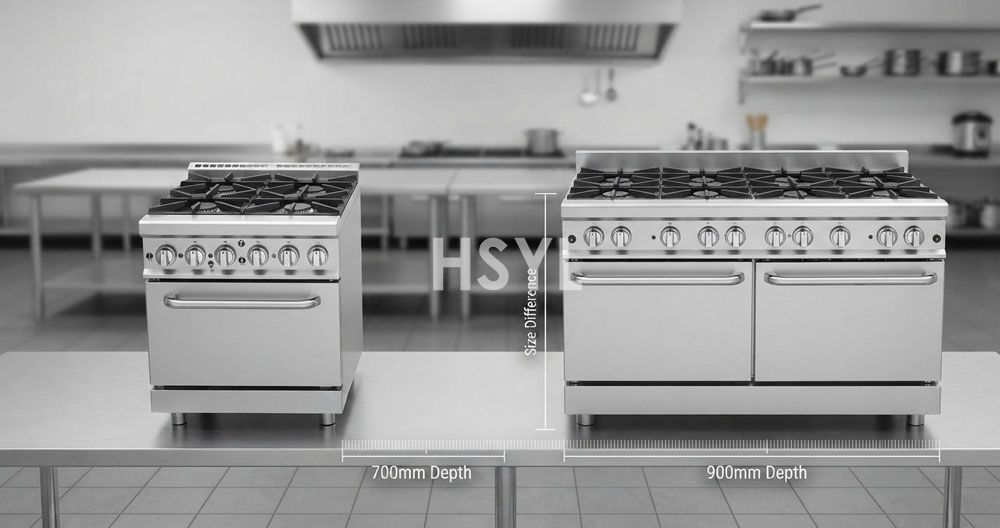
This guide compares the two series across five decision axes — cabinet depth, workstation coverage, model count, power supply options, and ideal deployment scenarios — so you can match your kitchen's physical constraints and menu volume to the correct platform without over-specifying or under-capacitating your cooking line.
1. Cabinet Depth: The 200 mm Difference That Determines Fit
| Dimension | 700 Series | 900 Series |
|---|---|---|
| Net cabinet depth | 700 mm | 900 mm |
| Net cabinet height | 920 mm | 920 mm |
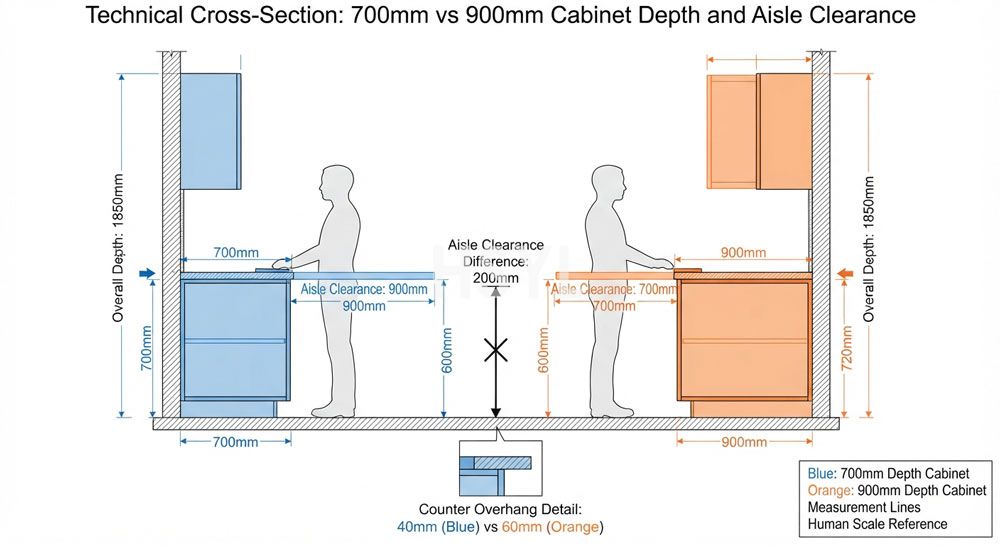
| Depth advantage | Fits behind standard 70 cm counters; preserves aisle clearance in narrow kitchens | Requires dedicated 90 cm+ counter run or island placement |
| Typical fit scenario | Boutique restaurant, café, small central kitchen, demonstration kitchen | Hotel main kitchen, hospital canteen, school cafeteria, large central kitchen |
Layout Note: The 200 mm depth difference translates directly into aisle width or seating area in compact venues. A 700 mm deep range leaves roughly 200–300 mm more walkway space than a 900 mm unit in the same kitchen footprint. If your kitchen's back-of-house aisle is narrower than 1200 mm between counter runs, the 700 Series may be the only option that meets local fire and safety egress codes.
In practice, this means the 700 Series can slot into an existing counter run originally sized for domestic or light-commercial equipment without rebuilding the cabinetry. The 900 Series requires either a purpose-built 900 mm counter run or an island layout where the deeper cabinet does not encroach on adjacent work zones.
2. Workstation Coverage: Four Families vs Three
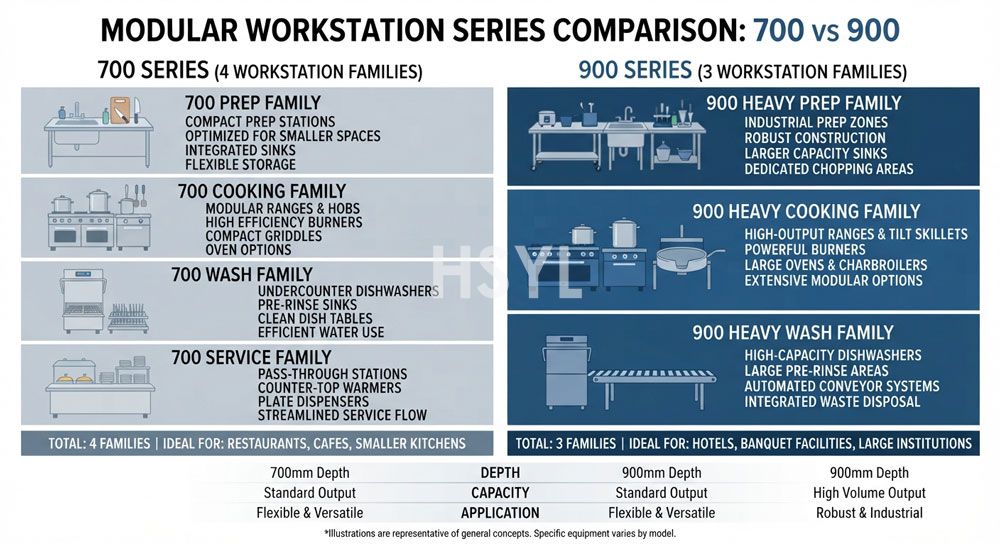
This is the most significant functional difference between the two series. The 700 Series covers four distinct workstation families across 31 models. The 900 Series covers three workstation families across 16 models, but each workstation carries higher per-burner gas power and a wider cooktop surface.
| Workstation Family | 700 Series | 900 Series |
|---|---|---|
| Stockpot / Open-burner range | No (not included) | HS — twin/four/six-burner (6 models) |
| Flat griddle | HG — single/double, gas/electric, with oven option (10 models) | HG — single/double, gas/electric, with oven option (6 models) |
| Solid top | HTP — gas/electric, with oven option (6 models) | HTP — gas/electric, with oven option (4 models) |
| Pasta cooker | HP — single/double 28 L cylinder, gas/electric (4 models) | No (not included) |
| Jacketed boiling pan | HTG — 80 L jacketed pan, gas/electric (2 models) | No (not included) |
| Tilting bratt pan | HBG — 60 L tilting pan, gas/electric (2 models) | No (not included) |
| Fryer | HF — single/double/three-tube, gas/electric (5 models) | No (not included) |
| Bain marie / Worktable | HB/HWT — holding basins and prep surfaces (7 models) | No (not included) |
| Total models | 31 | 16 |
Selection Implication: Choose the 700 Series if your menu requires pasta boiling, soup production in jacketed pans, batch braising in tilting bratt pans, deep-frying, or dish holding — all on one 700 mm deep platform. Choose the 900 Series if your primary need is high-output wok and stockpot cooking alongside searing griddle and sauce solid-top work, and you do not require fryer or pasta stations built into the same cabinet line.
3. Power Supply: 220V Option vs 380V Only
Power supply compatibility is frequently the decisive factor in retrofit projects where the existing electrical infrastructure cannot be easily upgraded.
| Power Parameter | 700 Series Electric | 900 Series Electric |
|---|---|---|
| Low-power stations | 220V / 50Hz single-phase available (HG7040-E at 2.8 kW, HB7040-E at 1.5 kW, HB7080-E at 3.0 kW) | Not available — all electric models are 380V only |
| High-power stations | 380V / 50Hz three-phase (solid top with oven, pasta cooker, jacketed pan, bratt pan, fryer) | 380V / 50Hz three-phase (all electric models) |
| Maximum electric power | 18.0 kW (HP7080-E double-cylinder pasta cooker) | 16.5 kW (HG9080VE griddle with electric oven) |
| Hybrid oven option | Gas-top + electric oven (VE) and Gas-top + gas oven (VG) both available | Gas-top + electric oven (VE) and Gas-top + gas oven (VG) both available |
Retrofit Note: If your site has 220V single-phase power but no 380V three-phase supply, the 700 Series is the only choice that gives you electric cooking stations without a costly electrical upgrade. A café or small QSR counter running HG7040-E (2.8 kW) plus HB7040-E (1.5 kW) on existing 220V circuits can deploy a complete short-order cooking station within a single afternoon.
4. Width Tiers and Capacity Scaling
| Width Tier | 700 Series Models | 900 Series Models |
|---|---|---|
| 400 mm (compact) | Single-burner griddle, single-cylinder pasta cooker, single-cylinder fryer, single-basin bain marie, prep worktable, three-tube fryer | Twin-burner stockpot (HS9040), compact griddle (HG9040) |
| 800 mm (standard) | Double-burner griddle, double-cylinder pasta cooker, double-cylinder fryer, double-basin bain marie, full worktable, jacketed pan, tilting bratt pan, solid top | Four-burner stockpot (HS9080), full-size griddle (HG9080), solid top (HTP9080) |
| 1200 mm (wide) | Not available | Six-burner stockpot (HS9120) with oven options |
The 900 Series offers a 1200 mm width tier on the HS stockpot line (six burners) that the 700 Series does not provide. This makes the 900 Series the only choice for very-high-volume wok or stockpot stations where six simultaneous burners are required — typical of hotel Chinese-restaurant main kitchens serving 200+ covers per service.
5. When to Choose the 700 Series
- Compact restaurant or bistro kitchen — Your counter-run depth is 700 mm or less, and you need griddle, fryer, pasta-boiling and holding stations in one flush line without step joints.
- Café or quick-service upgrade — You have 220V single-phase power only and cannot justify a 380V three-phase electrical upgrade for a few kilowatts of cooking load.
- Small central kitchen or ghost kitchen — You need batch braising (HBG60 tilting bratt pan), soup production (HTG80 jacketed pan), frying (HF7080 double-cylinder fryer) and holding (HB7080 double-basin bain marie) on a shallow 700 mm platform that preserves aisle clearance.
- Demonstration or teaching kitchen — The shallower 700 mm depth lets an instructor stand behind the line while students observe from the front, with better sightlines than a 900 mm deep unit would permit.
Budget-constrained first build — The 700 Series lower-power 220V stations have a lower installed cost (no three-phase panel upgrade, smaller circuit breakers) while still delivering commercial-grade output for menus under approximately 150 covers per service.
6. When to Choose the 900 Series
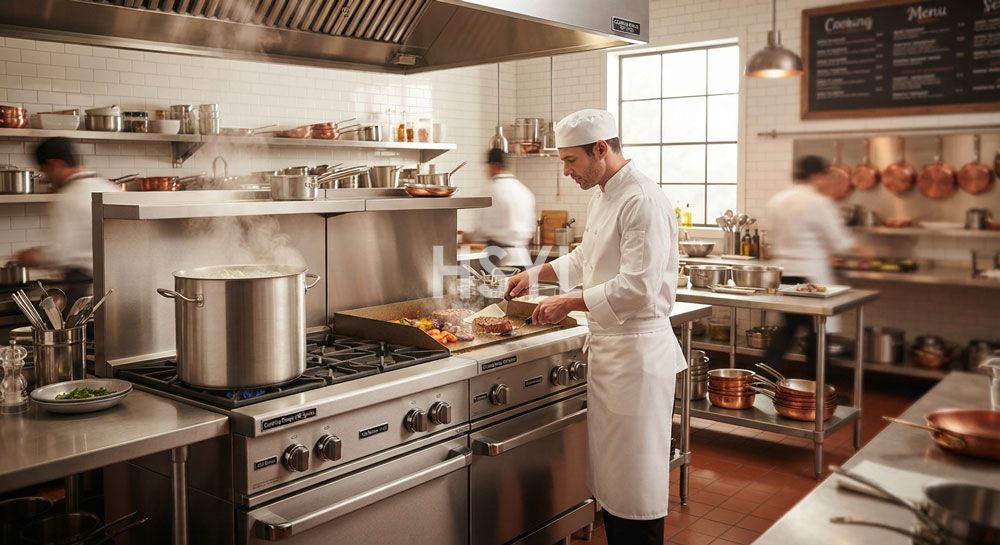
- Hotel Chinese-restaurant main kitchen — You need HS stockpot ranges with four to six open burners for wok work alongside HG griddles and HTP solid tops, all on a coordinated 900 mm platform with optional ovens below.
- Central kitchen hot-prep line — You are designing a dedicated hot-prep module with floor space allocated specifically for a 900 mm deep counter run, and your menu volume justifies the higher per-burner gas output (up to 41 kW on the HS9120VG-G six-burner model).
- Hospital or institutional canteen — You require all-electric operation (no gas) and can provision 380V three-phase power throughout the kitchen. The 900 Series electric HG and HTP models deliver stable high-power output without any gas connection.
- School cafeteria or large-scale catering — You need the 1200 mm six-burner HS9120 platform for high-volume congee and soup production, with integrated oven capacity for batch baking and roasting beneath the cooktop.
- Upgrade from an existing 700 Series line — Your current 700 Series layout has reached its capacity ceiling and you need to step up to wider cooktops and higher gas output without changing brand or retraining staff on different controls and workflows.
7. Cost and Value Considerations
| Cost Factor | 700 Series Profile | 900 Series Profile |
|---|---|---|
| Equipment unit cost | Lower per-station on compact models (400 mm width, lower power) | Higher per-unit due to larger cooktop area and heavier construction |
| Electrical installation | 220V stations use existing single-phase circuits; minimal upgrade cost | All electric models require 380V three-phase panel — higher upfront electrical cost |
| Gas connection | Lower total gas load (max ~28 kW on HF7040-3G three-tube fryer) | Higher total gas load (up to 41 kW on HS9120VG-G); may require upsized gas meter or regulator |
| Capacity per linear meter | More workstation types per meter of counter run (four families on 700 mm depth) | Fewer workstation types but higher output per workstation (larger burners, wider plates) |
| Long-term value angle | Labor efficiency through multi-station integration on one shallow platform; lower retrofit barrier for sites upgrading from domestic equipment | Higher throughput per operator on wide cooktops; step-up path for growing operations that started on 700 Series |
Value Angle: Neither series is universally "better" — the correct choice depends on whether your binding constraint is physical depth (favoring 700) or output-per-station (favoring 900). A common mistake is overspecifying the 900 Series for a compact kitchen that would actually achieve higher overall throughput with a 700 Series multi-station line fitting more workstations into the same counter length.
Related Equipment for Your Cooking Line
Both the 700 Series and 900 Series integrate with HSYL's broader kitchen equipment solutions portfolio. These resources are typically evaluated alongside your range selection:
- Commercial Kitchen Equipment Hub — Complete overview of HSYL's commercial kitchen product categories including refrigeration, ice makers, sterilizers and preparation equipment to complement your cooking range selection.
- Cooking Range 700 Series Product Page — Full specification tables for all 31 models across the four 700 Series workstation families, with dimensions, power ratings and capacity data.
- Sandwich Griddle 37E / 41E / 57E — Compact countertop griddle option for breakfast and sandwich stations where a full upright range is not required.
- Full-View Electric Oven — Complementary baking and roasting oven for kitchens that need dedicated oven capacity separate from the range-integrated VG/VE oven options.
- How to Choose Commercial Kitchen Equipment for a Central Kitchen — Planning guide covering capacity calculation, equipment zoning, and vendor evaluation for buyers scoping a complete kitchen equipment package.
Frequently Asked Questions
What is the main difference between Cooking Range 700 Series and 900 Series?
Which cooking series should I choose for a compact café kitchen?
Can I install a 900 Series in a kitchen with only 220V power?
Does the 700 Series support wok cooking like the 900 Series?
How many models are available in each series?
What widths are available for each series?
Can I mix 700 Series and 900 Series units in the same kitchen?
Which series is better for a hotel Chinese restaurant kitchen?
Related Articles



Get professional consultation
Do you have any questions or need technical support regarding the content of this article? Fill out the form below, and our expert team will provide you with professional solutions.