What a Canned Fish Production Line Layout Must Achieve
A canned fish production line layout has one non-negotiable constraint that a layout for dry food, bakery, or beverage lines does not: raw fish and sterilized canned product must never share the same air, the same personnel path, or the same equipment surface. The layout is not primarily about equipment position — it is about creating a physical barrier between the raw-material zone and the post-retort zone, with a unidirectional product flow that makes cross-contamination physically impossible, not just procedurally controlled.When estimating capital expenditures across filling, seaming, and batch retorts, review our comprehensive analysis on fish canning line cost breakdown.
This article walks through the layout of a canned fish production line from raw fish receiving at the dock to the retort sterilization stage and post-retort cooling and packing. It covers sardine, tuna, and mackerel canning — the three most common canned fish products. The layout principles described apply to any fish species, but the equipment footprint, throughput, and utility demand vary by species, fish size, and can format.
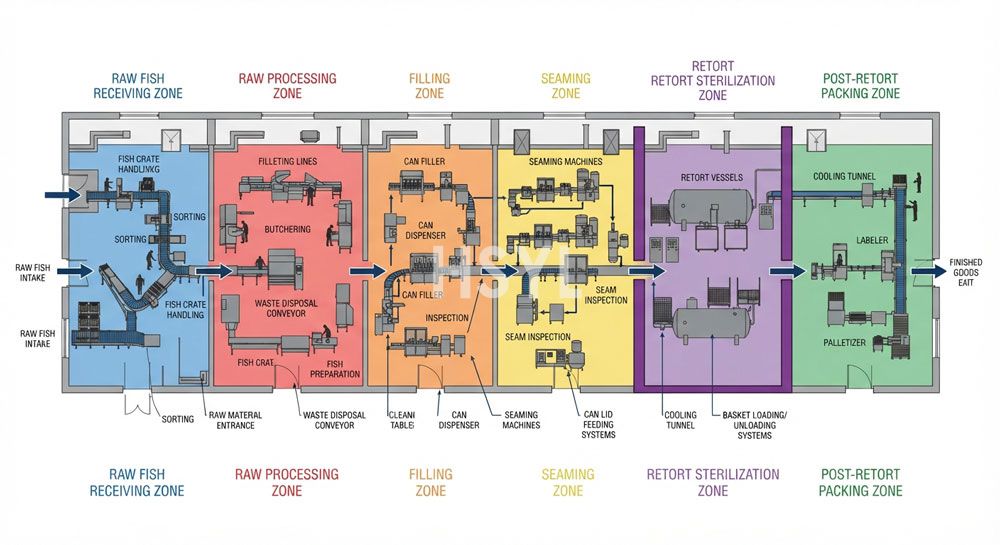
The layout is designed on the straight-line principle: raw fish enters at one end of the building, processed and sterilized cans exit at the other end, and nothing flows backward. This is the standard for new-build fish canning plants and the layout recommended in every food safety code applicable to canned seafood. For the broader factory-level layout covering all zones including warehousing and utilities, see the fish canning factory layout guide.
Raw Material Conditions That Determine the Layout
The layout starts with the fish, not the equipment. Three raw-material variables determine equipment selection and therefore equipment position:
- Fish species and size: sardines (10–20 cm) are handled by different cutting and filling equipment than tuna (30–80+ cm), which requires pre-cooking and loin extraction before canning. A sardine line cannot process tuna, and vice versa. Mackerel sits between the two in processing complexity. The layout for a multi-species plant must either dedicate separate lines or accept lengthy changeover between species.
- Fresh vs frozen receipt: fresh fish arrives in ice and must be processed within hours — the receiving-to-first-processing distance must be measured in metres, not tens of metres. Frozen fish arrives in blocks or IQF (individually quick-frozen) and requires a thawing stage upstream of processing — this adds a thawing room or thawing tank area before the processing line, increasing the building footprint and requiring temperature-controlled zones.
- Can format and fill media: the can diameter, height, and fill media (oil, brine, tomato sauce, water) determine the filling-machine type and the seamer specification. A line designed for 125 g oval sardine cans cannot package 200 g round tuna cans without changing the filling and seaming equipment — and in many cases, the conveyor-rail width and can-handling guides throughout the entire line.
The single most expensive layout error in fish canning: designing the line for one can format and discovering during commissioning that the buyer needs to run three formats. The layout must either be single-purpose or designed with format-changeover stations and accumulation capacity built into the conveyor system. For the broader cost factors affecting line specification, see the fish canning line cost analysis.
Step-by-Step Layout Flow: Raw Fish Receiving to Retort
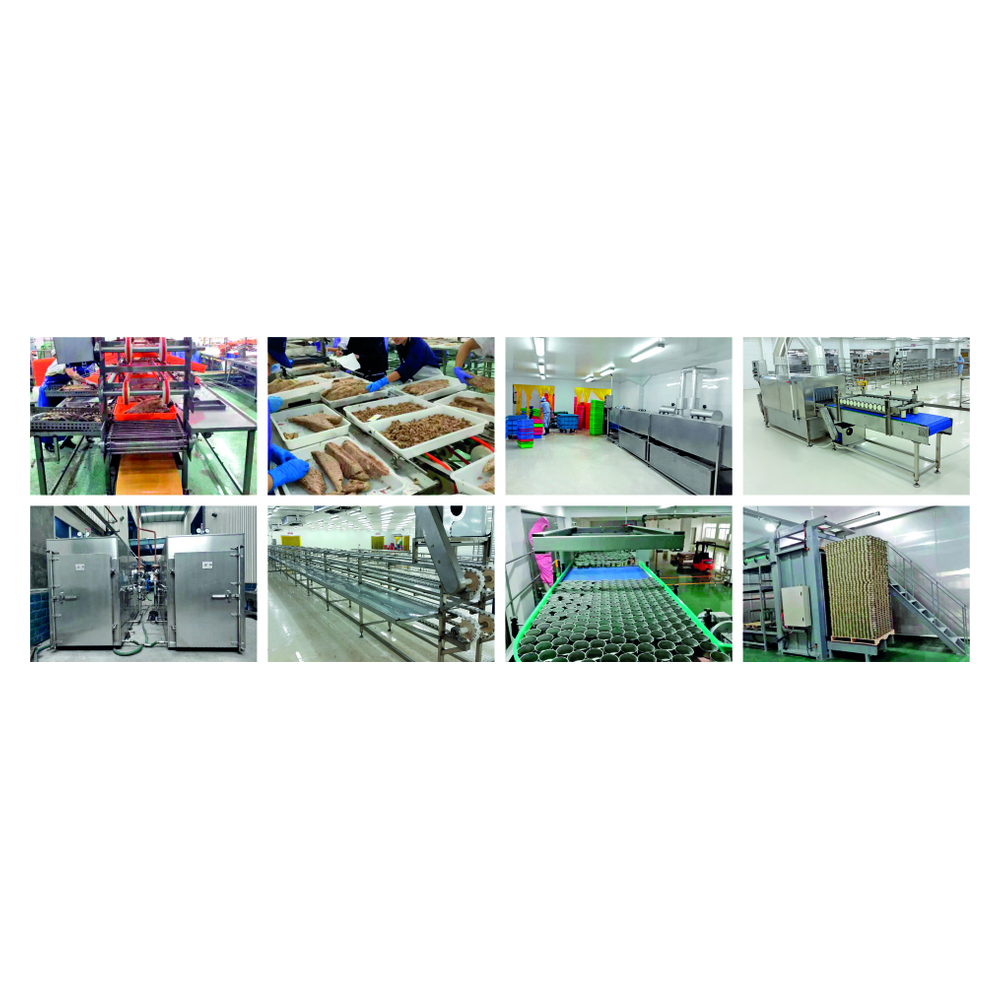
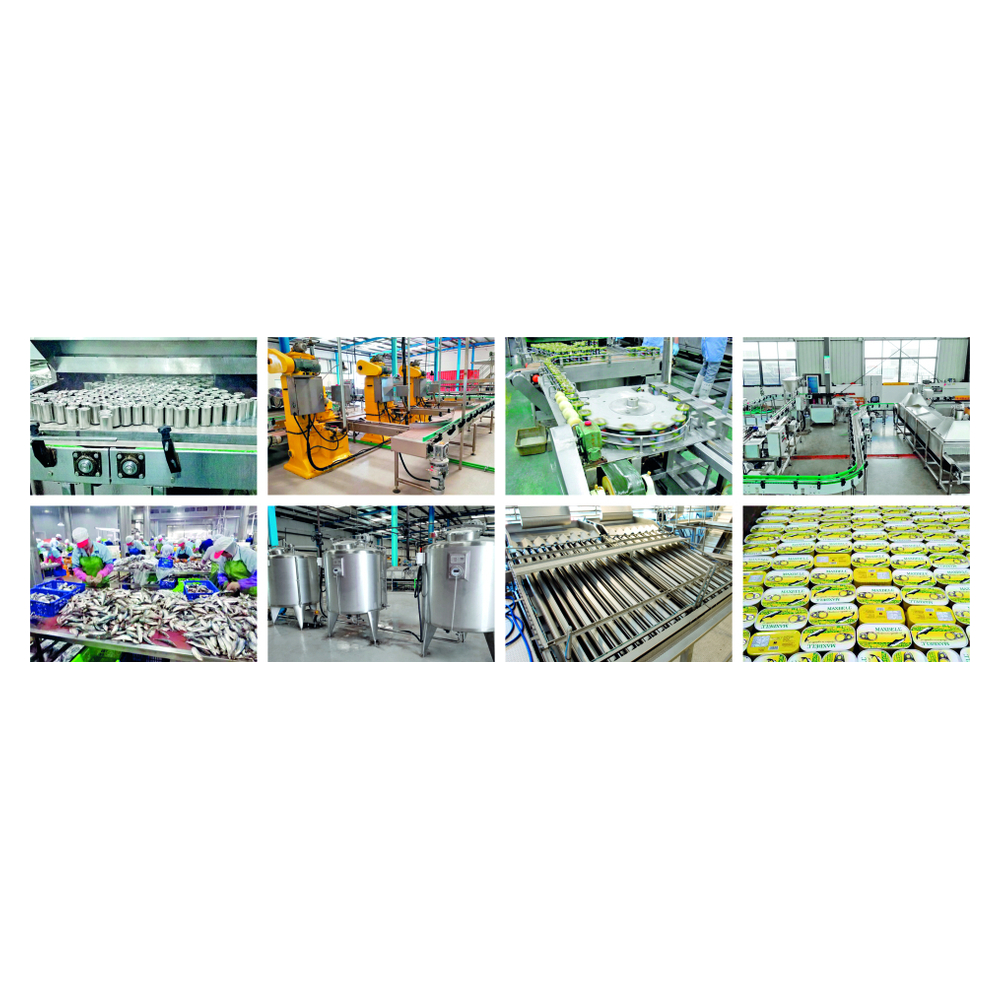
The production line is organized in a straight line with six zones. Product flows in one direction; personnel, air, and waste flow in the opposite direction where they must cross. The zones are separated by physical walls or at minimum defined transition points with hand-wash stations and boot-change areas:
Zone 1: Raw Fish Receiving and Cold Storage
Fish arrives at the receiving dock — fresh on ice in insulated containers, or frozen in blocks on pallets. The receiving area includes an inspection table with scale, a temperature probe for fish-core temperature verification, and a wash-down station for containers. Fresh fish moves immediately into the processing line — the maximum acceptable time from receiving to first processing is measured in hours and depends on ice quality and ambient temperature. Frozen fish moves into a freezer holding area at −18°C or below, then to a thawing room or controlled-temperature water-thaw tank before entering the processing line.
Layout requirements: the receiving dock must be directly adjacent to the raw processing zone. No corridor, no shared hallway, no path that crosses cooked-product or can-storage areas. The receiving floor must be sloped to drains, constructed of non-slip, cleanable material, and equipped with high-pressure hot-water hose stations for cleaning between deliveries.
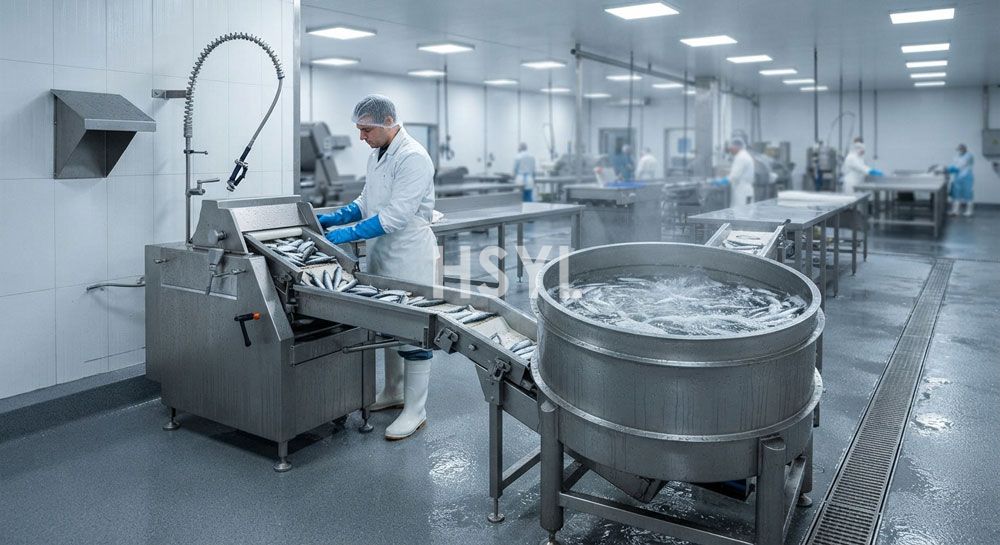
Zone 2: Raw Fish Processing — Gutting, Heading, Washing
This is the highest-contamination zone. Fresh fish are manually or mechanically sorted by size, then processed through gutting and heading machines or manual stations. The processing sequence depends on species:
- Sardines and small pelagics: heading and gutting by rotary or belt-fed machine; washing in a drum or bubble washer; brining in a salt solution for firmness and flavour. The fish move continuously through connected equipment — the conveyor is the production rhythm.
- Tuna: pre-cooking in steam cookers or hot-water tanks to firm the flesh for loin extraction; manual or mechanical skinning and deboning; loin cutting to can length. The pre-cooking stage is the single largest equipment footprint in a tuna line and generates significant steam and wastewater — it must be positioned with direct drain access and overhead exhaust.
- Mackerel: heading, gutting, and cutting to can-length sections; washing and brining — similar to sardine processing but with larger fish requiring wider conveyors and larger cutting heads.
Layout requirements: this zone must be physically separated from all downstream zones by a wall or barrier. Personnel working in this zone must not enter post-cooking zones without changing protective clothing and washing hands and boots. The floor must handle constant water and fish-waste exposure — sloped to trench drains with solids interception. Waste fish — heads, viscera, trimmings — must be collected continuously and removed from the processing area without crossing the product flow path.
Zone 3: Can Filling and Weighing
Processed fish pieces enter the filling zone — a medium-hygiene zone between raw processing and seaming. Fish pieces are manually or automatically placed into cans on a filling conveyor. For solid-pack products (tuna loins, mackerel fillets), manual filling is still common at lower capacities because the variation in piece shape and size makes full automation difficult. For small pelagics (sardines), automatic belt fillers align and place fish into cans at speeds of 80–150 cans per minute.
After filling, each can passes over a check-weigher. Under-filled cans are rejected and returned for top-up; over-filled cans are adjusted. Filling accuracy directly determines product giveaway — even 2 g of excess fill per can at 100 cans per minute accumulates to 12 kg of giveaway product per hour, or approximately 100 kg per shift.
The filling medium — oil, brine, tomato sauce, or water — is dosed into the can either before or after solid fill, depending on the product and filling machine type. Sauce preparation and holding tanks are located adjacent to the filling zone, connected by stainless steel pipework.
Layout requirements: the filling zone bridges Zone 2 (raw fish) and Zone 4 (seaming). Cans enter empty from the can-depalletizing and washing station — positioned at the Zone 2/3 boundary — and exit filled and weighed to seaming. The empty-can supply path must not cross the raw-fish path.
Zone 4: Seaming and Can Washing
Filled cans enter the seamer — the machine that seals the can lid to the can body with a double seam. The seamer is the most mechanically precise machine on the line: seam tightness measured in fractions of a millimetre determines whether the can will maintain sterility through retort and during shelf life. The seamer must be mounted on an independent vibration-damping base — not bolted to the same platform as the filler — because filler vibration transmitted to the seamer produces inconsistent seam dimensions.
After seaming, sealed cans pass through a can washer that removes oil, brine, or product residue from the can exterior. Unwashed cans carry organic material into the retort, where it bakes onto the can surface and creates a post-retort cleaning problem. The washer uses hot water with detergent; the wash water drains separately from the raw-fish-zone drainage.
Layout requirements: the seaming zone is the transition point between the medium-hygiene filling area and the post-seaming hygiene-controlled area. Sealed cans are now a closed system — the product inside is protected, but the can exterior must be clean before entering the retort area. The can-wash station should be positioned immediately after seaming, with the washed cans conveyed directly toward the retort loading area.
Zone 5: Retort Loading and Sterilization
Washed, sealed cans are loaded into retort baskets — perforated metal baskets that hold cans in a defined pattern to allow steam or water circulation around every can. Basket loading can be manual (cans placed by hand into baskets at lower capacities) or automatic (cans fed by conveyor into a basket-loading system). The loaded baskets are transferred into the retort — a large pressure vessel that sterilizes the canned product using saturated steam or superheated water at 116–121°C for a time determined by the product, can size, and required F₀ value (the sterilization lethality measured in equivalent minutes at 121°C).
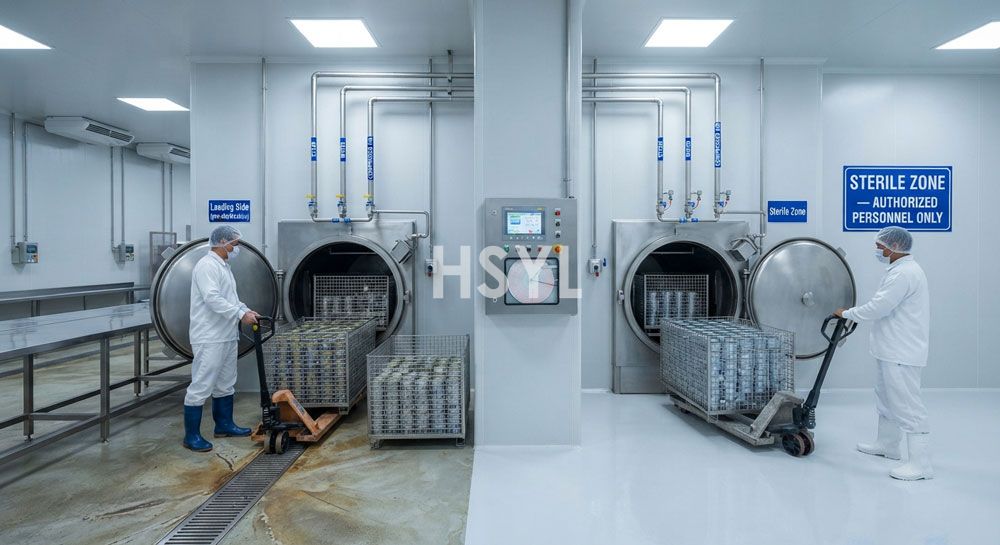
The retort room is the most strictly controlled zone in the plant. Layout requirements are absolute:
- The retort room must be physically separated from all pre-retort zones. Double-door (pass-through) retorts are preferred — raw-side loading, cooked-side unloading — because the retort body itself forms the physical barrier between the pre-sterilization and post-sterilization sides of the plant.
- For single-door retorts, a strict loading/unloading procedure with chemical indicator tape on every basket is mandatory — unsterilized baskets must be visually distinguishable from sterilized baskets at all times.
- Air flow must move from the post-retort (clean) side toward the pre-retort (raw) side — never in reverse. Positive air pressure on the clean side prevents airborne contamination from the raw side.
- The retort room floor must withstand thermal shock from basket transfers, sloped to drains with high-temperature-rated drainage materials.
- Steam supply, condensate return, compressed air, cooling water, and electrical supply to the retort control system must be routed overhead and dropped vertically to each retort — no utilities crossing the floor of the retort room.
For comprehensive bottleneck analysis including the retort stage, see the canning line bottleneck analysis.
Zone 6: Post-Retort Cooling, Drying, Labeling, and Packing
After retort sterilization, cans exit on the clean side. They are cooled — either in the retort itself (pressure cooling with cooling water) or in a separate cooling canal or tunnel — to a temperature below 40°C. Cans that are not adequately cooled will continue to cook from residual heat, degrading product texture and colour, and will not accept label adhesive properly.
Cooled cans are dried — air-knife or tunnel dryer — to remove surface moisture that would cause label adhesion failure or, in the case of unlabeled cans, corrosion during storage. Dried cans proceed to labeling (paper label or direct-print), date coding, and packing into cartons or shrink-wrapped trays. Packed cartons are palletized and moved to the finished-goods warehouse.
Layout requirements: post-retort handling is a clean operation. Cans are sterile inside — the exterior must be kept clean and dry. The packing area should be temperature and humidity controlled to prevent condensation on cooled cans. Pallet movement from the packing area to the warehouse must not cross the path of raw materials entering the plant.
Equipment at Each Stage
| Zone | Key Equipment | Function | Layout Positioning |
|---|---|---|---|
| 1. Receiving | Inspection table, scale, temperature probe, chill room or freezer, thawing tank | Receive, inspect, store, thaw | Building entry — direct adjacency to Zone 2 |
| 2. Raw processing | Gutting machine, heading machine, washer, brining tank, steam cooker (tuna) | Clean, gut, head, wash, pre-cook | Adjacent to Zone 1 — highest-contamination area |
| 3. Filling | Filling machine, check-weigher, sauce doser, can depalletizer | Fill cans with fish and medium | Bridges Zone 2 and Zone 4 |
| 4. Seaming | Can seamer, can washer, conveyor | Seal cans, wash exterior | Vibration-isolated base; transition to clean side |
| 5. Retort | Retort vessel, basket loader/unloader, steam system, control panel | Sterilize sealed cans | Physical barrier between raw and cooked sides |
| 6. Post-retort | Cooling canal/tunnel, can dryer, labeler, date coder, carton packer, palletizer | Cool, dry, label, pack | Clean side — controlled environment |
Critical Control Points and Food Safety
The layout must enable — not obstruct — the HACCP plan. The critical control points in canned fish production and their layout implications:
- CCP 1 — Retort sterilization: the process step that eliminates Clostridium botulinum spores. The retort must have calibrated temperature and pressure instrumentation, a validated vent schedule for steam retorts, and an automatic recording system. The layout must provide operator access to the retort control panel and chart recorder without entering the raw side.
- CCP 2 — Seam integrity: the double seam is the physical barrier that prevents recontamination after sterilization. Seam inspection — visual and teardown measurement — must be performed at a frequency defined in the HACCP plan. The layout must position the seam-inspection station immediately after the seamer, with a reject conveyor for cans that fail seam inspection before they enter the retort basket.
- CCP 3 — Container integrity (post-retort): post-retort can handling must not damage the double seam. Conveyor drops, can-to-can impacts at direction changes, and excessive can-rail pressure can all compromise seam integrity after sterilization. The post-retort conveyor must be designed for gentle can handling — minimum drops, cushioned direction changes, and no accumulation that creates can-to-can pressure.
- Hygiene barrier: the retort room is the physical CCP barrier in the layout. No product can bypass the retort — the layout must make it impossible for an un-retorted basket to reach the post-retort side without passing through the retort vessel. This is verified by the layout design, not by procedure.
Capacity Bottlenecks in Fish Canning Layout
The straight-line layout works because each zone feeds the next. It fails when any zone is slower than the one feeding it. The most common bottlenecks in canned fish lines, and how layout affects them:
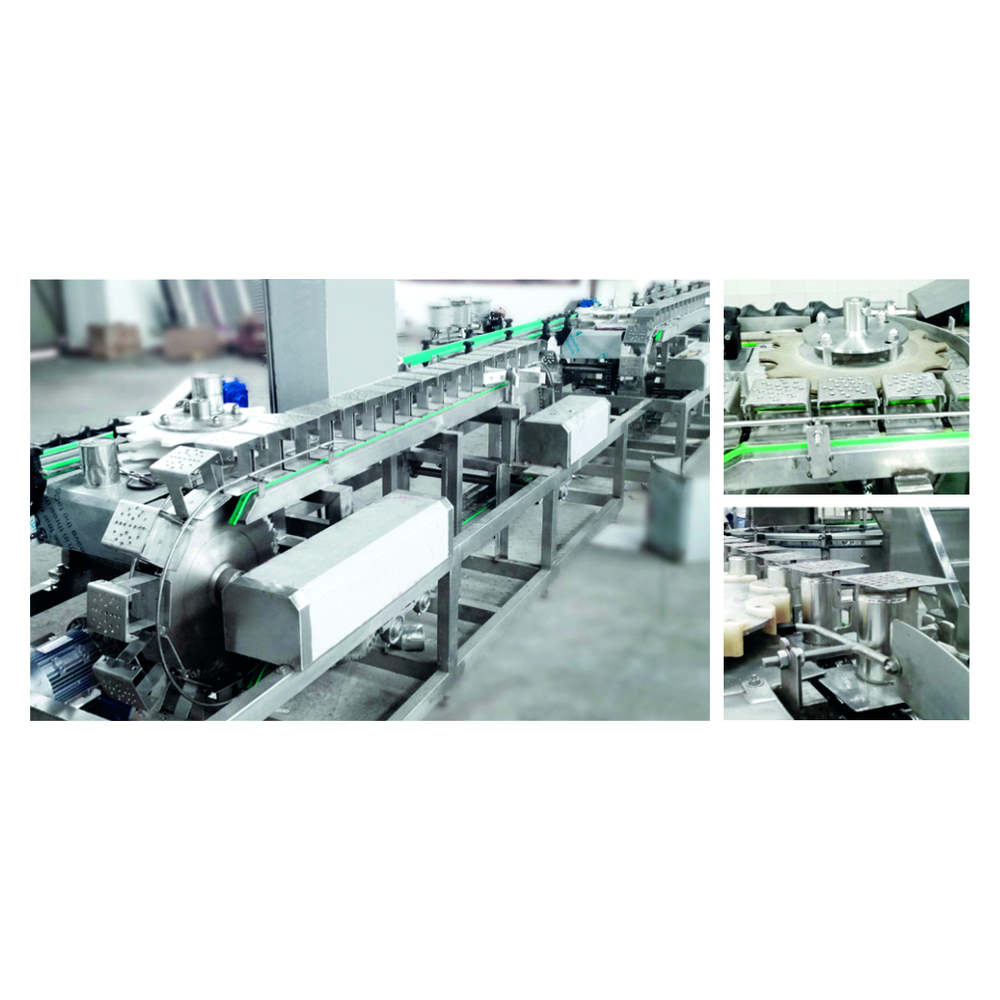
- Filling-to-seaming imbalance: the filler and seamer must be mechanically synchronized — they run at the same speed, driven by the same line shaft or electronically synchronized. If the filler stops, the seamer must stop, and vice versa. The conveyor between filler and seamer must provide accumulation capacity for the cans in transit during a brief stoppage — typically 30–60 seconds of line output.
- Retort capacity: the retort is typically the bottleneck because it is a batch process in an otherwise continuous line. The number of retort baskets, retort cycle time, and the number of retort vessels determine the maximum daily throughput. A line running at 120 cans per minute with a retort cycle of 70 minutes and 4 baskets per retort requires a specific number of retort vessels — increasing retort count is the standard capacity-expansion path for fish canning plants.
- Post-retort cooling: cans exit the retort at 116–121°C and must be cooled to below 40°C. Cooling-water temperature, flow rate, and dwell time in the cooling stage determine whether cooling keeps pace with sterilized-can output. In tropical-climate plants, cooling-water temperature is often the limiting factor — the layout must accommodate a cooling-water chiller or cooling tower with sufficient capacity.
Planning Inputs for a Canned Fish Line Layout
Before finalizing a layout, the following information must be confirmed — guessing any of these creates a layout that will not work when built:
- Fish species and size range — determines processing equipment type and footprint;
- Fresh or frozen receipt — determines whether a thawing zone is required;
- Target throughput — cans per minute at the seamer, which determines filler, seamer, retort, and cooling capacity;
- Can format(s) — diameter, height, material (tinplate or aluminum), and easy-open or standard lid — every format change affects conveyor-rail width and can-guide dimensions;
- Fill medium — oil, brine, tomato sauce, water — determines filling-machine type and sauce-preparation equipment;
- Target F₀ value and retort type — steam, water-spray, or full-water-immersion retort — determines retort specifications and cycle time;
- Available utilities — steam pressure and capacity, compressed air, water supply and temperature, electrical supply, drainage capacity;
- Building dimensions — length, width, column positions, ceiling height, floor load capacity — the straight-line layout requires a building long enough to accommodate the full line length with access aisles;
- Destination country food safety regulations — determines HACCP documentation requirements and may specify minimum zone separation distances.
Conclusion
A canned fish production line layout is an exercise in unidirectional flow, physical zone separation, and bottleneck management — not equipment positioning. The straight-line layout with six separated zones works because it makes cross-contamination impossible by design. The retort room is the layout's centrepiece: everything upstream feeds it, everything downstream depends on it, and the physical barrier it creates between the raw and sterile sides of the plant is the single most important food-safety feature of the building.
If you are planning a canned fish production line, start with the retort location and work outward: raw fish enters upstream, sterilized product exits downstream. Define the retort capacity first — it determines the maximum line speed. Then work backward through seaming, filling, processing, and receiving, ensuring each zone can feed the next at the line speed the retorts can handle. A layout designed in this sequence will function. A layout designed by placing equipment in a building and connecting it with conveyors will not. For turnkey fish canning line engineering support, contact the engineering team with your species, target throughput, can format, and building dimensions.
Frequently Asked Questions
How should a canned fish production line be laid out?
Why is straight-line layout preferred for fish canning?
What is the most important zone in a canned fish line layout?
How should the retort room be positioned in the layout?
What causes filling weight giveaway in fish canning?
How should the seamer be installed in the layout?
What are the main capacity bottlenecks in a canned fish line?
What information is needed to design a canned fish line layout?
Related Articles



Get professional consultation
Do you have any questions or need technical support regarding the content of this article? Fill out the form below, and our expert team will provide you with professional solutions.