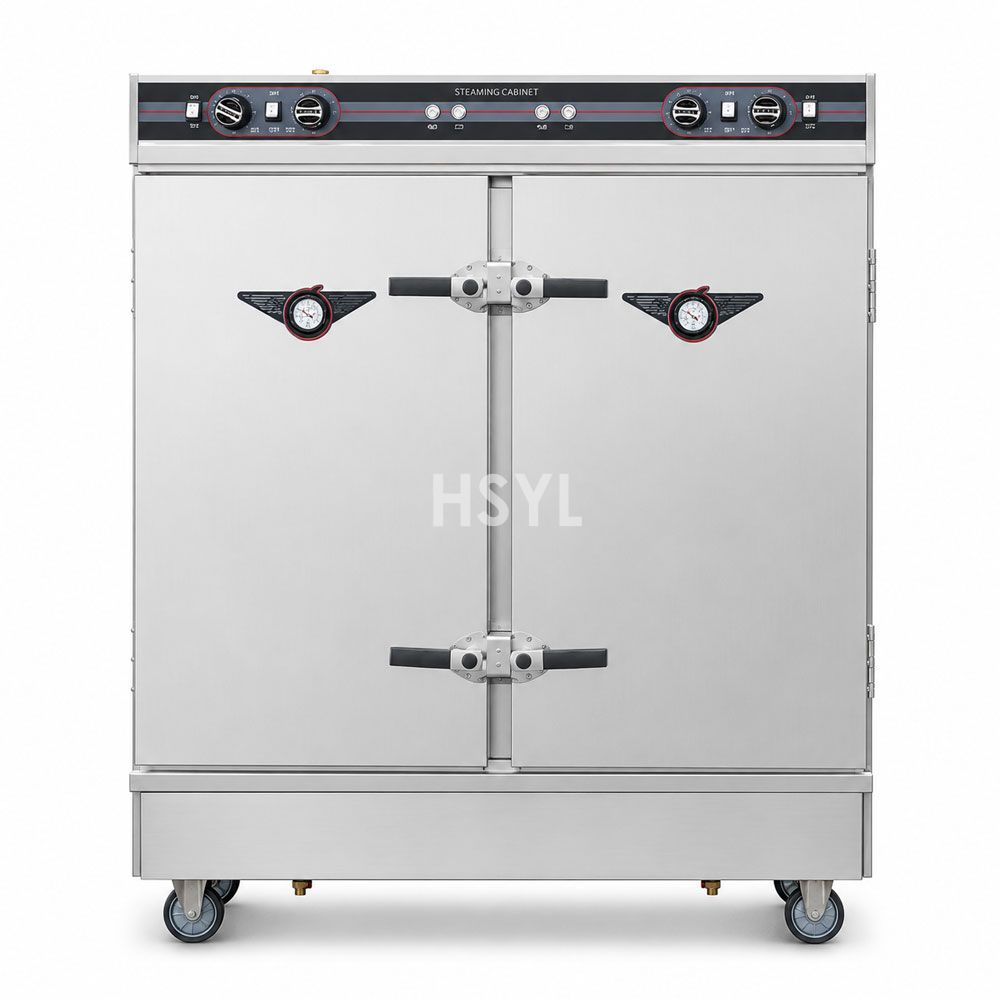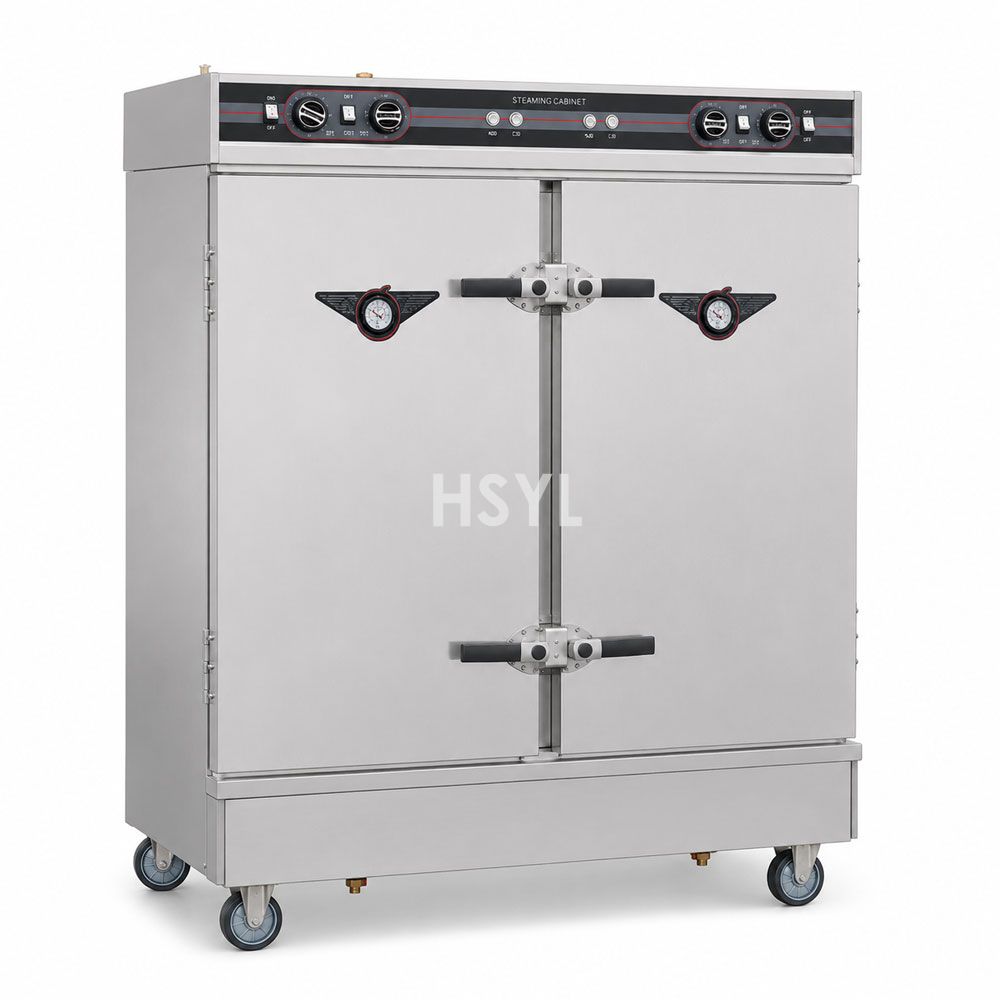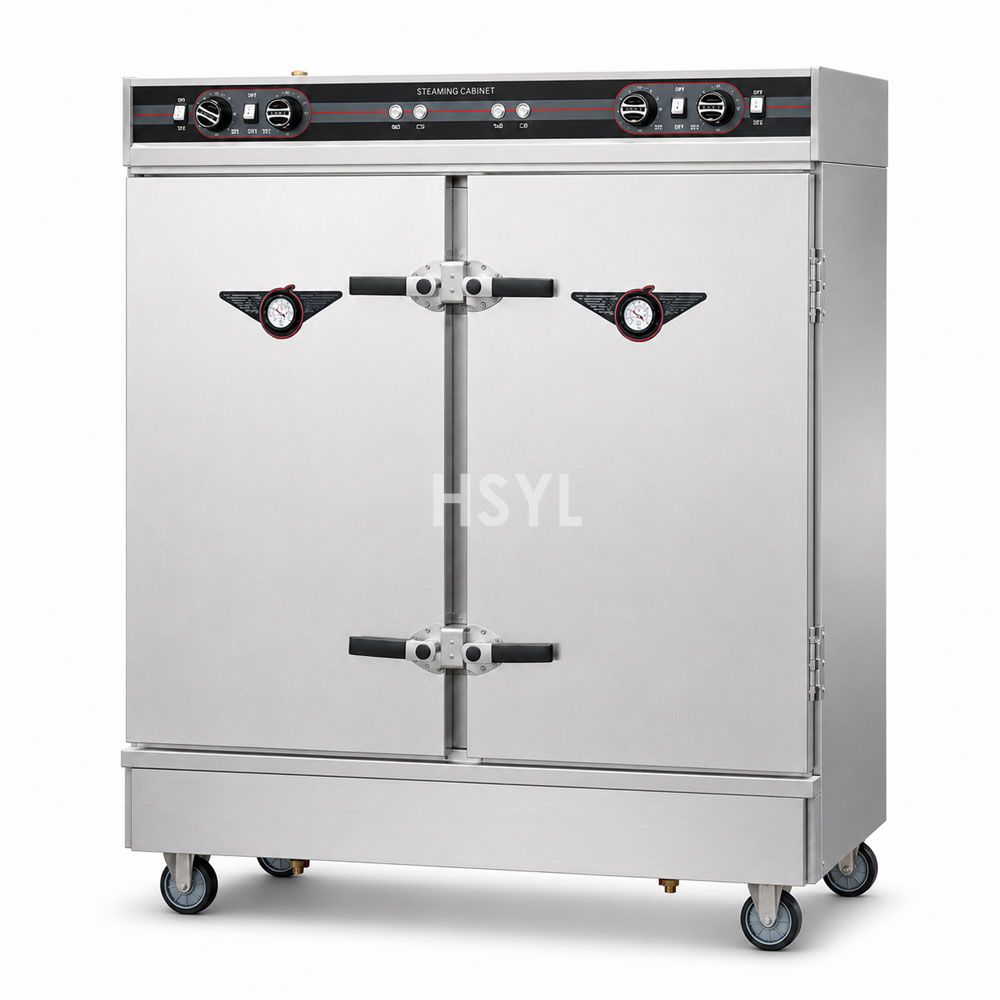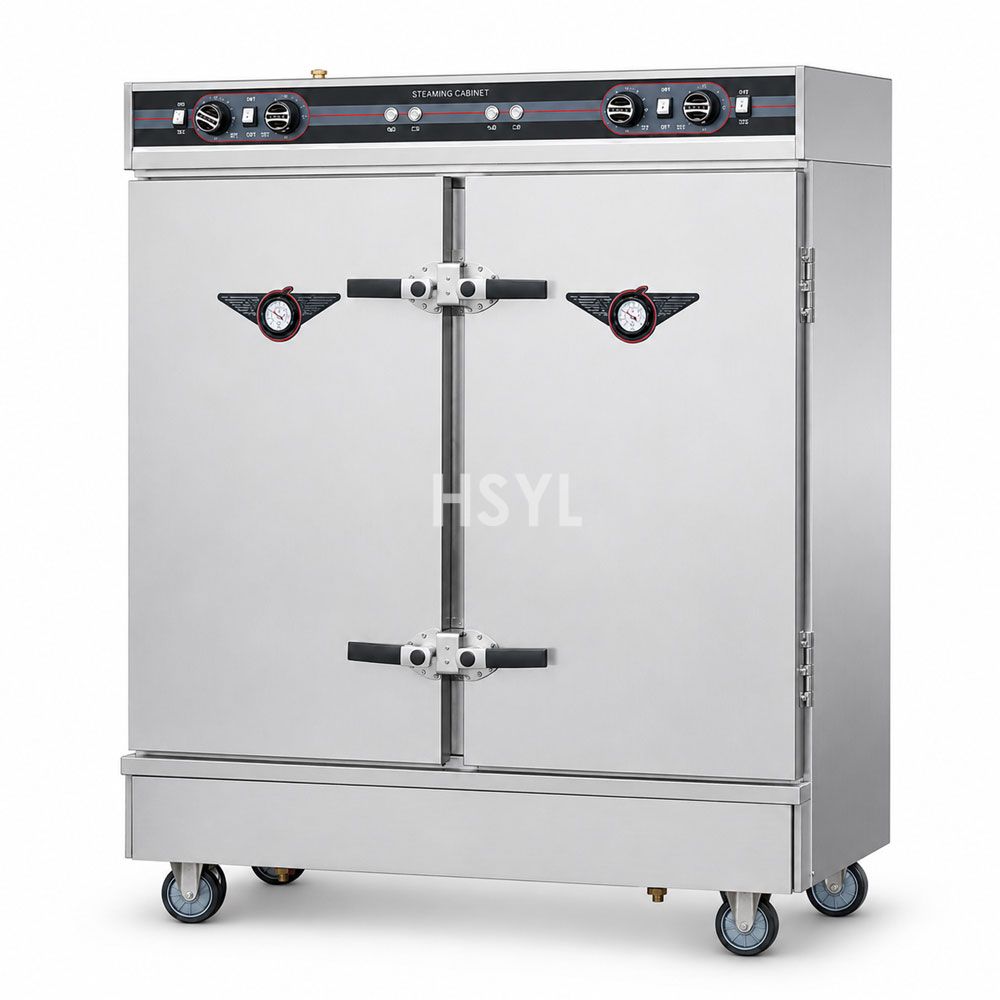
Automatic Steamer Cabinet | 6–24 Tray Auto Electric Steamer

HSYL Automatic Steamer Cabinet (EBA-DRS Series) offers 7 models from 6 to 24 trays with verified dimensions, power ratings (9kW–24kW), and weight specs. Electric boiler steam generation with automatic operation features, standard and vertical configurations available. Ideal for central kitchens, restaurants, and canteens needing consistent batch steaming with reduced manual intervention. Request model match and quotation.

Detailed Equipment Introduction
Gain in-depth insights into Automatic Steamer Cabinet | 6–24 Tray Auto Electric Steamer equipment’s working principles, application scenarios, and technical highlights.

Product Introduction

When your central kitchen, restaurant chain, or canteen runs multiple steaming cycles every day — breakfast rice, lunch buns, dinner dim sum — each cycle means manually filling water, setting timers, watching temperatures, draining reservoirs, and resetting for the next load. Over a busy service, that manual overhead adds up in labor hours, inconsistency between cycles, and operator fatigue. The Automatic Steamer Cabinet (EBA-DRS Series) addresses this by combining proven chamber-and-tray architecture with automated control functions that reduce hands-on time per cycle while delivering repeatable steaming results.

The EBA-DRS series is built around a 7-model capacity ladder ranging from 6 trays to 24 trays, with verified dimensions, electric boiler power ratings, and net weights for every tier. The series covers two practical size bands: compact-to-mid cabinets (6–12 trays, 695 mm wide) for smaller kitchens and satellite stations; and mid-capacity units (24 trays, 990–1390 mm wide) for restaurant kitchens and medium central kitchens where higher throughput is needed. For installations where floor width is limited, select models offer a Vertical type configuration (EBA-DRS-12V, 24V) with a narrower, taller chamber profile.

Every model uses electric boiler steam generation with configurable voltage — 2~220V single-phase for sites without three-phase supply (models 6–12), and 3~380V three-phase for the 24-tray units. The standard tray size across the entire series is 400 × 600 × 50 mm, compatible with common commercial kitchen tray systems and GN pan adapters. Each tray is rated for approximately 4 KG of food capacity. Steam enters through a DN 20mm Y-shaped connection at ≤0.02MPa vapor pressure, with water input pressure ≤4kPa.

The "Automatic" designation positions the EBA-DRS series above manual or basic economic steamer cabinets by reducing operator tasks at each cycle stage. For kitchens running 3+ steaming shifts per day or where labor consistency across operators is a concern, the automated control approach provides more predictable output quality with less supervision (specific feature set To confirm per model). For kitchens evaluating whether automatic or economic tier better fits budget and operational needs, see the Economic Steamer Cabinet (EBJ-DRS Series) for the manual-operation alternative with wider 4–48 tray range.

Technical Specification — Full Model Table

ModelTraysCabinet Size (mm)
W×D×H
Rated PowerRated VoltageCapacityWater Input
Pressure
Circuit
Breaker
Steam InletTray Size (mm)Vapor
Pressure
Net Weight
EBA-DRS-66695×615×11859kW3~380v
or
2~220v
4KG/Tray≤4kPaY-shaped
connection
method
DN 20mm400×600×50≤0.02MPa36kg
EBA-DRS-88695×615×135543kg
EBA-DRS-1010695×615×152547kg
EBA-DRS-1212695×615×169512kW52kg
EBA-DRS-12
(Vertical type)
12495×859×69512kW52kg
EBA-DRS-24241390×615×169512kW×23~380v96kg
EBA-DRS-24
(Vertical type)
24990×815×69584kg

Note: Dimensions are Width × Depth × Height in millimeters. "Vertical type" denotes narrower, taller chamber for space-constrained installations. Rated Voltage shows factory-specified option per model — confirm 220V availability with HSYL before ordering. Circuit breaker sizing must be coordinated with your electrical contractor based on rated power and local code.

Model Selection Guide by Daily Meal Volume

Daily Steamed Meals (approx.)Recommended ModelsTrays NeededCabinet Footprint (mm W×D)Notes
150–350EBA-DRS-6, DRS-86–8695 × 615Satellite station, small café, or supplement
350–700EBA-DRS-8, DRS-10, DRS-128–12695 × 615 or 495 × 859 (12V)Small-to-mid restaurant; consider 12V if width constrained
700–1,500EBA-DRS-12, 12V, 24, 24V12–24695×615 / 1390×615 / 990×815Mid-size central kitchen or hotel main kitchen
1,500–2,500+EBA-DRS-24, 24V (multiple units)24+ parallelper unit aboveLarger volumes may need multiple units; contact HSYL for multi-unit layout

Daily estimates assume mixed menu items across 1–3 cycles per service. If volume exceeds 24-tray single-unit capacity, consider the Economic Steamer Cabinet (EBJ-DRS) series extending to 48 trays, or deploying multiple EBA-DRS units.

Automatic vs Economic — EBA-DRS vs EBJ-DRS Comparison

AspectAutomatic (EBA-DRS)Economic (EBJ-DRS)
Tray range6 – 24 trays (7 models)4 – 48 trays (14 models)
Operation modeAutomated control (reduced manual intervention)Manual / basic operation
Ideal user profileLabor-efficient, consistency-focused kitchensBudget-focused, maximum-capacity-per-dollar kitchens
Power range9 – 24 kW9 – 48 kW
Config optionsStandard + Vertical (12V, 24V)Standard + Vertical (12V, 24V, 30V, 45V)
Best fit scenarioMulti-shift ops, labor-conscious, consistency-critical menusBudget-constrained, single-shift, capacity-maximizing layouts

Specific automation features vary by model — confirm detailed feature list with HSYL during quotation. Common capabilities include programmable cycle timers, auto water level sensing/refill, auto drainage post-cycle, digital temperature display, and program memory storage.

When to Choose the Automatic Tier

  • Kitchen operates 3+ steaming shifts per day and cumulative manual task time creates meaningful labor burden.
  • Cycle consistency matters — different operators produce varying results on manual cabinets and you need standardized output regardless of who runs the machine.
  • Limited dedicated steaming staff — operators need to manage other prep tasks while cabinet runs with minimal attention.
  • Menu includes items with precise timing requirements (dim sum, delicate proteins) where over/under-steaming directly affects quality and waste rate.

When Economic Tier May Suffice

  • Running 1–2 steaming cycles per day where manual overhead does not justify incremental automation investment.
  • Priority is maximum tray capacity per dollar and you need larger single units than 24 trays (EBJ-DRS extends to 30, 36, 45, 48).
  • Operator training already ensures consistent results on manual equipment.

Standard Configuration vs Vertical Type

  • Standard configuration — Wider, lower-profile chamber with front-opening horizontal door. Example: EBA-DRS-12 (695×615 mm); EBA-DRS-24 (1390×615 mm). Choose when kitchen has sufficient depth and can accommodate wider footprint.
  • Vertical type — Narrower, taller chamber for width-constrained sites. Examples: EBA-DRS-12V (495×859 mm); EBA-DRS-24V (990×815 mm). Confirm adequate overhead clearance before selecting. Both deliver same tray count and steaming performance.

When planning your kitchen equipment layout, overlay cabinet footprint onto floor plan with at least 300–500 mm door-side clearance. If Standard does not fit your zone, check whether a Vertical type exists for your target tray count — it does for both 12T and 24T tiers.

Working Process

  1. Loading. Place portioned items onto 400 × 600 × 50 mm trays, slide onto rack guides inside chamber. Arrange for even steam circulation. Close and latch door.
  2. Program & Start. Using control interface (digital controller type To confirm), select or program desired cycle parameters: hold time, temperature setpoint (if adjustable), special modes. Initiate cycle. Depending on automation features, subsequent steps require reduced operator involvement versus a manual cabinet.
  3. Heating & Steam Generation. Built-in electric boiler (9kW for 6–10T, 12kW for 12T, 12kW×2=24kW for 24T) heats water generating saturated steam via DN 20mm Y-shaped inlet at ≤0.02MPa. Heating time depends on capacity, initial water temp, load mass. Steam surrounds all trays uniformly through condensation heat transfer.
  4. Steaming Hold. At target temperature (~100°C sea level), hold phase begins. Duration varies by item: rice 20–40 min; buns/dim sum 8–15 min. On automatic models, controller manages timer and may alert near completion (behavior To confirm).
  5. Unloading & Auto Reset. Post-cycle, open door carefully allowing brief steam venting. Remove trays and transfer to next station — such as cooking range hot zone for plating or packing area for assembly. Depending on feature set, cabinet may initiate auto-drainage, cooldown, or readiness indication with reduced manual reset steps versus non-automatic cabinets.

Hygiene checkpoint: Between services/end-of-day, drain boiler reservoir (may be auto-handled depending on features), descale if hard water (keep water input ≤4kPa), wipe interior surfaces with food-safe sanitizer. Ensure DN 20mm Y-connection and drain lines stay clear of mineral buildup.

Applications

  • Central kitchen. High-value application — continuous steaming shifts benefit from automation reducing per-cycle labor and improving batch-to-batch consistency. EBA-DRS-24 handles significant throughput; multiple units run parallel for larger facilities. Fits within overall central kitchen workflow between prep stations and cooling/packing zones.
  • Restaurant / Hotel kitchen. Hotels with breakfast buffet stations and dim sum/Cantonese restaurants benefit from automated cycle management during busy services. 12–24T covers typical per-service demand. Automation helps when staff multitask between stations during peaks.
  • Canteen / Institutional kitchen. School/hospital/corporate canteens serving steamed rice rely on batch steamers for uniform portions. EBA-DRS delivers consistent results with less skill variance than manual alternatives. Automated interface lowers training bar for reliable operation.
  • Prepared-meal production facility. Facilities producing chilled/frozen meal kits use steamers for partial protein and vegetable cooking before blast chilling. 12–24T provides sufficient throughput for component lines where controlled moist heat preserves texture. Automation supports repeatable parameters important for standardization.
  • Bakery / Dim sum workshop. Production bakeries and dim sum workshops use cabinet steamers for final steaming of buns (baozi, mantou), siu mai, har gow, rice noodle sheets. EBA-DRS-12 or 12V fits production layouts. Programmed cycle automation helps when same few recipes run repeatedly with strict timing requirements.

Advantages

  • Automated cycle management reduces labor per service. Key cycle stages handled with reduced operator intervention (specific features To confirm). For 3+ shift kitchens, cumulative time savings meaningfully reduce staffing burden or free operators for concurrent tasks.
  • Improved cycle-to-cycle consistency. Automated controllers execute programmed parameters identically each time, reducing output variation from different operators following slightly different manual routines. Important where steaming quality drives satisfaction or compliance standards.
  • Full 7-model ladder with verified specs. 6→24 trays, every model ships with factory-confirmed dimensions, power, voltage, weight. Map volume to tray count, verify footprint, confirm electrical load, proceed confidently.
  • Standard + Vertical type flexibility. Both 12T and 24T tiers offer Vertical alternative with narrower/taller chamber. Meaningful choice when standard footprint does not fit — switch to Vertical without dropping tray count.
  • Electric-only — no gas dependency. Integrated electric boiler on every model. No gas piping, combustion interlocks, flue ventilation required. Eliminates infrastructure complexity for sites without gas access.
  • Scalable power (9kW → 24kW). 9kW compact (6–10T) → 12kW (12T) → dual 12kW=24kW (24T) ensures proportionally higher heating capacity for larger chambers, maintaining heat-up time and saturation at full loading.
  • Uniform 400×600×50 mm tray system. All 7 models accept same standard tray. Interchangeable within EBA-DRS series and compatible with EBJ-DRS economic series (same size), simplifying spare inventory across mixed-equipment facilities.
  • Clear metric: 4 KG per tray. Convert daily portion weight directly to minimum tray count: divide by 4KG, add buffer, read matching model.
  • Voltage flexibility. Small models (6–12T) support 3~380V and 2~220V accommodating single-phase-only sites. Large models (24T) use 3~380V aligned with dual-boiler draw.
  • Standing-height cabinet ergonomics. Front-opening door at standing height reduces strain vs bending into countertop units. Upright format cuts cumulative bending/reaching across multiple daily cycles.

Power & Electrical Requirements Summary

Model GroupModelsTotal Rated PowerVoltageMin. Circuit Capacity
Compact (6–10 trays)EBA-DRS-6, 8, 109 kW3~380V or 2~220VTo confirm with electrician
Small-Mid (12 trays)EBA-DRS-12, 12V12 kW3~380V or 2~220VTo confirm with electrician
Mid (24 trays)EBA-DRS-24, 24V24 kW (12kW×2)3~380VTo confirm with electrician

Circuit breaker/wire sizing by licensed electrical contractor based on rated power, voltage, local code, installation conditions. HSYL provides electrical diagrams upon request.

Related Equipment for Your Kitchen Workflow

Get Your Automatic Steamer Cabinet Quotation

Send your daily meal capacity (or peak steamed portion count), kitchen floor plan or equipment-zone dimensions, site voltage (220V/380V), preferred model or tray-count range, automation priorities, and target delivery schedule. HSYL will confirm best-fitting model(s) from EBA-DRS series, provide detailed automation feature specifications, deliver project quotation with lead time and shipping info, and support voltage customization or optional accessory configuration.

Contact HSYL today: Share your requirement — equipping new central kitchen with automated steaming, upgrading existing manual station to reduce labor, comparing EBA-DRS vs EBJ-DRS for budget/priority fit, validating electrical load for 24T installation, or confirming which automatic features come with each model.
Frequently Asked Questions

What is the Automatic Steamer Cabinet EBA-DRS series?
The Automatic Steamer Cabinet (EBA-DRS series) is a commercial kitchen electric steam cooking machine from HSYL with 7 models ranging from 6 trays to 24 trays. It shares the same electric-boiler multi-tray chamber architecture as the Economic Steamer Cabinet line but adds automated control features that reduce manual intervention per steaming cycle. All models use an electric boiler steam generator, accept standard 400×600×50 mm commercial trays, and are rated at 4 KG capacity per tray. Select 12-tray and 24-tray models are available in both standard and Vertical type configurations.
How does the Automatic Steamer Cabinet differ from a manual or economic steamer?
Primary difference lies in operator involvement per cycle. On manual/economic cabinets (such as EBJ-DRS series), the operator fills water, sets mechanical timers, monitors visually, drains manually, resets for next load — each step requiring hands-on attention. The EBA-DRS automatic series automates some or all of these stages (features vary by model — confirm with HSYL) so the operator loads, initiates, and returns when alerted. This reduces labor per cycle, improves consistency between operators, frees staff for concurrent tasks. Trade-off: automatic models top out at 24 trays whereas manual economic series extends to 48 trays.
How do I choose the right EBA-DRS model for my daily meal volume?
Estimate total weight of steamed food during busiest service. Divide by 4 KG per-tray capacity for baseline tray count, add 15–25% buffer for spacing/circulation, match to nearest EBA-DRS model. Example: 60 kg peak output ÷ 4 = 15 trays baseline → +20% buffer = 18 trays → round up to EBA-DRS-24 or consider EBA-DRS-12 with two shorter cycles. Always cross-check cabinet footprint against floor plan. If volume exceeds single 24-tray unit, consider multiple parallel units or evaluate larger-tray Economic series.
What is the difference between Standard and Vertical type in EBA-DRS?
Standard = wider lower-profile chamber with horizontal front door — EBA-DRS-12 is 695mm wide, EBA-DRS-24 is 1390mm wide. Vertical = narrower taller chamber — EBA-DRS-12V is 495mm wide, EBA-DRS-24V is 990mm wide. Choose Vertical when equipment zone has limited width but adequate height/depth; choose Standard when width available and you prefer conventional loading ergonomics.
What voltage does EBA-DRS require?
Models 6 through 12 (including 12V) support both 3~380V three-phase and 2~220V single-phase, suitable for sites without three-phase supply. 24-tray models (24, 24V) use 3~380V three-phase due to dual 12kW boiler config (24kW total). Confirm with electrical contractor before ordering.
What automatic features does EBA-DRS include?
Features vary by model — confirm with HSYL for your target model. Common capabilities: programmable digital cycle timer with recipe memory, auto water level sensing/refill, auto drainage post-cycle, digital temperature display with setpoint adjustment, completion alert, safety interlock monitoring. Request detailed feature list during quotation.
Can I use existing commercial trays with EBA-DRS?
Yes if trays match standard 400×600×50 mm dimension used across all EBA-DRS models. Same tray size as EBJ-DRS Economic series — trays interchangeable between product lines within facility.
How much floor space does EBA-DRS require?
Plan external footprint plus clearance: EBA-DRS-12 std ~1200×1100mm including 300–500mm door-side clearance; EBA-DRS-24 std ~1900×1100mm; EBA-DRS-24V ~1490×1300mm but needs greater overhead height. Add rear/side clearance for power routing, water inlet (≤4kPa), drainage.
What can I cook in an automatic steamer cabinet?
Any moist-heat electric steaming item: steamed rice (portion/bulk pans), buns/breads (baozi, mantou, rolls), dim sum (siu mai, har gow, cheong fun), vegetables (leafy/root/corn), fish fillets, chicken, eggs, pre-cooked meal components for chilled/frozen production. Arrange on 400×600×50mm trays with spacing, adjust cycle time per item type.
How do I clean/maintain EBA-DRS?
Daily: verify boiler drained (if auto-drain equipped), wipe interior/door seal, clean racks. Weekly/biweekly: descale if hard water (monitor input ≤4kPa), check door seals, inspect DN20mm Y-connection for mineral buildup, verify drains flow freely, test auto-drain/auto-fill mechanisms. Monthly: verify controller accuracy, check interlocks, review fault logs if stored.
Does EBA-DRS come gas-powered?
Based on current spec sheet, EBA-DRS uses integrated electric boiler elements — no gas variant in this series. Contact HSYL for alternative lines if gas-powered steaming needed.
What is lead time for Automatic Steamer Cabinet order?
Varies by model, config (voltage, standard vs vertical, accessories), factory schedule. Standard configs typically faster than customized. Provide model selection and timeline for estimated delivery.
Do I need special ventilation for EBA-DRS?
Cabinet-style electric steamers release steam mainly when door opens post-cycle. General kitchen ventilation or extractor hood above loading area manages moisture/heat. No combustion ventilation needed (electric boilers only). Consult layout engineer for low-ventilation zone installs.
Should I choose Automatic (EBA-DRS) or Economic (EBJ-DRS)?
Choose Automatic (EBA-DRS) if priorities are reduced labor per cycle, consistent output across operators, and required tray count ≤24. Choose Economic (EBJ-DRS) if priority is max capacity per dollar (up to 48 trays), fewer cycles/day where manual overhead manageable, or need larger single unit than 24 trays. Some kitchens mix both: automatic for high-frequency precision items, economic for bulk high-volume items.
Certifications
Internationally recognized certifications guarantee equipment reliability and compliance.
CE Certification

CE Certification

ISO 9001

ISO 9001

FDA Certification

FDA

Halal Certification

Halal Certified

Environmental Certification

Environmental Certification

Patented Technology

Patented Technology

Are you ready to customize your next production line?

Get professional customized solutions

Fill in your requirements, and our expert team will tailor the optimal food equipment solution for you.

Format: +[country code][number] (e.g. +8615098926008)

Your information will be kept strictly confidential, and we guarantee a response to your inquiry within 24 hours.