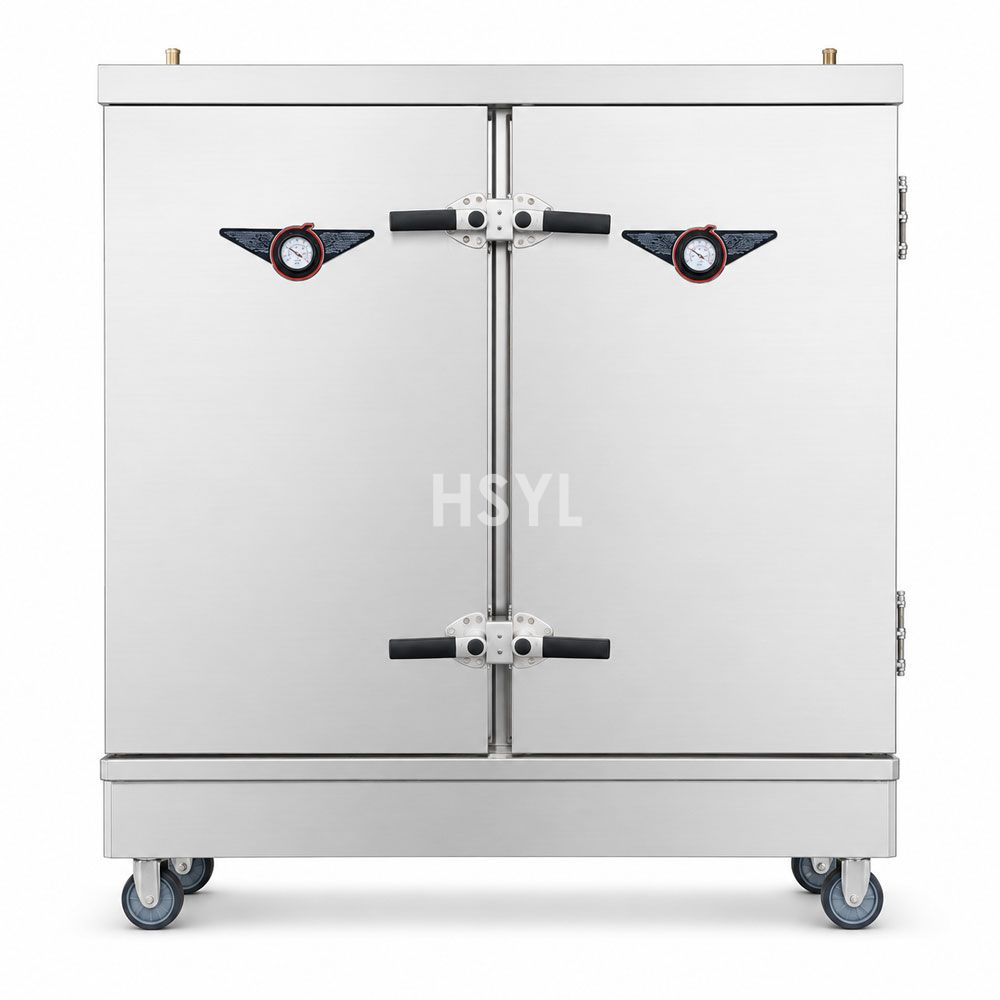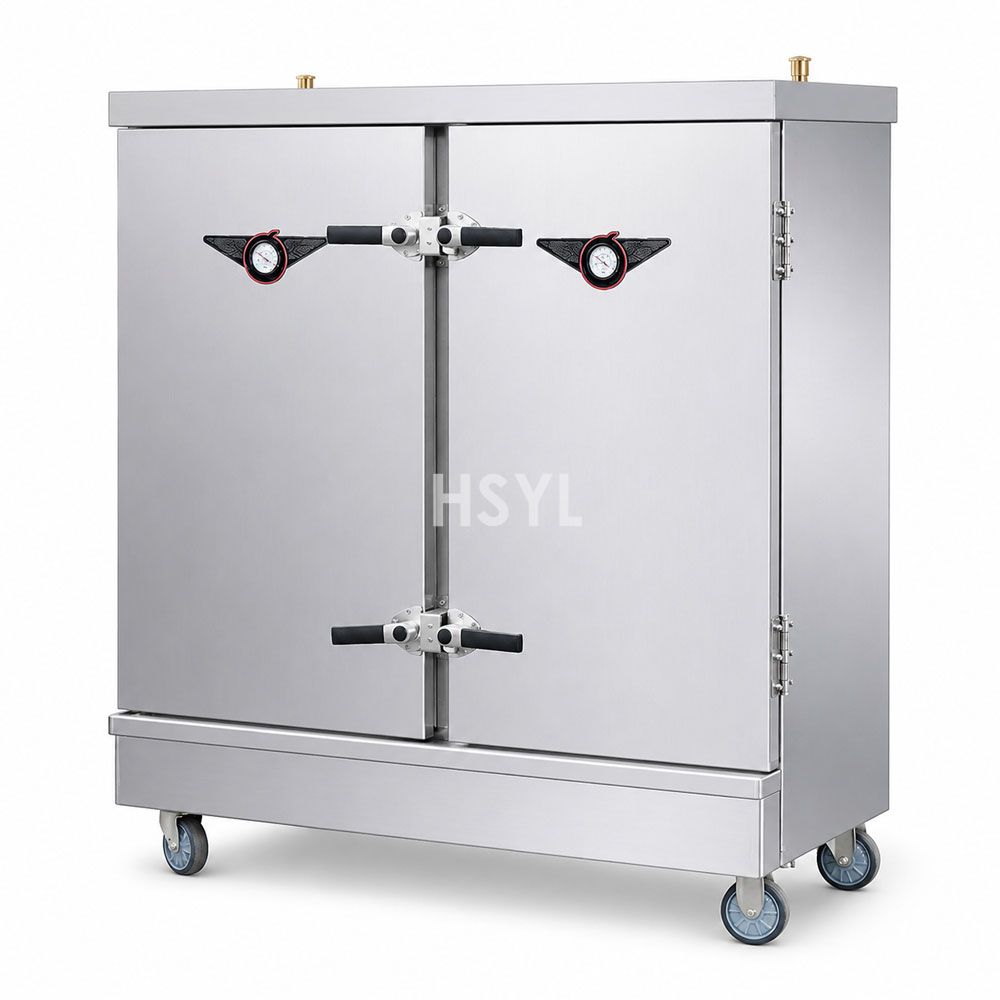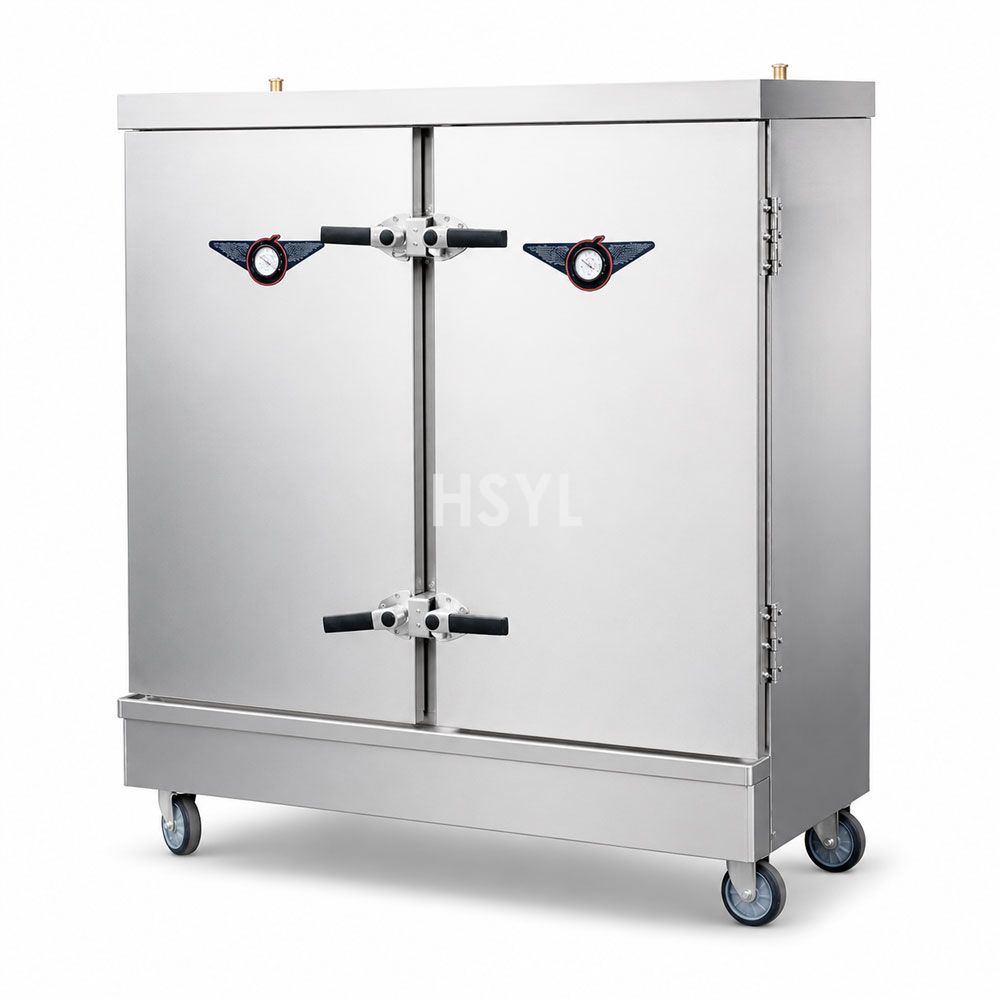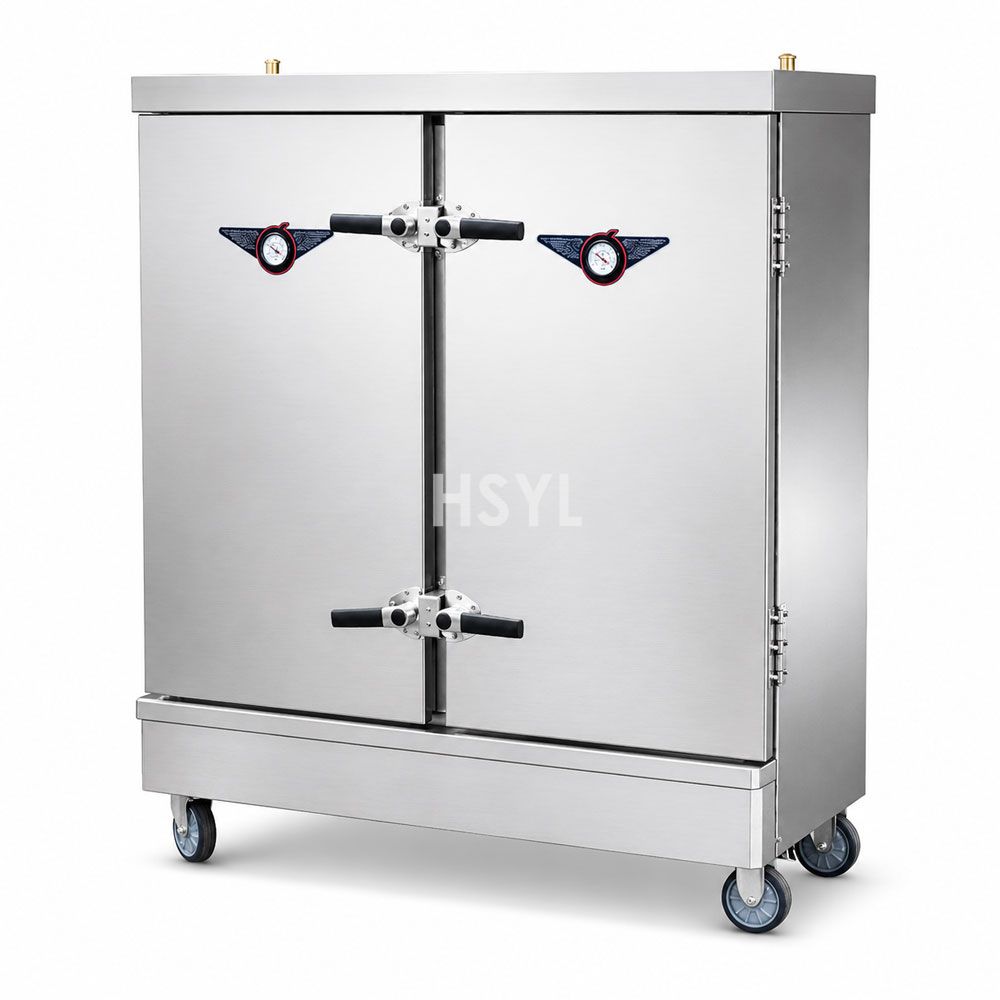
Economic Steamer Cabinet | 4–48 Tray Electric Steamer

HSYL Economic Steamer Cabinet (EBJ-DRS Series) offers 14 models from 4 to 48 trays with verified dimensions, power ratings (9kW–60kW), and weight specs. Electric boiler steam generation, standard and vertical configurations available. Ideal for central kitchens, restaurants, and canteens needing batch steaming for buns, rice, dim sum, and vegetables. Request model match and quotation.

Detailed Equipment Introduction
Gain in-depth insights into Economic Steamer Cabinet | 4–48 Tray Electric Steamer equipment’s working principles, application scenarios, and technical highlights.

Product Introduction

When your central kitchen, restaurant chain, or canteen needs to steam hundreds of portions per service — whether it is rice trays, buns, dim sum, vegetables, or pre-cooked proteins — selecting the right steamer cabinet means matching tray capacity, footprint, and power to your actual daily output rather than guessing or oversizing. The Economic Steamer Cabinet (EBJ-DRS Series) is built around a 14-model capacity ladder ranging from 4 trays to 48 trays, with verified dimensions, electric boiler power ratings, and net weights for every tier. This lets you pick a model that fits your kitchen's floor space and meal volume with confidence instead of relying on generic one-size descriptions.

The series covers three practical size bands: compact cabinets (4–12 trays, 695 mm wide) for smaller kitchens and satellite stations; mid-capacity units (20–30 trays, 1000–1390 mm wide) for restaurant kitchens and medium central kitchens; and high-throughput models (36–48 trays, 1420–1580 mm wide) for large central kitchens and institutional facilities producing thousands of steamed meals per day. For space-constrained layouts where a wide footprint is difficult to accommodate, select models also offer a Vertical type configuration (EBJ-DRS-12V, 24V, 30V, 45V) with a narrower, taller chamber design that fits into tighter floor plans while maintaining the same tray count.

Every model in the EBJ-DRS series uses electric boiler steam generation with configurable voltage — 2~220V single-phase for smaller installations where three-phase power is not available, and 3~380V three-phase for mid and larger models requiring higher power input. The standard tray size across the entire series is 400 × 600 × 50 mm, which is compatible with common commercial kitchen tray systems and GN pan adapters. Each tray is rated for approximately 4 KG of food capacity, giving buyers a straightforward way to convert daily meal portion targets into a minimum tray-count requirement. Steam enters the chamber through a DN 20mm Y-shaped connection at ≤0.02MPa vapor pressure, with water input pressure requirement of ≤4kPa.

For kitchens that are scaling up from individual countertop steamers, replacing aging equipment, or planning a new central kitchen equipment layout, the EBJ-DRS series provides a structured selection path: count your peak-service steamed portions, calculate the tray count needed, check the footprint against your layout drawing, confirm your site voltage, and select the matching model. HSYL supports this process with model-specific specifications and project quotation tailored to your kitchen's conditions.

Technical Specification — Full Model Table

The table below lists all 14 models in the Economic Steamer Cabinet (EBJ-DRS) series with verified technical parameters from the factory specification sheet. Use this table to compare tray count, cabinet dimensions, rated power, voltage, and net weight across the full capacity range.

ModelTraysCabinet Size (mm)
W × D × H
Rated PowerRated VoltageCapacityWater Input
Pressure
Circuit
Breaker
Steam InletTray Size (mm)Vapor
Pressure
Net Weight
EBJ-DRS-44695×615×8159kW3~380v
or
2~220v
4KG/Tray≤4kPaY-shaped
connection
method
DN 20mm400×600×50≤0.02MPa27kg
EBJ-DRS-66695×615×98530kg
EBJ-DRS-88695×615×115534kg
EBJ-DRS-1010695×615×132539kg
EBJ-DRS-1212695×615×149512kW46kg
EBJ-DRS-12
(Vertical type)
12495×815×149512kW3~380v44kg
EBJ-DRS-20201390×615×135512kW×257kg
EBJ-DRS-24241390×615×152512kW×278kg
EBJ-DRS-24
(Vertical type)
241000×815×152512kW×284kg
EBJ-DRS-30301000×815×180015kW×2120kg
EBJ-DRS-30
(Vertical type)
301580×815×152512kW×3145kg
EBJ-DRS-36361580×815×152512kW×3145kg
EBJ-DRS-45V
(Vertical type)
451580×815×180015kW×3164kg
EBJ-DRS-48481420×1025×159012kW×4187kg


Note: Dimensions are Width × Depth × Height in millimeters. "Vertical type" denotes a narrower, taller chamber configuration for space-constrained installations. Rated Voltage column shows the factory-specified option per model — confirm availability of 220V single-phase option for your target model with HSYL before ordering. Circuit breaker sizing should be coordinated with your electrical contractor based on the rated power and local code requirements.

Model Selection Guide by Daily Meal Volume

Daily Steamed Meals (approx.)Recommended ModelsTrays NeededCabinet Footprint (mm W × D)Notes
100–200EBJ-DRS-4, DRS-64–6695 × 615Satellite station or small canteen supplement
200–500EBJ-DRS-8, DRS-10, DRS-128–12695 × 615
or 495 × 815 (12V)
Small restaurant or departmental kitchen; consider 12V if depth is limited
500–1,200EBJ-DRS-20, DRS-2420–241390 × 615
or 1000 × 815 (24V)
Medium central kitchen or hotel main kitchen; 24V for narrower footprint
1,200–2,000EBJ-DRS-30, DRS-30V, DRS-3630–361000 × 815 (30 std)
1580 × 815 (30V/36)
Large central kitchen; choose between 30 (deeper but narrower) and 30V/36 (wider) based on floor plan
2,000–3,500+EBJ-DRS-45V, DRS-4845–481580 × 815 (45V)
1420 × 1025 (48)
High-volume production facility; DRS-48 offers deepest tray capacity in widest format

Daily meal estimates assume mixed menu items (rice + buns/proteins + vegetables) distributed across 1–3 steaming cycles per service. Actual tray requirement depends on portion size, menu mix, and cycle frequency. Contact HSYL with your specific menu and output targets for a precise model recommendation.

Standard Configuration vs Vertical Type — When to Choose Which

The EBJ-DRS series offers two physical configurations for select models in the mid-to-large capacity range:

  • Standard configuration — Wider, lower-profile chamber with a front-opening horizontal door. Examples: EBJ-DRS-12 (695 mm wide), DRS-24 (1390 mm wide), DRS-30 (1000 mm wide). This format loads at a comfortable standing height and distributes weight across a wider base. Choose standard when your kitchen has sufficient front-to-back depth and can accommodate the wider footprint.
  • Vertical type — Narrower, taller chamber designed for installations where floor width is constrained but ceiling height allows a taller unit. Examples: EBJ-DRS-12V (495 mm wide vs 695 mm standard), DRS-24V (1000 mm wide vs 1390 mm standard), DRS-30V (1580 mm wide vs 1000 mm standard), DRS-45V. Note that the vertical type trades width for height — confirm your installation location has adequate overhead clearance for the taller cabinet profile and enough room to open and close the door vertically if applicable.

When planning your kitchen equipment layout, overlay the cabinet footprint (Width × Depth from the spec table) onto your floor plan with at least 300–500 mm of operating clearance on the door side for safe loading and unloading. If the standard configuration does not fit within your allocated equipment zone, check whether a Vertical type alternative exists for your target tray count — this can often resolve space conflicts without dropping to a smaller tray capacity model.

Working Process

The Economic Steamer Cabinet operates as a self-contained electric-batch steaming station. Below is the standard operating sequence for a typical steaming cycle:

  1. Loading. Place portioned items onto standard 400 × 600 × 50 mm trays and slide them onto the rack guides inside the chamber. Arrange items so that steam circulation reaches each tray evenly — avoid overcrowding a single tray surface. Close and latch the door to seal the chamber for the cycle.
  2. Heating & Steam Generation. The built-in electric boiler (power rating varies by model: 9kW for small units up to 12kW×4 = 48kW for the 48-tray model) heats water to generate saturated steam inside the chamber via the DN 20mm Y-shaped steam inlet connection. Heating time to operating temperature depends on cabinet capacity, initial water temperature, and load mass — larger models with higher total power reach temperature faster relative to their chamber volume. Steam surrounds all trays uniformly, transferring heat to each item through condensation at ≤0.02MPa vapor pressure.
  3. Steaming Hold. Once the chamber reaches the target steaming temperature (approximately 100 °C at sea level for standard-pressure operation), the hold phase begins. Duration depends on item type and portion thickness: rice trays may require 20–40 minutes depending on quantity and layer depth, while thin-skinned buns or dim sum may be ready in 8–15 minutes. The operator sets the hold time based on menu requirements using the cabinet control interface (timer type To confirm — mechanical or digital per model).
  4. Unloading & Reset. After the timer completes, open the door carefully to allow brief steam venting before reaching in. Remove steamed trays and transfer to the next workstation — such as a cooking range hot zone for finishing plating or a packing area for prepared-meal assembly. Wipe or rinse the chamber and tray racks before the next load. For high-throughput kitchens running multiple cycles per service, a quick-reset protocol keeps downtime between loads short.

Hygiene checkpoint: Between services, drain the boiler reservoir, descale if local water hardness requires it (water input pressure must stay within ≤4kPa spec during operation), and wipe all interior surfaces with a food-safe sanitizer. Regular descaling intervals depend on water quality and daily cycle count — hard-water sites may need more frequent maintenance than soft-water facilities. Ensure the steam inlet Y-connection and any condensate drain lines remain clear of mineral buildup.

Applications

The Economic Steamer Cabinet (EBJ-DRS series) serves commercial kitchen formats where batch electric steaming is a core daily operation:

  • Central kitchen. Highest-value application — steaming is often the highest-volume thermal process in a central kitchen producing prepared meals, school lunch components, or airline catering bases. A 30–48 tray cabinet can handle dozens of rice trays or hundreds of bun portions per cycle, making it a throughput-critical station in the overall central kitchen workflow. Large-scale operations may deploy multiple cabinets in parallel for continuous output across breakfast, lunch, and dinner services.
  • Restaurant / Hotel kitchen. Hotels with breakfast buffet steaming stations and restaurants serving dim sum, Cantonese cuisine, or health-focused steamed-menu items use cabinet steamers for consistent quality across every service. A 12–24 tray model typically covers the per-service steaming demand of a mid-to-large restaurant kitchen. The cabinet format integrates into a standard equipment lineup alongside ranges and ovens without requiring dedicated steam-room construction.
  • Canteen / Institutional kitchen. School, hospital, and corporate canteens serving steamed rice as a staple rely on batch steamers to produce uniform rice portions at scale. An 8–20 tray cabinet matched to the canteen's peak seating capacity eliminates the inconsistency that comes with running multiple small countertop steamers at different temperatures and times.
  • Prepared-meal production facility. Facilities producing chilled or frozen meal kits use steamers to partially cook protein and vegetable components before blast chilling or freezing. A 20–30 tray cabinet provides sufficient per-cycle throughput for component cooking lines where controlled moist heat preserves texture better than dry-heat methods.
  • Bakery / Dim sum workshop. Production-focused bakery operations and dim sum workshops use cabinet-style steamers for batch proofing or final steaming of products such as steamed buns (baozi), mantou, siu mai, har gow, or rice noodle sheets where steam humidity is essential to product quality. A 12–24 tray model with standard or vertical configuration can fit into production line layouts depending on available floor space.

Advantages

  • Full 14-model capacity ladder with verified specs. Unlike generic steamer listings that describe one or two vague size options, the EBJ-DRS series documents every model from 4 trays to 48 trays with factory-confirmed dimensions, power ratings, voltages, and weights. This eliminates guesswork — a buyer can directly map their daily meal volume to a tray count, verify the cabinet footprint against their kitchen layout drawing, and confirm the electrical load requirement before quoting.
  • Standard and Vertical type options for flexible space planning. Four models in the series (12, 24, 30, 45 trays) offer both a standard horizontal-door configuration and a Vertical type alternative with a different width-depth-height ratio. This gives buyers a meaningful choice when the standard footprint does not fit neatly into their equipment layout — they can switch to the Vertical type without dropping down to a lower tray count model and losing capacity.
  • Electric boiler steam generation — no gas utility dependency. Every model in the EBJ-DRS series uses an integrated electric boiler as its steam source. This simplifies installation by eliminating gas piping, gas safety interlocks, and combustion ventilation requirements. For kitchens where gas access is unavailable, expensive to install, or operationally undesirable, the all-electric design reduces infrastructure complexity and regulatory overhead.
  • Scalable power architecture (9kW → 60kW equivalent). The series uses a logical power-scaling pattern: 9kW for compact 4–10 tray units, 12kW for 12 trays, dual 12kW boilers (24kW total) for 20–24 trays, dual 15kW (30kW) or triple 12kW (36kW) for 30–36 trays, and quad 12kW (48kW) for the 48-tray flagship. This progressive scaling ensures that larger chambers receive proportionally higher heating capacity to maintain acceptable heat-up time and steam saturation even at maximum tray loading.
  • Uniform tray system across all models. Every model from the 4-tray EBJ-DRS-4 to the 48-tray EBJ-DRS-48 accepts the same 400 × 600 × 50 mm standard commercial tray. This means trays are interchangeable between models within the same facility, spare tray inventory is simplified, and GN pan adapters or custom inserts developed for one model work on any other model in the series.
  • Clear capacity metric for planning: 4 KG per tray. The 4 KG per tray capacity rating gives procurement planners and kitchen designers a concrete conversion factor: estimate your peak-service steamed portion weight, divide by 4 KG, add a 15–25% buffer for tray spacing and air circulation, and read the minimum tray count required. This makes the model selection process quantitative rather than subjective.
  • Voltage flexibility for global installation. Smaller models (4–12 trays) support both 3~380V three-phase and 2~220V single-phase power, accommodating sites where only single-phase supply is available or where electrical upgrade cost is a constraint. Mid and larger models (20+) are specified for 3~380V three-phase, which aligns with the higher power draw of multi-boiler configurations. Export-market voltage customization should be confirmed with HSYL at quotation stage.
  • Cabinet-format ergonomics at standing height. Loading and unloading happen through a front-opening door at standing working height, which reduces operator physical strain compared with bending into low countertop units during high-volume meal prep shifts. For kitchens running multiple steaming cycles per service, the upright cabinet format cuts cumulative bending and reaching time significantly compared with stacking multiple countertop steamers on benchtops.

Power & Electrical Requirements Summary

Model GroupModelsTotal Rated PowerVoltageRecommended Min. Circuit Capacity
Compact (4–10 trays)EBJ-DRS-4, 6, 8, 109 kW3~380V or 2~220VTo confirm with electrician
Small-Mid (12 trays)EBJ-DRS-12, 12V12 kW3~380V or 2~220VTo confirm with electrician
Mid (20–24 trays)EBJ-DRS-20, 24, 24V24 kW (12kW×2)3~380VTo confirm with electrician
Large (30 trays std)EBJ-DRS-3030 kW (15kW×2)3~380VTo confirm with electrician
Large (30V–36 trays)EBJ-DRS-30V, 3636 kW (12kW×3)3~380VTo confirm with electrician
X-Large (45V trays)EBJ-DRS-45V45 kW (15kW×3)3~380VTo confirm with electrician
Flagship (48 trays)EBJ-DRS-4848 kW (12kW×4)3~380VTo confirm with electrician

Circuit breaker and wire sizing must be performed by a licensed electrical contractor based on the rated power, voltage, local code, and installation conditions (cable run length, ambient temperature, conduit fill). The values above show the total nameplate power for each model group. HSYL can provide electrical connection diagrams and recommended breaker specifications upon request during the quotation stage.

Related Equipment for Your Kitchen Workflow

A steam cabinet works best when connected to upstream preparation stations and downstream cooling or packing support. Below are complementary equipment categories that frequently appear alongside EBJ-DRS steamer cabinets in commercial kitchen layouts:

  • Central kitchen equipment solution — Plan the full kitchen workflow including steaming zones, cooking areas, washing stations, and cooling/packing sections with a holistic layout approach.
  • Cooking Range 700 Series — Hot-zone cooking equipment for wok, griddle, fryer, and oven stations that handle direct-heat cooking steps before or after steaming.
  • Washing and cleaning machines — Post-cooking hygiene support for utensils, trays, equipment sanitation, and compliance with kitchen cleanliness standards.
  • Food factory layout and cost guide — Practical guidance on planning equipment placement, utility routing (electrical, water drainage), and capital allocation for new or expanding kitchen projects.

Get Your Economic Steamer Cabinet Quotation

Send your daily meal capacity (or peak steamed portion count), kitchen floor plan or available equipment-zone dimensions, site voltage (220V single-phase or 380V three-phase), preferred model or tray-count range, and target delivery schedule. HSYL will confirm the best-fitting model(s) from the EBJ-DRS series, provide a detailed quotation with lead time and shipping information, and support voltage customization or optional accessory configuration for your project.

Contact HSYL today: Share your steaming requirement — whether you are equipping a new central kitchen, upgrading an existing canteen steam station, comparing standard vs vertical type footprints for a tight layout, or validating electrical load capacity for a 30+ tray installation.
Frequently Asked Questions

What is the Economic Steamer Cabinet EBJ-DRS series?
The Economic Steamer Cabinet (EBJ-DRS series) is a commercial kitchen electric steam cooking machine offered by HSYL with 14 models ranging from 4 trays to 48 trays. Every model uses an electric boiler steam generator, accepts standard 400×600×50 mm commercial trays, and is rated at 4 KG capacity per tray. The series includes both standard horizontal-door configurations and Vertical type (narrower/taller) options for select models, allowing buyers to match both tray capacity and physical footprint to their kitchen layout.
How do I choose the right EBJ-DRS model for my daily meal volume?
Start by estimating the total weight of steamed food your kitchen produces during the busiest service. Divide that weight by 4 KG (the per-tray capacity rating) to get a baseline tray count, then add 15–25% buffer for tray spacing and air circulation. Match the resulting tray count to the nearest model in the EBJ-DRS series. Example: if your peak service requires approximately 80 kg of steamed output, 80 ÷ 4 = 20 trays baseline → with 20% buffer = 24 trays → consider EBJ-DRS-24 or EBJ-DRS-24V (Vertical type). Always cross-check the cabinet footprint against your floor plan before confirming.
What is the difference between Standard and Vertical type configurations?
Standard configuration models have a wider, lower-profile chamber with a horizontal front-opening door (e.g., EBJ-DRS-24 is 1390 mm wide × 615 mm deep). Vertical type models have a narrower width but greater height with a door suited to tall-format loading (e.g., EBJ-DRS-24V is 1000 mm wide × 815 mm deep × 1525 mm high). Choose Vertical type when your equipment zone has limited width but sufficient height and depth; choose Standard when width is available and you prefer a lower center of gravity and potentially easier loading ergonomics. Both configurations deliver the same tray count and steaming performance.
What voltage does the EBJ-DRS series require?
Small models (EBJ-DRS-4 through DRS-12) support both 3~380V three-phase and 2~220V single-phase power, which makes them suitable for sites without three-phase supply. Mid and larger models (EBJ-DRS-20 and above) are specified for 3~380V three-phase due to their higher total power draw (24 kW and above). Confirm voltage availability and circuit capacity with your electrical contractor before selecting a model, and notify HSYL of your target voltage during quotation so the correct electrical configuration is prepared.
Can I use my existing commercial trays with the EBJ-DRS cabinet?
Yes, provided your trays match or are compatible with the standard 400 × 600 × 50 mm dimension used across all 14 models in the EBJ-DRS series. Most commercial kitchen tray systems and GN pan adapters are designed around this size or can accommodate it with standard adapter frames. If your current trays use a different dimension, confirm compatibility with HSYL or plan to procure matching trays with your cabinet order.
How much floor space do I need for an EBJ-DRS steamer cabinet?
Floor space depends on the selected model and configuration. Plan for the cabinet’s external footprint (Width × Depth from the spec table) plus at least 300–500 mm of clearance on the door side for operator loading and unloading, plus rear/side clearance for utility connections (power cable routing, water inlet line at ≤4kPa, condensate drainage). Example: EBJ-DRS-24 (standard) measures 1390 × 615 mm — allow roughly 1900 × 1100 mm including operational clearance. Vertical type models have a smaller width but require more overhead clearance due to their taller profile.
What can I cook in an EBJ-DRS economic steamer cabinet?
The cabinet handles any food item suited to moist-heat electric steaming: steamed rice (portion trays or bulk pans), buns and breads (baozi, mantou, steamed rolls), dim sum items (siu mai, har gow, cheong fun), leafy greens and root vegetables, fish fillets, chicken pieces, eggs, corn cobs, and pre-cooked meal components for chilled or frozen prepared-meal production. Arrange items on 400×600×50 mm trays with appropriate spacing for steam circulation, and adjust cycle time per item type and portion thickness.
How do I clean and maintain an EBJ-DRS steamer cabinet?
Daily: after the last cycle, drain the boiler reservoir, wipe interior surfaces and door seal with a damp cloth, and clean tray racks. Weekly or biweekly: run a descaling cycle if your water source is hard (monitor water input pressure stays within ≤4kPa), check door seals for wear, inspect the DN 20mm steam inlet Y-connection for mineral buildup, and verify drain lines flow freely. Monthly: verify thermostat or controller accuracy and check safety interlocks. Maintenance interval may increase with softer water and fewer daily cycles.
Does the EBJ-DRS series come in a gas-powered version?
Based on the current factory specification sheet, the EBJ-DRS series is an electric-boiler steam cabinet line — all 14 models use integrated electric boiler elements as the steam source. If your project specifically requires a gas-heated steamer, contact HSYL to inquire about alternative product series in their portfolio that offer gas boiler or external steam connection configurations.
What is the lead time for an Economic Steamer Cabinet order?
Lead time depends on model (some tray counts may be stock items while others are built to order), configuration (voltage, standard vs vertical type, optional accessories), and current factory production schedule. Standard-configured models typically have shorter lead times than fully customized units. Contact HSYL with your model selection and project timeline to receive an estimated production and delivery schedule.
Do I need special ventilation for an EBJ-DRS steamer cabinet?
Cabinet-style electric steamers release steam primarily when the door is opened after a cycle completes. Adequate general kitchen ventilation or an extractor hood positioned above the loading area helps manage ambient moisture and heat during repeated cycles. Because the EBJ-DRS series uses electric boilers (no combustion exhaust), there is no additional flue or combustion ventilation requirement beyond normal kitchen airflow standards. Consult your kitchen layout engineer for site-specific recommendations if your installation is in a low-ventilation zone or enclosed prep room.
Certifications
Internationally recognized certifications guarantee equipment reliability and compliance.
CE Certification

CE Certification

ISO 9001

ISO 9001

FDA Certification

FDA

Halal Certification

Halal Certified

Environmental Certification

Environmental Certification

Patented Technology

Patented Technology

Are you ready to customize your next production line?

Get professional customized solutions

Fill in your requirements, and our expert team will tailor the optimal food equipment solution for you.

Format: +[country code][number] (e.g. +8615098926008)

Your information will be kept strictly confidential, and we guarantee a response to your inquiry within 24 hours.