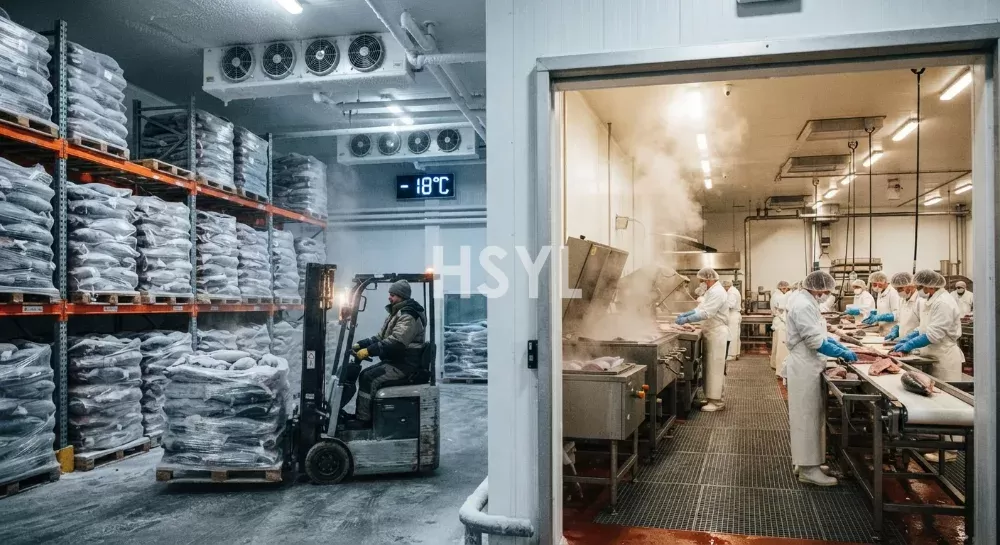
Seasonal Fish Canning: Cold Storage, Multi-Species Rotation and Year-Round Line Utilization
Direct AnswerThe most expensive asset in a fish cannery is not the retort or the...


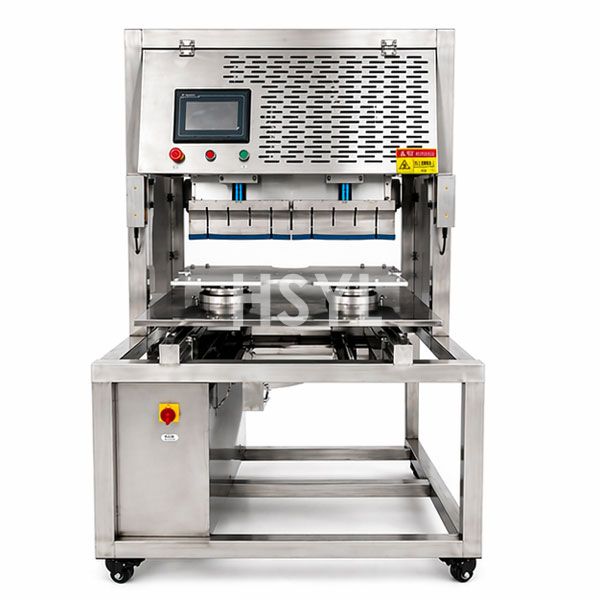
Ultrasonic sandwich cutting machine for industrial sandwich factories and central kitchens. Clean triangle and rectangle cuts, minimal filling retreat, SUS316L design, turnkey line integration.
The ultrasonic sandwiches cutting machine is designed for industrial sandwich factories, airline catering kitchens, and central kitchens that need stable, high-throughput portioning with clean, retail-ready cut faces. By using ultrasonic vibration instead of purely mechanical compression, the machine keeps fillings flush with the bread edge and significantly reduces defects such as filling retreat, smearing, and crust fracture on diagonal cuts.
| Parameter | Specification |
|---|---|
| Blade Vibration Frequency | 20 kHz standard (optional 40 kHz configuration for crusty or artisan breads) |
| Blade Amplitude (Peak-to-Peak) | Approx. 60–100 µm, adjustable via HMI |
| Production Capacity | Approx. 800–2,400 portions/hour (sandwich size and cut type dependent) |
| Servo Positioning Repeatability | ±0.1 mm across programmed cut patterns |
| Maximum Cut Frequency | Approx. 40–100 cuts/min |
| Conveyor Infeed Width | Typical 300–600 mm for standard sandwich formats |
| Blade Contact Material | Ti-6Al-4V titanium alloy, electropolished, food-contact finish |
| Frame & Structural Material | SUS304 structural frame with SUS316L food-contact zones |
| Control System | PLC-based control with touchscreen HMI and recipe memory for multiple sandwich SKUs |
| Power Supply | 380 V, 3 phase, 50 Hz standard (other voltages on request) |
| Ingress Protection Rating | IP65 for washdown of the cutting area |
In conventional sandwich cutting systems, a static stainless blade or guillotine applies compressive force ahead of the cutting edge. Soft fillings such as mayonnaise-bound salads, avocado spreads, egg mixtures, or cheese creams are pushed sideways away from the cut plane before the bread crumb is separated. On diagonal cuts in particular, this lateral movement creates visible gaps between the filling and the crust.
The ultrasonic sandwiches cutting machine uses a titanium blade horn that vibrates at ultrasonic frequency with a small, controlled amplitude. At this frequency, the blade separates bread and filling at the acoustic cut plane with a lower effective friction coefficient than a static blade. Instead of pushing fillings out of the way, the vibrating blade cleanly passes through the filling stack, allowing the filling to remain close to the bread edge within the specification window defined by retailers.
The servo-controlled gantry moves the blade through straight and diagonal trajectories, and positioning is repeatable to within a small tolerance across the full conveyor width. Recipes in the HMI define cut angles, positions, and sequence patterns so that operators can switch between straight-cut subs, rectangular halves, and diagonal triangle sandwiches without mechanical reconfiguration.
In industrial sandwich factories, the ultrasonic cutting machine is typically installed after sandwich assembly and pressing, just before the packaging stage. Multiple assembled sandwiches are conveyed into the cutting zone in lanes, where the ultrasonic blade performs straight or diagonal cuts according to the selected recipe. The clean cut faces are then presented to the packaging equipment for wrapping or tray loading.
Central kitchens that supply retail chains, convenience stores, and airline catering units often run a wide variety of sandwich types on a single line. The ultrasonic cutter supports this variety by storing named recipes for different bread formats, fillings, and cut styles. Operators select the appropriate recipe on the HMI, and the machine adjusts blade paths and cutting sequences accordingly, helping maintain consistency across outlets and brands.
For operations that handle high-care or allergen-sensitive fillings, the ultrasonic cutter’s repeatable cuts and stable positioning support tighter control of portion size and filling distribution. Slice geometry is more predictable, which simplifies downstream tasks such as label weight control and shelf presentation.
The ultrasonic sandwiches cutting machine is commonly integrated into a complete sandwich or ready-to-eat line that includes bread handling, depositing, assembly, cutting, and packaging. In many projects it works alongside upstream and downstream equipment that are defined in the bakery and cereal solutions portfolio at industrial bakery and cereal production line solutions, where line layout and throughput are matched to product demand.
For plants that send cut sandwiches directly into wrapping or tray sealing, the cutter is placed just before the packaging systems described under food packaging systems for bakery and ready-to-eat products. Transfer belts and accumulation areas are designed to keep the orientation of triangle and rectangular sandwiches stable so that the packaging equipment always receives them in the correct position.
When new sandwich plants or central kitchens are planned, engineers often review options through the solutions overview at Hongsheng Yuanlin turnkey solutions. This helps position the ultrasonic cutter in the sandwich assembly line so that operators have sufficient access for loading, inspection, and cleaning, and so that overall line efficiency is maintained.
All food-contact surfaces, including the blade, cutting table, and guides, are manufactured from stainless materials suitable for sandwich production. The cutting area is designed with smooth surfaces and removable or lift-up guards to support daily cleaning and visual inspection. CIP-compatible spray bars can be specified where needed to assist with rinsing of the cutting zone between production runs.
For plants with multiple allergen classes in fillings, the machine’s design allows cleaning procedures and blade changeovers to be integrated into allergen control programs. Recipes and operating logs help document how different product families are separated in time and cleaning steps are applied. During commissioning, Hongsheng Yuanlin engineers work with the customer’s quality and maintenance teams to define practical cleaning and inspection routines.
Service support includes installation guidance, on-site commissioning where required, and training for operators and maintenance personnel. Recommended spare blades, horn assemblies, and key wear parts can be provided, and voltage and control configurations can be adapted for export projects and regional standards.


Direct AnswerThe most expensive asset in a fish cannery is not the retort or the...
A sardine and mackerel canning line processes small pelagic fish — typically 10–...
Direct AnswerA low-acid canned vegetable processing line — corn, peas, and green...
The filling medium — the liquid that fills the void spaces between the fish piec...